
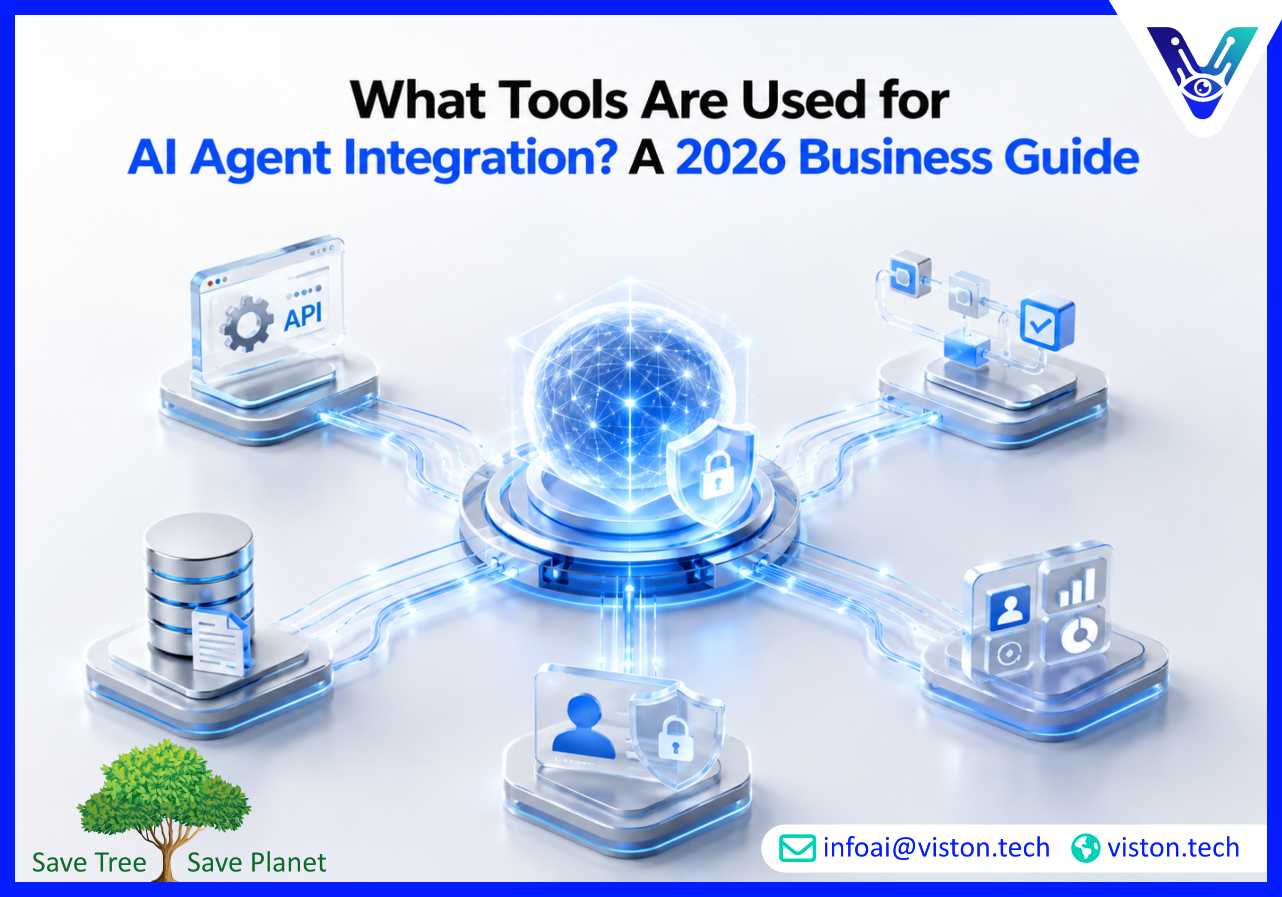
As AI agents become a practical part of business operations, organizations are increasingly asking a critical question: what tools are actually used for AI agent integration? While AI models provide intelligence, integration tools enable agents to connect with business systems, access data, automate workflows, and execute tasks across an organization.
AI agent integration refers to the process of connecting AI agents with business applications, databases, workflows, communication channels, and operational systems. Without integration, an AI agent can only provide isolated responses. With proper integration, agents can retrieve information, update records, trigger workflows, coordinate with other systems, and support real business processes.
In 2026, businesses are moving beyond standalone chatbots and implementing agent ecosystems that interact with CRM platforms, ERP systems, helpdesks, cloud infrastructure, analytics tools, and internal knowledge bases.
The tools used for AI agent integration typically fall into several categories, each serving a different role within the overall architecture.
Application Programming Interfaces (APIs) remain the foundation of most AI agent integrations. APIs allow agents to communicate with external software systems and exchange data securely.
Common API integration tools help agents:
Modern businesses frequently integrate AI agents with platforms such as Salesforce, HubSpot, Microsoft Dynamics, SAP, ServiceNow, and various custom business applications through APIs.
Workflow automation tools help AI agents execute business processes across multiple systems.
Popular categories include:
These tools enable agents to perform actions such as ticket creation, lead routing, document approvals, notifications, and operational task management.
AI agent frameworks provide the structure required to build, manage, and coordinate intelligent agents.
These frameworks typically support:
Organizations building advanced agent systems often rely on frameworks that support scalable deployment, monitoring, and governance.
AI agents require access to reliable business information. Database integration tools connect agents to operational and analytical data sources.
Common integrations include:
These integrations help agents provide accurate responses and make informed decisions based on current business information.
Many organizations now deploy multiple specialized agents rather than relying on a single general-purpose assistant.
Multi-agent orchestration platforms manage:
This approach enables businesses to automate more complex workflows involving multiple departments, systems, and decision points.
Retrieval-Augmented Generation (RAG) has become a standard component of enterprise AI agent deployments.
Vector databases help agents:
These systems significantly reduce hallucinations and improve business reliability.
Security remains a major priority for enterprise AI adoption.
Identity management tools help organizations control:
Proper access management ensures agents only interact with information and systems they are authorized to access.
Selecting integration tools depends on business requirements rather than technology trends.
Organizations should evaluate:
The most effective AI agent integrations typically prioritize business outcomes rather than deploying the largest number of tools.
Organizations across industries are using integrated AI agents to improve operational efficiency and customer experiences.
These use cases demonstrate why integration capabilities are often more important than the AI model itself.
Understanding what tools are used for AI agent integration is only one part of the challenge. Businesses must also determine how those tools fit into their existing processes, systems, and operational goals.
Viston AI specializes in Agent Integration Services that help organizations connect AI agents with business applications, workflows, databases, APIs, and automation platforms. The focus extends beyond building individual agents to creating integrated systems that deliver measurable operational value.
Whether an organization is implementing workflow automation, multi-agent orchestration, CRM integrations, knowledge retrieval systems, or enterprise process automation, successful deployment requires careful planning, secure architecture, integration expertise, and ongoing optimization.
By aligning AI agent capabilities with real business workflows, Viston AI helps organizations move from experimentation to practical implementation while maintaining scalability, governance, and operational reliability.
There is no single tool that fits every use case. APIs are typically the foundation because they enable agents to communicate with business systems and applications.
Many business implementations benefit from workflow automation tools because they allow agents to trigger actions, coordinate tasks, and execute business processes across multiple systems.
Vector databases support retrieval-based AI systems by helping agents access relevant business knowledge, documents, and information in real time.
Not always. They are most valuable when multiple specialized agents need to collaborate on complex workflows involving several systems or departments.
Yes. Viston AI provides Agent Integration Services designed to connect AI agents with enterprise applications, workflows, databases, APIs, and operational systems.
Understanding what tools are used for AI agent integration is essential for businesses planning AI adoption in 2026. Successful implementations typically combine API integrations, workflow automation platforms, AI agent frameworks, knowledge retrieval systems, orchestration technologies, and security controls. The right toolset depends on business objectives, operational complexity, and integration requirements. When implemented strategically, Agent Integration Services help organizations transform AI from an isolated capability into a connected business asset that improves efficiency, decision-making, and operational performance.
