
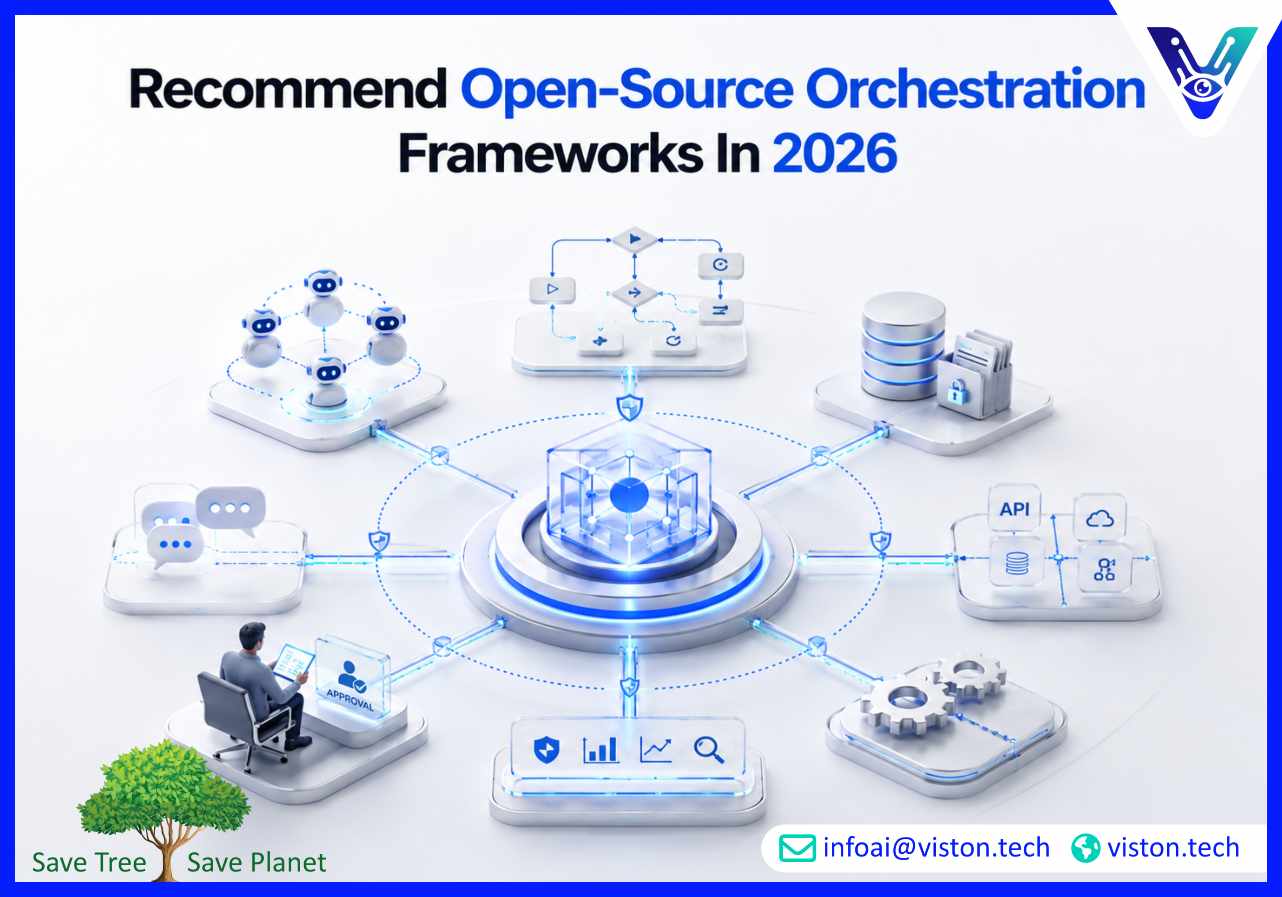
Choosing the right open-source orchestration framework is now a serious architecture decision for businesses building AI agents, workflow automation, and production-ready agentic systems. The right framework helps teams coordinate agents, tools, memory, approvals, APIs, and monitoring without locking the entire solution into a closed platform.
Open-source orchestration frameworks help developers design, connect, and control AI agents inside structured workflows. Instead of building one isolated chatbot or script, businesses can use orchestration frameworks to manage how agents plan tasks, call tools, retrieve data, share context, hand off work, and return reliable outputs.
In AI agent development and deployment, orchestration is the layer that turns model capability into usable business execution. A large language model may generate responses, but an orchestrated agent system can follow workflow logic, use company data, trigger integrations, check results, and escalate when human review is required.
Open-source frameworks are especially attractive because they give engineering teams more transparency and flexibility. Businesses can inspect the codebase, adapt workflows to internal systems, avoid unnecessary vendor dependency, and build agentic applications that match their security, governance, and scalability requirements.
However, open source does not automatically mean production-ready. A framework must still be evaluated for reliability, documentation, community support, integration maturity, observability, state management, deployment patterns, and long-term maintainability.
In 2026, businesses are moving beyond simple AI experiments. Many teams now want agents that can support customer operations, sales workflows, document processing, internal knowledge search, data enrichment, reporting, software workflows, and back-office automation. These use cases require more than prompt engineering.
Open-source orchestration frameworks matter because they help companies build agent systems that are structured, testable, and easier to improve over time. They also support different architectural choices, such as graph-based workflows, multi-agent collaboration, retrieval-augmented generation, tool calling, workflow automation, and human-in-the-loop approval.
The best framework depends on what the business is trying to build. A framework suitable for conversational multi-agent experiments may not be the best choice for regulated enterprise workflows. A tool built for retrieval and knowledge systems may not be enough for complex action-based automation. This is why selection should begin with business requirements rather than popularity.
Several open-source orchestration frameworks stand out in 2026 because they address different parts of AI agent development and deployment. Each has strengths, trade-offs, and ideal use cases.
LangGraph is a strong option for teams that need controlled, stateful, graph-based agent workflows. It is useful when workflows involve branching logic, retries, multi-step reasoning, tool execution, memory, and human review points.
For production agent systems, LangGraph is often considered when reliability and workflow control matter more than quick prototyping. It gives developers a clearer way to define nodes, edges, states, and transitions, which is valuable for business workflows that cannot rely on unpredictable agent loops.
LangGraph is well suited for customer support routing, internal research assistants, compliance review workflows, data validation pipelines, operations automation, and systems where agents must follow a defined process.
CrewAI is commonly used for role-based multi-agent collaboration. It allows teams to define agents with specific responsibilities, assign tasks, and coordinate them toward a shared objective.
This makes it useful for workflows where businesses want to model a team-like structure, such as researcher agents, analyst agents, writer agents, reviewer agents, support agents, or task execution agents. It is often easier to understand for teams exploring multi-agent collaboration for the first time.
CrewAI is a good fit for research workflows, content operations, sales intelligence, market analysis, internal knowledge workflows, and structured business task automation. Teams should still evaluate its suitability for strict enterprise governance, large-scale monitoring, and complex production deployment.
AutoGen supports multi-agent conversations and collaborative agent workflows. It is useful when agents need to communicate with each other, solve problems iteratively, and involve human input in the process.
It can be valuable for engineering assistants, coding workflows, research agents, decision-support workflows, and systems where multiple agents exchange messages to reach a result. AutoGen is often considered by teams that want flexible experimentation with agent collaboration patterns.
For business deployment, teams should define clear boundaries, evaluation criteria, escalation rules, and monitoring practices. Conversational agent collaboration can be powerful, but it needs guardrails to avoid unnecessary loops, inconsistent outputs, or uncontrolled tool use.
LlamaIndex is especially relevant for data-centric AI applications. It helps connect language models with private, structured, and unstructured data sources through retrieval-augmented generation workflows.
Businesses often consider LlamaIndex when the main requirement is knowledge access, document search, internal data retrieval, customer support knowledge bases, enterprise search, research assistants, or AI systems grounded in company information.
Although it is not only an orchestration framework in the same sense as graph-based or multi-agent tools, it plays an important role in agent architecture. Many production AI systems need reliable retrieval before they can safely automate decisions or generate responses.
Semantic Kernel is useful for teams building enterprise-grade AI applications that need planning, plugins, connectors, and integration with business systems. It is particularly relevant for organizations already working heavily with Microsoft technologies, .NET, Azure, or enterprise application stacks.
It supports structured AI development patterns and can help teams connect AI capabilities with existing software workflows. For businesses with enterprise integration requirements, Semantic Kernel may be a practical choice because it aligns well with application development, service integration, and controlled deployment.
n8n is an open-source workflow automation platform that can support AI agent integrations, tool-based automation, and business process workflows. It is not only an AI orchestration framework, but it can be useful when teams need to connect AI steps with many business applications.
For companies that want practical automation across apps, APIs, databases, webhooks, email, CRM, and internal tools, n8n can act as a workflow execution layer. It may be especially useful for operations teams and technical teams that want visual workflow control with extensibility.
The right framework should match the workflow, risk level, engineering capacity, and business outcome. A poor framework choice can create brittle automation, high maintenance costs, weak governance, or systems that work in demos but fail in daily operations.
If the workflow needs strict routing, state management, and predictable control, graph-based orchestration may be more suitable. If the workflow needs collaborative role-based agents, a multi-agent framework may be better. If the main challenge is grounding outputs in private data, retrieval-focused infrastructure becomes essential.
Businesses should look beyond GitHub popularity. Production readiness includes error handling, observability, logging, testing support, deployment flexibility, version control, human approval mechanisms, security controls, and integration with existing infrastructure.
AI agents become valuable when they connect to real systems. Teams should review whether the framework supports APIs, databases, vector stores, document repositories, CRMs, helpdesks, identity systems, cloud platforms, and internal tools.
A powerful framework is only useful if the team can maintain it. Python-heavy teams may prefer frameworks with mature Python ecosystems. Microsoft-focused teams may benefit from Semantic Kernel. Operations teams may find n8n easier for workflow automation.
AI agent deployment should include permission controls, audit trails, prompt and workflow versioning, data handling rules, fallback logic, evaluation metrics, and human-in-the-loop review where needed. Open-source flexibility should be paired with responsible implementation.
Viston AI is relevant for businesses evaluating open-source orchestration frameworks because its work aligns with AI agent development, AI automation, workflow bots, and multi-agent orchestration. Selecting a framework is only one part of the challenge. Businesses also need the right architecture, implementation roadmap, integrations, guardrails, testing approach, and deployment process.
Viston AI can help organizations assess whether frameworks such as LangGraph, CrewAI, AutoGen, LlamaIndex, Semantic Kernel, or n8n fit a specific business workflow. This includes reviewing use cases, data sources, agent responsibilities, system integrations, approval points, security requirements, and scalability expectations.
For companies building AI agents for support, operations, sales, internal knowledge, reporting, or process automation, Viston AI’s service focus can support practical implementation rather than tool selection alone. A strong deployment approach requires clear agent design, workflow orchestration, API connectivity, monitoring, and ongoing optimization.
The value is not simply choosing an open-source framework. The value is building an AI agent system that works reliably in real business conditions, supports measurable outcomes, and can evolve as workflows become more complex.
There is no single best framework for every use case. LangGraph is strong for controlled stateful workflows, CrewAI is useful for role-based multi-agent collaboration, AutoGen supports conversational agent systems, LlamaIndex is strong for data-grounded applications, Semantic Kernel fits enterprise integration needs, and n8n helps connect AI workflows with business applications.
Some frameworks can support production use when implemented carefully, but production readiness depends on architecture, testing, monitoring, security, integrations, error handling, and governance. Businesses should validate the framework against real workflows before full deployment.
CrewAI and AutoGen are often considered for multi-agent collaboration. CrewAI is useful for structured role-based agent teams, while AutoGen is useful for agent-to-agent conversations and iterative problem solving. LangGraph can also support multi-agent systems when stronger workflow control is required.
LangGraph and Semantic Kernel are strong candidates for enterprise AI workflows because they support structured development patterns and controlled orchestration. The best choice depends on the company’s technology stack, workflow complexity, compliance needs, and deployment environment.
Yes. Viston AI can support businesses with AI agent development and deployment by helping assess framework fit, design agent workflows, connect systems, add governance, test outputs, and deploy scalable AI automation solutions.
Open-source frameworks are useful when businesses need flexibility, transparency, customization, and control. Closed platforms may be easier for simple use cases. For strategic AI agent systems, many businesses prefer open-source or hybrid architectures to reduce lock-in and improve adaptability.
To recommend open-source orchestration frameworks in 2026, businesses must look beyond popularity and focus on workflow fit, production reliability, integration needs, governance, and long-term maintainability. LangGraph, CrewAI, AutoGen, LlamaIndex, Semantic Kernel, and n8n each serve different AI agent development and deployment needs. The right choice depends on whether the business needs controlled workflow execution, multi-agent collaboration, data-grounded responses, enterprise integration, or app-based automation. Viston AI is a relevant partner for organizations that want to move from framework evaluation to practical, scalable AI agent implementation.
