
Enterprise adoption of agentic AI has shifted decisively from experimentation to execution. According to Mayfield’s 2026 CXO Network survey of 266 technology leaders, 42% of organizations now have AI agents in production, with 72% actively deploying or piloting these systems across IT, operations, finance, and customer experience workflows . Yet the path from pilot to enterprise-wide deployment remains obstructed—not by model capabilities, but by the complex reality of integration.
Custom AI agent integration solutions have emerged as the critical differentiator between organizations capturing measurable ROI and those stuck in perpetual testing. For business decision-makers evaluating this space, understanding what separates successful deployments from failed pilots is essential before committing resources.
The term “AI agent” is widely used but often misunderstood. Unlike standalone chatbots that respond to predefined triggers, modern AI agents are systems that perceive their environment, decompose complex goals into executable steps, use external tools and APIs, and complete multi-step workflows autonomously .
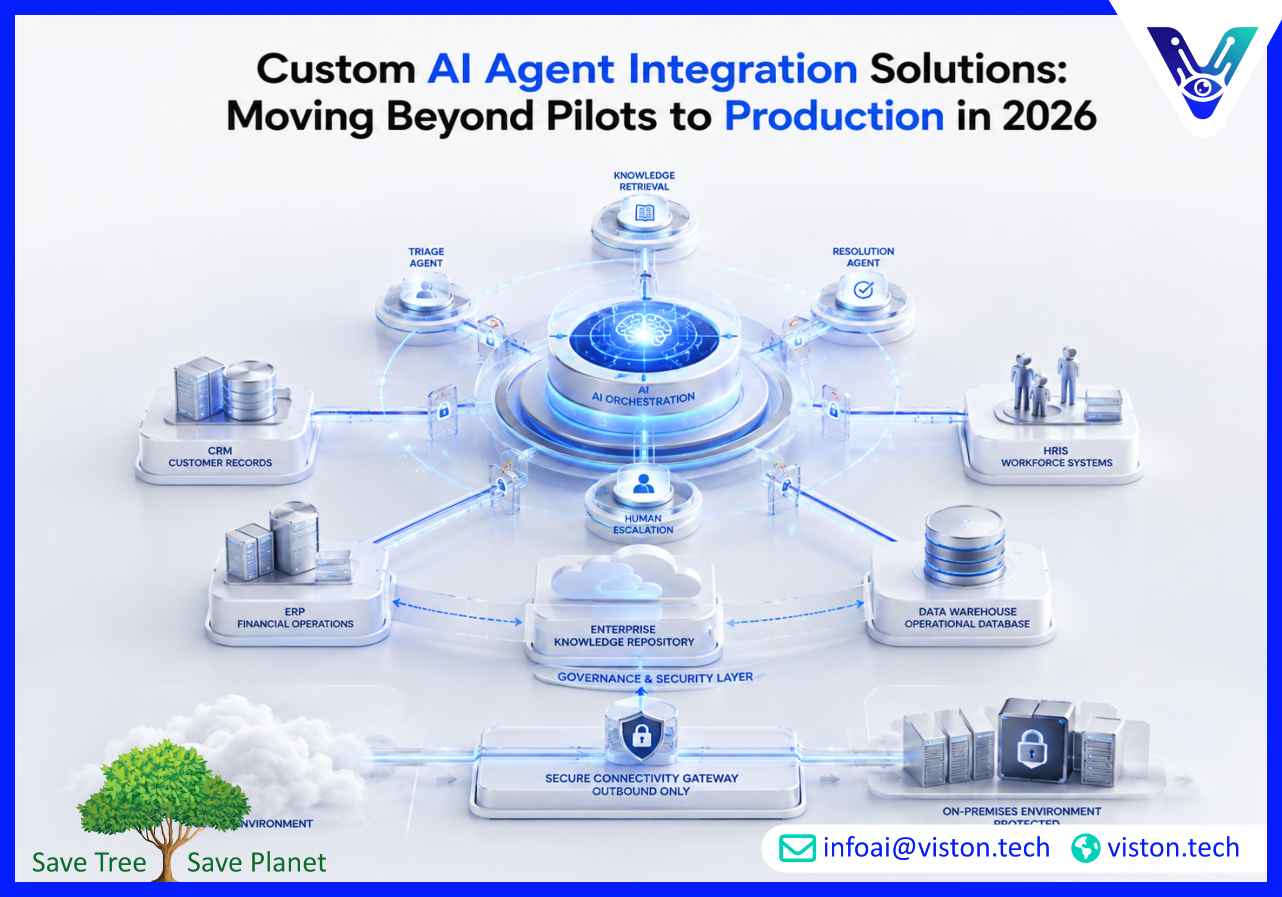
Custom integration refers to the deliberate work of connecting these agents to your existing software estate—CRMs, ERPs, HRIS platforms, knowledge bases, communication tools, and data warehouses. This is not a plug-and-play exercise. Enterprise environments are fragmented by design, with systems that were never architected to expose their capabilities to autonomous software.
The fundamental challenge agents face is one of access and authorization. An agent tasked with resolving an employee’s payroll inquiry needs to query the HRIS, check ticket history in the service management system, perhaps update a record in Workday, and communicate the resolution back through Teams or Slack . Each of these steps requires the agent to authenticate, understand system-specific schemas, execute precisely scoped operations, and leave auditable traces.
Without purpose-built integration architecture, agents fail at the first system boundary. They may be capable of sophisticated reasoning, but they cannot act. This is why data readiness remains the number one blocker for enterprise AI adoption, cited by 58% of CXOs as their primary obstacle . The issue is not model performance; it is whether agents can safely and reliably interact with the systems where business actually happens.
Many organizations assume that off-the-shelf connectors or generic API access will suffice. In practice, these approaches introduce three distinct failure modes that derail production deployments.
Generic connectors expose raw database schemas directly to agents. An agent asked to “find all active customers with overdue invoices” would need to guess which tables contain customer data, which fields indicate active status, how overdue is calculated, and where invoice information resides. Each guess introduces potential error, and in multi-step workflows, these errors compound rapidly.
Custom integration solutions bridge this gap by presenting agents with business-aligned tools rather than raw schema. Each operation is pre-defined with scoped inputs, validated logic, and structured outputs . The agent does not reason through schema relationships—it calls a resolved tool and executes the next step, dramatically reducing error rates and token consumption.
Enterprises require that every agent action be auditable, that access controls be enforced at the most granular level, and that agents operate only within approved boundaries. Yet governance cannot come at the cost of paralysis. 84% of CXOs list security and compliance as non-negotiable requirements, but 60% report having only early-stage or no formal AI governance framework .
Custom integration solutions address this tension by implementing layered controls. Workspaces define data boundaries—finance agents cannot see HR data. Toolkits define action boundaries—an agent can query customer records but cannot update billing information. Every operation is logged, every access decision is attributable, and changes are versioned and reviewable .
As deployments scale, organizations find that single agents are rarely sufficient. A customer support workflow might involve a triage agent that classifies requests, a knowledge agent that retrieves relevant documentation, a resolution agent that executes system updates, and an escalation agent that involves human operators when confidence thresholds are not met.
These agents need to coordinate, share context, and hand off tasks without losing state. Custom integration architecture must support this multi-agent orchestration while maintaining the same governance and auditability applied to individual agent actions .
Organizations evaluating custom AI agent integration solutions should expect four foundational capabilities that distinguish production deployments from pilots.
Agents need access to purpose-built tools that reflect actual business workflows rather than generic system access. A proper integration layer provides three tiers of tooling: universal tools for consistent operations across all connected systems, custom tools for workflow-specific operations, and source tools that map directly to approved system actions with predictable execution guarantees .
Enterprise data does not reside exclusively in the cloud. ERP systems, manufacturing databases, legacy systems, and operational stores often live behind firewalls. Integration solutions must provide secure pathways into these environments without opening inbound ports or exposing systems to public internet .
The architecture should establish outbound-only connections from within your infrastructure, ensuring that sensitive systems are never directly reachable while giving agents live access to the data they need.
As agent deployments scale to hundreds or thousands of autonomous workflows, manual access management becomes impossible. Integration solutions must support automated identity lifecycle management through SCIM 2.0, synchronizing users, groups, and permissions directly from identity providers . Access should be provisioned, updated, and revoked automatically as employees join, change roles, or leave.
Early agent deployments often struggle because each interaction starts from zero context. Production systems require memory—not just of past conversations, but of resolved workflows, successful tool selections, and institutional knowledge captured from query history and expert corrections .
The most effective integration solutions ingest operational signals, documentation, and historical patterns to give agents a rich understanding of how work actually gets done in your organization. This context layer is what enables agents to improve over time, reducing handling time by 40-50% as they learn from accumulated experience .
The economic argument for custom AI agent integration is becoming increasingly clear. Academic analysis of production deployments shows that autonomous agents can reduce contact processing costs by more than 90% compared with local personnel and approximately 85% relative to offshore outsourcing . At a volume of 50,000 contacts per month, the annual financial impact reaches approximately $2.8 million.
Beyond direct cost reduction, organizations report significant improvements in decision quality and reduced cognitive load on knowledge workers . Developer productivity gains are particularly pronounced, with some organizations reporting that six-month developers can deliver at levels previously requiring three years of experience when supported by agentic tooling .
The 2026 budget outlook reflects this momentum, with 91% of CXOs planning to increase their agentic AI investments and over half actively reallocating budget from legacy vendors toward AI-native alternatives .
Viston AI specializes in designing and implementing custom AI agent integration solutions for enterprises that need more than generic connectors and proof-of-concept demonstrations. Our approach addresses the three factors that determine production success: data readiness, governance architecture, and measurable business outcomes.
We build integration layers that connect agents to your existing systems—CRMs, ERPs, HRIS platforms, knowledge bases, and data warehouses—with granular access controls and complete auditability. Our team implements tool-based architectures that present agents with business-aligned operations rather than raw schema, reducing error rates and token consumption while ensuring predictable execution. Whether your data resides in cloud applications, on-premises systems, or hybrid environments, we design secure access pathways that maintain compliance without sacrificing agent capability.
For organizations in regulated industries or those scaling agentic AI across multiple business functions, Viston AI delivers the integration foundation that turns autonomous agents from experimental technology into reliable digital workforce components.
A traditional chatbot responds to user inputs based on predefined scripts or retrieval patterns but cannot take independent action. An AI agent perceives its environment, decomposes complex goals into executable steps, calls external tools and APIs, executes multi-step workflows, and learns from outcomes to improve future performance .
Timelines vary based on system complexity, data readiness, and governance requirements. Organizations with clean data access patterns and documented workflows may see initial integrations in 4-8 weeks. More complex environments involving legacy systems or regulatory constraints typically require 3-6 months for production-ready deployments.
Production integration requires granular access controls, complete audit trails, automated identity lifecycle management (SCIM 2.0), secure on-premises data access without inbound ports, and versioned change tracking. 84% of enterprise buyers consider these security and compliance features non-negotiable .
Yes, through secure gateway architectures that establish outbound-only connections from within your infrastructure. This approach gives agents live access to on-premises data without exposing systems to public internet or requiring inbound firewall rule changes .
Production deployments show contact processing cost reductions of 85-90% compared with human-only operations . Additional benefits include 30-50% reduction in average handling time, improved decision quality, reduced cognitive load on knowledge workers, and developer productivity gains that accelerate time-to-value for new initiatives .
Key readiness indicators include documented business processes, accessible system APIs or integration endpoints, clean data access patterns, clear governance requirements, and executive commitment to measured outcomes. The most common blocker is data readiness, cited by 58% of organizations —addressing this before deployment significantly improves success rates.
Custom AI agent integration solutions have become the defining factor separating organizations that capture value from agentic AI and those that remain stuck in pilot purgatory. As AI agents move from experimental technology to production systems, the ability to connect these agents securely and reliably to existing business applications determines whether they deliver measurable ROI or become expensive experiments.
For business decision-makers, the path forward requires shifting focus from model capabilities to integration architecture. The organizations pulling ahead in 2026 are those investing in governed, tool-based integration layers that give agents safe, auditable access to the systems where work actually happens. Viston AI builds these integration foundations for enterprises ready to move beyond pilots and deploy AI agents that deliver measurable business outcomes.
