
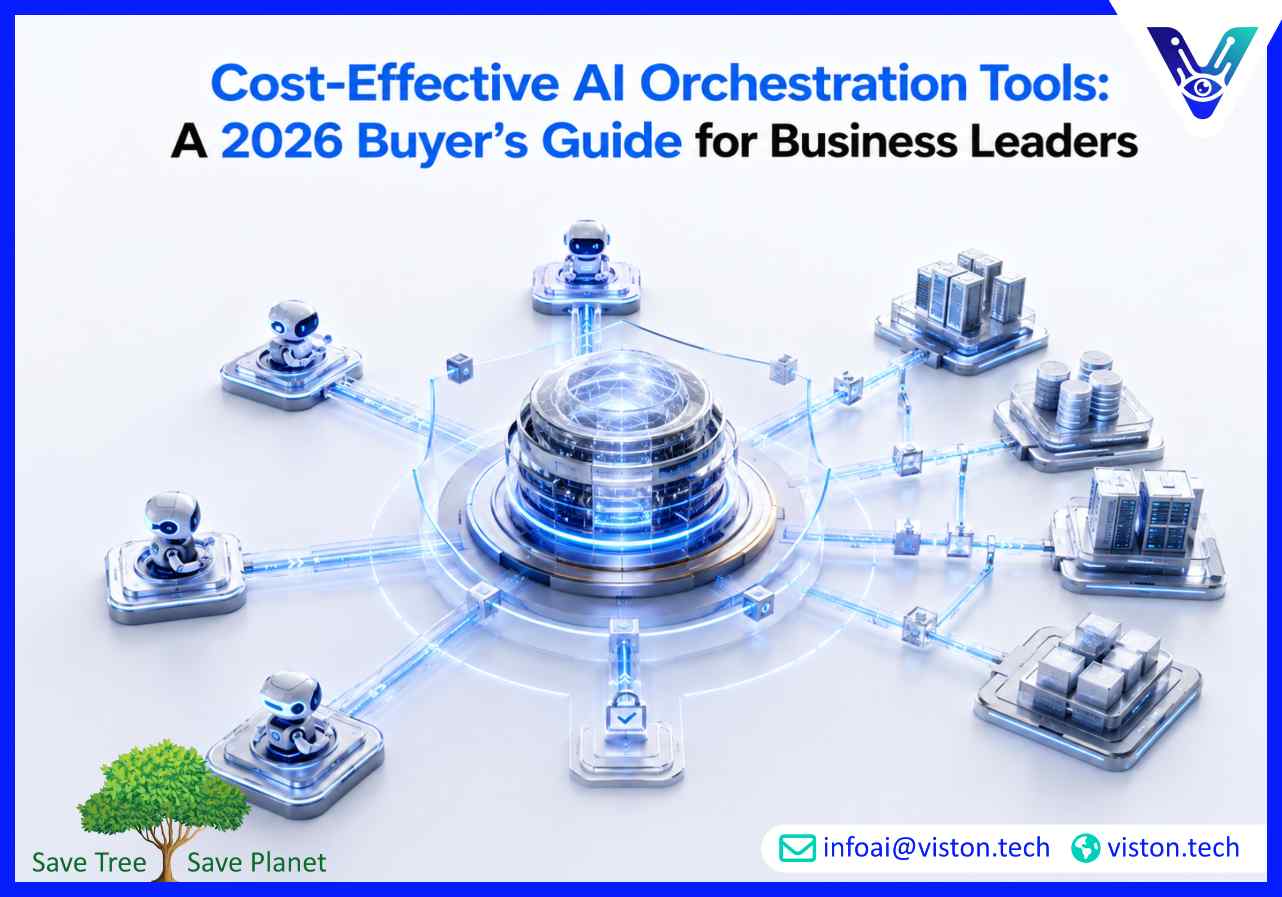
For the past two years, the conversation around artificial intelligence has centered on potential. In 2026, the conversation has shifted decisively to production. The question is no longer whether AI agents can work, but whether they can be governed, measured, and scaled across real-world operations . For business owners, technology leaders, and operations managers, this shift introduces a new challenge: managing the complexity of multi-agent systems without breaking the budget. This is where cost-effective AI orchestration tools become a strategic necessity, moving from a “nice-to-have” to the central nervous system of autonomous enterprise operations.
The current market landscape is flooded with powerful large language models (LLMs) from providers like Anthropic, OpenAI, Google, and DeepSeek. However, a common misconception is that the model is the product. In reality, the model is just the engine. The vehicle—the part that steers, brakes, and keeps the car on the road—is the orchestration layer. Raw API calls to GPT-5 or Claude 4 are not production-ready. Without orchestration, agents lose context, fail to recover from errors, and cannot coordinate complex tasks.
Orchestration tools manage the lifecycle of an AI agent. They handle session persistence (so an agent remembers what it did five minutes ago), tool use (connecting to APIs and databases), error recovery, and multi-agent communication. As enterprises move from pilot programs to business-critical operations, they need a system that can coordinate how work runs within departments and across the organization . Without this layer, you do not have an autonomous workforce; you have a collection of unreliable scripts.
When we discuss “cost-effective” tools, we must look beyond the price tag on a GitHub repo. The true cost of orchestration includes development hours, debugging time, infrastructure spend (compute for sandboxing and memory), and the often-hidden fees for observability.
In 2026, the industry is moving away from raw token pricing toward usage-based models that reflect actual value. For example, Anthropic’s Claude Managed Agents operates on a model of $0.08 per session-hour for active runtime, plus standard token costs . This model is effective for long-running, autonomous tasks because idle time—when the agent waits for a user or external tool—is not billed. Conversely, platforms like Botpress have shifted to conversation-based pricing, bundling AI inference costs into a flat per-conversation fee to eliminate the surprise of variable token usage .
For teams with strong engineering resources, open-source frameworks offer the lowest upfront financial cost. CrewAI remains a leader in adoption, boasting over 45,900 GitHub stars and an average latency of just 1.8 seconds, making it the fastest route to a multi-agent prototype . Its role-based model—assigning “personas” like researcher or writer to agents—is intuitive for business logic. LangGraph, on the other hand, offers finer control with a graph-based state model, achieving a task success rate of 87% in benchmarks, the highest among major frameworks . However, open source shifts the cost burden to your internal team, requiring significant investment in infrastructure, monitoring, and governance from scratch.
For enterprises prioritizing speed to market and compliance, commercial platforms like Microsoft’s Azure AI Agent Service or Google’s Vertex AI Agent Builder provide managed infrastructure. These reduce operational drag but often lock you into specific cloud ecosystems . The most cost-effective strategy depends on your existing stack: if you are already an AWS shop, leveraging managed services might be cheaper than hiring a team to secure an open-source framework.
When evaluating AI orchestration tools, business decision-makers must look beyond the demo and scrutinize the production architecture. Based on current market developments, four features are non-negotiable for cost control and reliability.
Sandboxed Code Execution: Without secure sandboxes, agents cannot safely run code or use tools. Look for disposable Linux containers or similar isolation layers to prevent security breaches .
Observability and Tracing: You cannot fix what you cannot see. Tools like Langfuse or AgentOps provide the necessary telemetry to see exactly which tool call or prompt caused a failure . This drastically reduces debugging time.
Multi-Agent Collaboration: Single agents have limited value. Modern orchestration requires support for A2A (Agent-to-Agent) protocols. Whether using Anthropic’s multi-agent coordination (currently in research preview) or CrewAI’s native messaging, the tool must allow agents to delegate subtasks .
MCP (Model Context Protocol) Integration: The industry is standardizing tool connections via MCP. A cost-effective tool in 2026 must support MCP servers to avoid expensive custom integration work for every API connection .
One of the biggest financial mistakes businesses make is over-engineering for perfection. While LangGraph offers an 87% success rate, CrewAI offers 82% with significantly faster setup and lower latency . For many internal knowledge management or summarization tasks, 82% accuracy is perfectly acceptable. The law of diminishing returns applies harshly to AI orchestration.
Furthermore, enterprises should watch for “vibe coding” or low-code solutions that allow non-engineers to build workflows. Platforms like Levelpath’s Agent Orchestration Studio allow procurement teams to build agents without IT resources, reducing labor costs . Similarly, Automation Anywhere’s AAI Code allows teams to describe workflows in natural language, generating enterprise-grade applications in as little as one week . The cost-effectiveness here comes from reduced reliance on scarce, expensive software engineering talent.
The ultimate goal of orchestration is Agentic Process Automation (APA). This moves beyond robotic process automation (RPA) to systems where AI handles decision-making, exception handling, and coordination across ERP, WMS, and CRM systems. Infor’s 2026 strategy highlights that agents must operate across advisory, supervisory, and autonomous modes, with confidence thresholds and controller agents ensuring compliance . Without a robust orchestration tool, this level of control is impossible. The orchestration tool is the governance layer. It dictates what data an agent can see, what actions it can take, and logs every step for auditability.
Navigating the landscape of open-source frameworks, cloud-managed services, and enterprise platforms is daunting. Many organizations possess the raw data and the use cases but lack the internal architecture to deploy agents safely and cost-effectively. This is where specialized expertise becomes critical.
Viston AI specializes in AI Agent Development & Deployment, focusing on turning experimental prototypes into governed, scalable production systems. Unlike generic consultancies, Viston AI focuses on the hard part of AI: the orchestration. They help businesses select the right orchestration tools—whether that is optimizing CrewAI for low-latency customer service or implementing LangGraph for complex financial reasoning tasks. By focusing on sandboxing, session persistence, and MCP integration, Viston AI ensures that your move to agentic systems does not introduce security vulnerabilities or runaway cloud costs. For enterprises in regulated industries or those looking to scale AI across departments, Viston AI provides the delivery framework that turns raw orchestration code into a reliable business asset.
Q: What is the cheapest way to start with AI orchestration?
A: The cheapest financial entry point is using open-source frameworks like CrewAI or AutoGen. However, the “cheapest” total cost of ownership often comes from managed platforms like Botpress or Claude Managed Agents, which reduce engineering hours spent on maintenance.
Q: Can I run AI agents on my own servers to save money?
A: Yes, using platforms like Vast.ai to rent GPU compute or deploying DeepSeek R1 locally can cut API costs drastically . However, you must account for the cost of the orchestration layer (memory, tool use) and engineering time to maintain the infrastructure.
Q: How do I calculate the ROI of an orchestration tool?
A> Calculate the cost of human error and manual handoffs. If an orchestration tool reduces a 10-minute manual data entry task to a 30-second agent workflow, multiply that time saved by the frequency of the task and your employee’s hourly rate.
Q: Do I need a different orchestration tool for every department?
A> Ideally, no. You want a unified orchestration layer that serves the whole enterprise. Solutions like Rasa or Automation Anywhere are designed to coordinate agents across HR, finance, and IT from a single governance framework .
Q: Is “serverless” orchestration really cheaper?
A: It depends on volume. Serverless (like Claude Managed Agents’ session-hour pricing) is great for spiky, unpredictable workloads. For constant, high-volume processing, reserved instances or dedicated GPU servers via orchestration are more cost-effective.
Q: What is the biggest hidden cost in AI orchestration?
A: Data engineering. 80% of agentic AI implementation time is consumed by data engineering and governance, not framework configuration . Dirty data leads to bad agent decisions, which leads to endless debugging loops.
The era of experimental AI is ending. In 2026, competitive advantage belongs to businesses that can orchestrate AI agents across their enterprise reliably and affordably. Cost-effective AI orchestration tools are not about finding the cheapest API call; they are about maximizing the success rate of tasks, minimizing downtime, and enforcing governance without friction. By leveraging a mix of open-source agility and managed service reliability, companies can deploy autonomous agents that drive real operational value. Partnering with a specialist like Viston AI for AI Agent Development & Deployment ensures that your orchestration strategy is built on proven architecture, allowing you to scale your digital workforce with confidence and control.
