
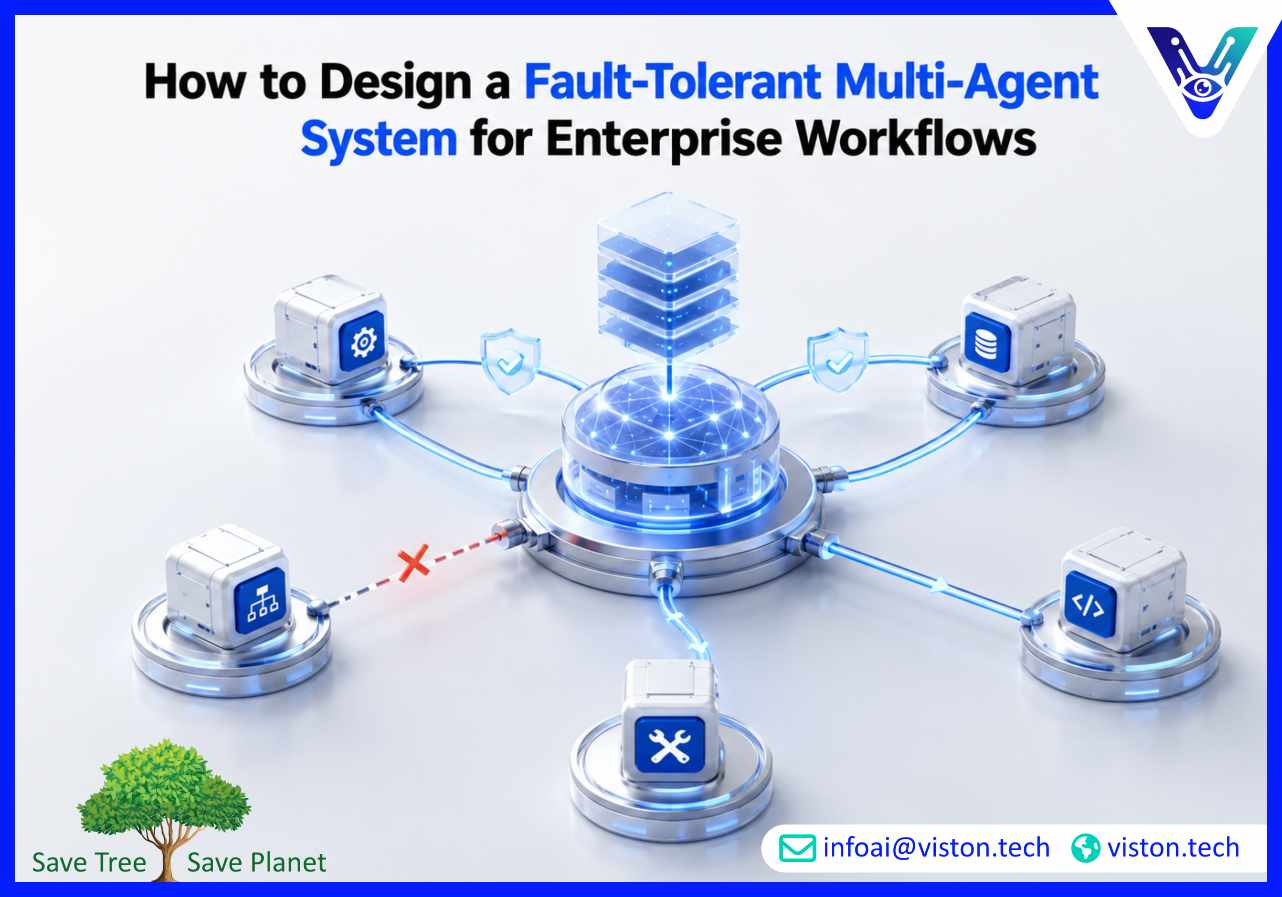
In 2026, the conversation around artificial intelligence has shifted decisively. The question is no longer “which model has the highest benchmark score,” but rather “how do we deploy this system to run critical operations without constant supervision?” For business decision-makers, the appeal of multi-agent systems is clear: distributing complex tasks across specialized, autonomous agents promises unprecedented efficiency. However, this distributed power introduces a proportional risk. Without the right architecture, a single failing agent—whether due to a network timeout, an API rate limit, or a logical error—can halt an entire workflow. Designing a fault-tolerant multi-agent system has therefore moved from a technical “nice-to-have” to a non-negotiable business requirement for enterprise reliability
Through 2026, we have observed a clear maturation in enterprise AI. Early adopters learned the hard way that autonomous agents are inherently probabilistic. Unlike deterministic software, agents can experience “agent bullwhip,” where decision instability amplifies errors across a supply chain or workflow . Consequently, reliability is no longer just about preventing crashes; it is about graceful degradation. A fault-tolerant system must handle DoS attacks, time-varying actuator faults (in physical systems), or simply a malformed tool call without losing context . The goal is “durable execution”—ensuring that if an agent fails mid-task, the system logs the state and resumes from that exact point, rather than starting from zero.
When designing for resilience, standard crash failures are the easiest to solve (restart the pod). However, in complex multi-agent ecosystems, Byzantine faults are the true threat. Here, an agent does not simply stop working; it sends contradictory, malicious, or misleading information to its peers . In a financial trading or drone coordination scenario, a compromised agent could bring down the whole network by broadcasting false data.
To achieve high-level fault tolerance, modern architectures are borrowing from distributed systems theory. Techniques such as Dual Byzantine Fault Tolerance (D2BFT) utilize a two-phase consensus protocol where a subset of validators verifies the actions of others before a state is committed . For LLM-based agents, confidence probes can weight information flow, allowing the system to ignore a “confused” agent that is hallucinating or outputting low-probability results .
Individual agent intelligence is not enough; you need a control plane to manage the chaos. This is where Multi-Agent Orchestration becomes the backbone of fault tolerance. An orchestrator acts as the conductor, but in a fault-tolerant design, it must also act as a circuit breaker.
Modern orchestration layers move beyond simple “if-this-then-that” logic. They implement hierarchical trust chains and event-triggered rescheduling. For instance, if a primary agent fails to respond, the orchestrator should automatically invoke a secondary “fallback” agent or reroute the task to a different specialized model . Furthermore, durable orchestration requires “replay logs.” If an agent crashes, the orchestrator replays the history of tool calls and outputs to rebuild the agent’s context, preventing memory loss .
You cannot fix what you cannot see. A fault-tolerant system relies on deep observability—logging not just API calls but the semantic “reasoning” of the agent. In practice, this means moving messages that repeatedly fail to a “dead-letter queue” (DLQ) for human review, rather than losing them. Additionally, every action must be idempotent . If an agent reboots and retries a payment or a database write, the system must ensure that action is only applied once. This combination of technical infrastructure (retries, circuit breakers) and design philosophy (idempotency) separates a demo from a production system.
Building a resilient agent ecosystem requires more than just connecting APIs; it requires an orchestration layer designed for the uncertainty of the real world. Viston AI provides enterprise-grade Multi-Agent Orchestration that prioritizes business continuity. Unlike generic workflow tools, Viston AI’s platform is built with fault tolerance as a core pillar. We integrate hierarchical trust-chain mechanisms to validate agent outputs and ensure continuity amid agent dropouts or recoveries . By leveraging durable execution principles—such as granular replay logging and state persistence—Viston AI ensures that your mission-critical processes survive network failures and API outages without data loss or manual intervention. For businesses in regulated industries or high-volume operations, Viston AI offers the specialized infrastructure required to move autonomous agents from experimental pilots to reliable, revenue-generating assets.
A crash fault is when an agent simply stops responding or shuts down, which is typically resolved by restarting the instance. A Byzantine fault is more insidious; the agent continues to operate but sends inconsistent, false, or malicious information to other agents, corrupting the collective decision-making process. Consensus mechanisms like PBFT are required to handle Byzantine faults .
Orchestration provides a central control plane that manages state, retries, and routing. It enables features like dead-letter queues (DLQs) for failed messages, circuit breakers to prevent cascading failures, and replay logs that allow agents to recover their exact memory state after a crash, rather than starting the task over .
While LLMs are probabilistic, recent 2026 research shows they can achieve high reliability through “confidence probing” and weighted consensus. By evaluating the confidence scores of outputs, orchestrators can ignore low-confidence or “confused” agent responses, effectively mimicking Byzantine fault tolerance in dynamic environments .
The agent bullwhip refers to the amplification of decision instability in autonomous multi-echelon systems. Stochastic agent decisions create variability that did not exist in the original demand signal. This means that even if the input is stable, faulty agent reasoning can create artificial “boom and bust” cycles in workflows or supply chains .
If your multi-agent system handles financial transactions, customer data, or supply chain logistics, a generic script will fail. Dedicated orchestration provides the necessary durability, audit trails, and fault recovery mechanisms required for compliance and operational continuity, specifically designed to handle the unique failure modes of autonomous agents.
As we move deeper into 2026, the competitive advantage belongs to businesses that can trust their AI to run unattended. Designing a fault-tolerant multi-agent system is a complex challenge that involves integrating Byzantine consensus, event-triggered rescheduling, and durable execution patterns. Generic workflow tools lack the specialized logic required to handle the probabilistic failures of LLMs. By leveraging expert Multi-Agent Orchestration, enterprises can build systems that not only work but self-heal. Viston AI stands ready to provide the technical infrastructure necessary to make your autonomous workflows resilient, auditable, and truly enterprise-ready.
