
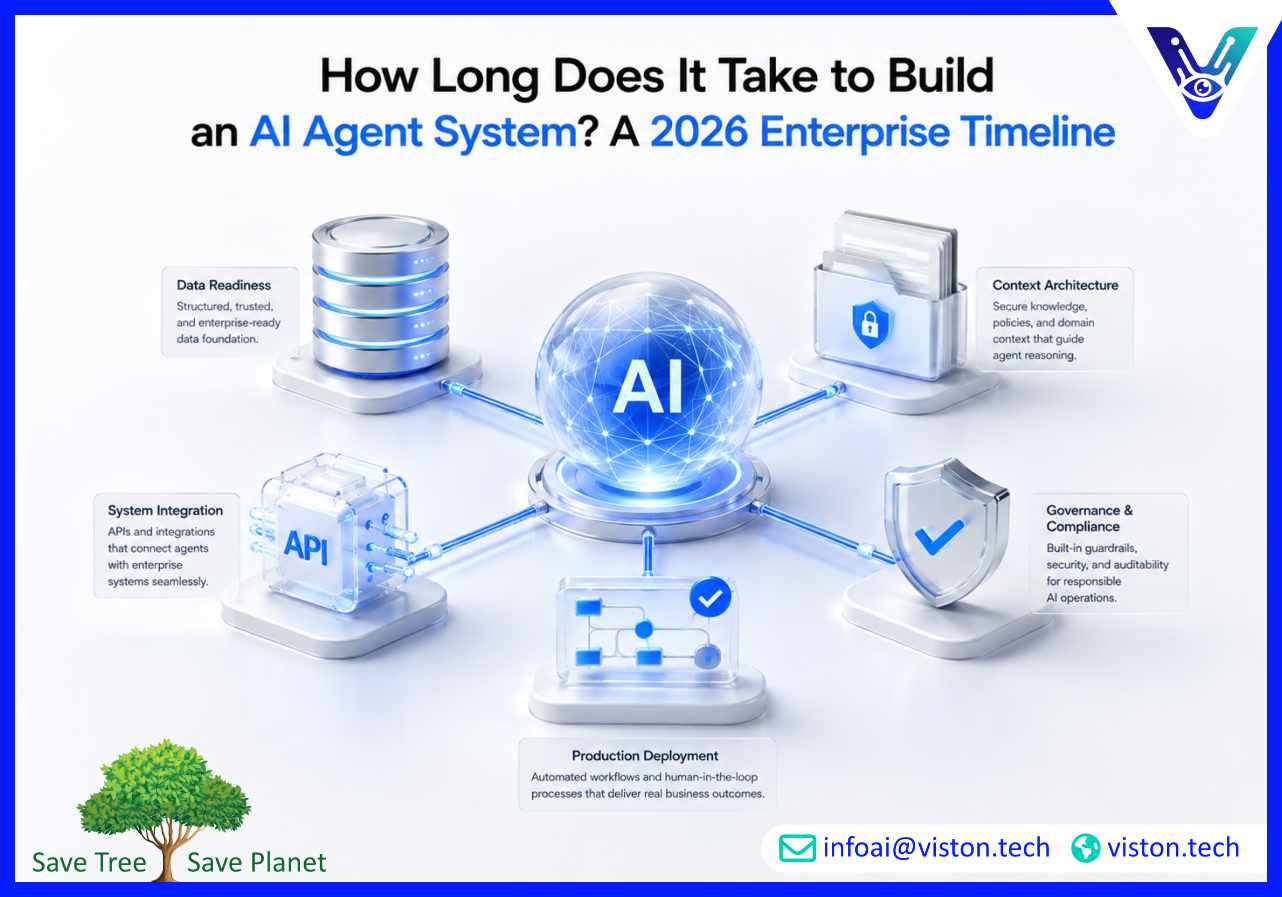
For business decision-makers, the question “how long does it take to build a system?” has taken on new urgency in 2026. With AI agents transitioning from technical experiments to enterprise-critical infrastructure, understanding realistic timelines separates successful deployments from stalled initiatives . The short answer: a production-ready AI agent system typically requires three to five months for mid-complexity deployments, with full multi-agent systems taking six to twelve months . But the more useful answer requires understanding what “building a system” actually means for your organization.
Unlike traditional software development, AI agent system deployment follows a fundamentally different curve. The gap between a working demo and production-ready system is where most timelines break. In 2026, three factors have compressed certain phases while extending others. Foundation model capabilities have matured significantly, with modern models demonstrating reliable reasoning, planning, and tool execution . Tooling ecosystems have standardized, with protocols like MCP (Model Context Protocol) and A2A (Agent-to-Agent) reducing integration friction . However, the “last mile” problem—data readiness, governance, and change management—now consumes 60-70% of total deployment time.
What hasn’t changed is the need for disciplined execution. Organizations that skip context architecture or attempt to boil the ocean with multiple simultaneous agents consistently face 3x longer timelines and higher failure rates.
Building an enterprise AI agent system follows a specific sequence that most technical tutorials get wrong. The following stages represent the actual workflow that produces systems worth deploying .
Before any technical decisions, successful deployments start with a written specification that answers: what specific business process will this agent handle, what are the representative queries, what are the failure modes, and who owns the data. This stage typically takes two to five working days, though collecting agreement across stakeholders often consumes the majority of that time . Organizations that skip this stage routinely discover critical requirements during production—the most expensive time to find them.
This is the single most underestimated phase in AI agent deployment. Context architecture involves mapping five distinct knowledge types your agent will need: data context (structured information from databases), knowledge context (documentation and policies), semantic context (business definitions and relationships), user context (preferences and history), and operational context (workflow rules and constraints) .
For most enterprises, this requires one to three weeks, depending on how fragmented your context sources are. Skipping this stage is the primary reason agents that pass demos fail in production. The agent may answer questions correctly in a sandbox but cannot operate reliably on real business data with actual downstream consequences.
Data readiness represents the most underestimated technical blocker. Agents require clean, classified, and accessible data to function. Your CRM duplicates, missing fields, and stale records—problems that humans navigate intuitively—will cause agents to hallucinate, target wrong accounts, or embarrass your organization .
One enterprise discovered that one-third of its Salesforce data consisted of duplicates, a problem only surfaced when an AI agent attempted to act on it . Budget time for data auditing and cleanup before full deployment. The good news: existing data signals like SQL history, BI dashboards, and data lineage can bootstrap a first-draft context model in days rather than weeks .
Framework selection comes after context mapping, not before. Once you understand your context requirements, you can select the appropriate agent framework and wire components in the correct sequence. Integration engineering is one of the two primary cost and time drivers, typically consuming two to six weeks . This phase includes building the necessary APIs, establishing authentication and authorization, and creating the orchestration logic that connects your agent to existing systems.
A critical decision point here is architecture choice. For deterministic business logic, a hybrid approach combining rule engines for defined processes and LLMs for unstructured decisions delivers higher reliability than pure LLM systems . Insurance companies using this hybrid model achieve 100% compliance while raising automation rates from 40% to 85%.
Before deployment, you need an evaluation layer that tests your agent against known-answer queries. This catches context gaps before they reach production. The evaluation layer should test for accuracy, latency, safety, and business rule compliance . Organizations that build evaluation post-deployment invariably discover issues through customer-facing failures rather than controlled testing.
Launch is not the finish line. Production deployment requires structured feedback loops that route corrections back to the context layer. This is where agents improve continuously through real-world use. The 30 days following deployment require intensive daily attention—typically one to two hours per day of reviewing outputs, correcting mistakes, adjusting tone, and refining escalation rules .
Every successful AI agent deployment requires at least 30 days of daily training after going live. One AI SDR needed 47 separate iterations just to handle pricing discussions correctly . This is not a bug—it is the normal amount of work required to get an agent dialed in on nuanced business topics.
During this period, you are essentially training a new team member. The agent will make mistakes: wrong dates, made-up case studies, weird phrasing, inappropriate pricing aggressiveness. Each correction improves performance. By day 30, a properly trained agent becomes genuinely useful. Before that, it requires active management.
Organizations that treat agents as “set and forget” tools consistently fail. One production agent quietly stopped ingesting new training data for four months with no error message, no alert, no crash—it just kept running on an increasingly stale knowledge base . Outputs still looked plausible, slightly off in retrospect, but not wrong enough to trigger alarm. The agent had no way to know something was broken, and the team was not looking.
For organizations needing multiple agents working in coordination, timelines extend significantly. Full multi-agent systems typically require six to twelve months for mid-complexity deployments . The limiting factor is rarely technology—it is organizational bandwidth for training and management.
Most teams can absorb approximately 1.5 new agents per month before quality starts slipping . The recommended scaling path: go from zero to one agent (starting with something horizontal and simple), then one to three agents (adding vertical specialization), then three to five. Trying to deploy twenty agents simultaneously guarantees mediocre results across the board.
Different industries face different deployment horizons based on regulatory requirements and system complexity. Financial services and healthcare typically require additional time for compliance validation, audit trail implementation, and regulatory review. Manufacturing and logistics deployments often move faster for predictive maintenance applications but require more time for IoT integration and edge deployment.
Strongly regulated industries should budget for a three-stage verification process: sandbox environment for functional validation, pre-production for load testing, and production with gradual rollout . One logistics company using this strategy reduced system failure rates from 3.2% to 0.07%.
Viston AI specializes in enterprise AI agent development and deployment, serving sectors including finance, healthcare, manufacturing, logistics, and supply chain . The company’s approach recognizes that deployment timelines depend less on technology selection and more on organizational readiness, data quality, and change management capacity.
Viston AI provides end-to-end support across the full deployment lifecycle, from AI strategy and consulting through development, integration, and ongoing optimization . Its capabilities include AI/ML development, custom agent architecture, security and governance frameworks, and integration with existing enterprise systems. The company emphasizes ISO-certified security, data governance, and compliance for enterprise deployments—critical considerations in regulated industries .
What distinguishes Viston AI’s delivery model is recognition that successful agent deployment requires both technical excellence and business process redesign. The company works with clients to restructure workflows around agent capabilities rather than simply automating broken processes. For organizations asking “how long does it take to build a system,” Viston AI provides structured timelines based on verified capabilities, data readiness assessments, and proven deployment methodologies that connect technical implementation to measurable business outcomes across customer engagement, automation, forecasting, and intelligent decision-making.
A basic AI agent for a well-defined, bounded use case typically takes three to five months from kickoff to production deployment . This includes use case definition, context mapping, data preparation, integration engineering, evaluation, and the 30-day post-launch training intensive. Simple chatbot-style agents on standardized platforms can launch in 30 days, but these lack the integration and autonomous capabilities of true enterprise agents .
Data readiness is the number-one timeline extension factor. Organizations consistently underestimate the time needed to audit, clean, and structure data for agent consumption. The second factor is organizational change management—getting stakeholder alignment, establishing governance, and training teams to work alongside agents. Third is underestimating the 30-day post-launch training requirement .
Concurrent deployment of multiple agents is strongly discouraged. Each agent requires daily management, especially in the first 30 days. Most organizations can absorb about 1.5 new agents per month before quality degrades . The proven path is stair-stepping: one agent first, then scale gradually as your team develops operational maturity.
Readiness requires meeting three conditions: the evaluation layer shows acceptable accuracy on known-answer queries, the context architecture is fully mapped and implemented, and your team has allocated the daily management time required for the first 30 days post-launch. If any of these conditions is missing, deployment will fail .
ROI follows a three-stage maturity curve. Stage 1 (cost savings) typically delivers returns in weeks to months through operational efficiency. Stage 2 (revenue generation) follows in three to nine months, with current benchmarks showing seven-figure wins in the $2-3 million range. Stage 3 (new business capabilities) requires 12+ months of sustained investment but can generate $10-100 million or more in value .
Production agents require daily monitoring to ensure continued accuracy. A daily 20-30 minute review across your agent stack is typical for mature deployments . This includes reviewing outputs, checking data ingestion, monitoring for drift, and updating context as business processes change. Agents that are not directly tied to revenue are most likely to be neglected—and those are exactly the ones that drift longest before issues are detected.
Understanding how long it takes to build an AI agent system requires moving past simplistic answers. For most enterprises, the realistic timeline for a production-ready agent is three to five months, with full multi-agent systems requiring six to twelve months . The critical insight is that technology selection is not the timeline driver—data readiness, context architecture, and organizational change management are. Organizations that treat agent deployment as a discrete project with a defined end date consistently fail. Those that view it as building organizational capability—complete with data cleanup, context mapping, intensive training periods, and ongoing monitoring—succeed. For businesses evaluating AI agent development and deployment, Viston AI offers structured methodologies that address both technical integration and business process redesign, helping organizations move from experimentation to measurable ROI with realistic timelines and proven practices across finance, healthcare, manufacturing, and logistics.
