Agent Orchestration Implementation: A 2026 Step-by-Step Plan for Enterprise Business Leaders
Introduction
Agent orchestration has moved beyond pilot phases to become a critical enterprise capability in 2026. For business leaders evaluating multi-agent systems, the challenge is no longer whether to adopt orchestration, but how to implement it reliably at scale. This guide provides a practical, six-phase implementation plan for organizations seeking production-ready agent integration.
Phase 1: Define Your Orchestration Requirements and Success Metrics
Before implementing any orchestration layer, establish clear business and technical requirements. Agent orchestration without governance leads to what industry analysts identify as the primary failure mode: expensive, ungoverned agent interactions that spiral beyond control .
Assess Process Suitability for Agentic Orchestration
Not every business process belongs in an agent orchestration framework. Apply the 80/20 rule: approximately 80 percent of enterprise processes require deterministic execution, while only 20 percent genuinely benefit from agentic reasoning . Candidate processes for agent orchestration typically involve exception-heavy flows, cross-system dependencies, or real-time decision requirements that traditional automation cannot handle .Document your target processes, identifying which steps require autonomous reasoning versus deterministic execution. This analysis forms the foundation of your orchestration architecture.
Establish Governance and Observability Requirements
Traditional monitoring does not suffice for agentic systems. Implement trace-level visibility into reasoning chains, tool calls, and decision points before deployment . Key governance controls include token budget caps per session, interaction limits, escalation triggers, and comprehensive audit trails for every agent action .
Phase 2: Design Your Agent Architecture and Communication Protocols
Architecture design determines whether your orchestration scales or fails. Current research demonstrates that design quality is the primary enterprise concern, with governance serving as an enforcement mechanism rather than a substitute for good design .
Select Your Orchestration Pattern
Three primary orchestration patterns have emerged for enterprise deployments. The autonomous front-end pattern suits consumer-facing exploratory interactions with high token consumption. The agent workflow pattern sequences specialized agents for defined multi-step tasks. The deterministic peer nodes pattern handles compliance-sensitive transactions requiring predictable execution .Most enterprises require hybrid architectures. Map each business process to the appropriate pattern rather than forcing a single approach across all use cases.
Define Agent Roles and Boundaries
Capability boundaries must be explicit. Each agent requires defined autonomy allocation, interaction protocols, tool authority, and state management parameters . Avoid the common pitfall of creating too many agents without design discipline, which produces distributed complexity and operational fragility .Establish clear handoff protocols using standardized formats. Industry implementations increasingly use TOML for agent-to-agent communication due to its fault tolerance and human readability .
Phase 3: Build the Orchestration Layer
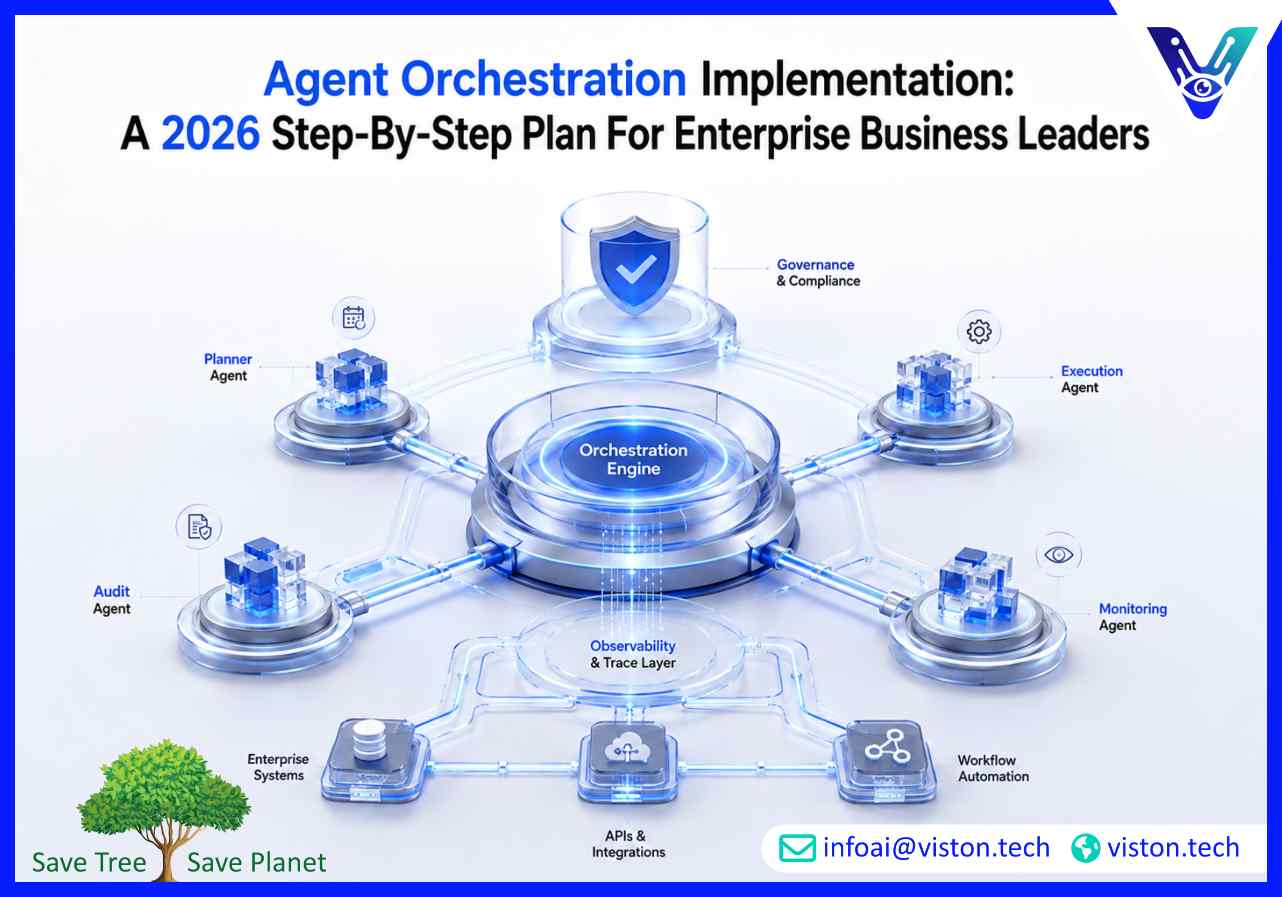
The orchestration layer serves as the system’s central nervous system. It must handle intent understanding, dynamic task decomposition, resource dispatch, and state management across all agents.
Implement the Orchestrator Core
Your orchestrator requires four key components. The gateway layer handles input normalization and validation. The orchestration hub performs task decomposition using chain-of-thought reasoning. The execution coordination layer manages specialist agents. The memory and state layer maintains context using vector databases for retrieval-augmented generation .Design the orchestrator to generate structured task plans, typically in JSON or YAML format, with explicit dependencies and required executor types for each subtask .
Configure Tool Calling and Integration Contracts
Treat tools as deterministic contracts first, code second. Define strict JSON schemas for all tool calls with type validation, enums, and required fields. Implement pre-call validation and post-call verification with explicit timeouts and idempotent design .For external system integration, prefer official APIs whenever available. Reserve headless browser automation for scenarios where APIs do not exist, and harden browser-based automation with semantic locators, snapshots, and caching .
Phase 4: Implement Safety Controls and Human-in-the-Loop Mechanisms
Production agent orchestration requires engineered guardrails built into the runtime architecture before deployment, not added afterward .
Deploy Step Budgets and Loop Prevention
Agents can enter reasoning or invocation loops that accumulate compute costs exponentially. Implement strict step budgets—typically five iterations per loop—after which the agent must halt and escalate to human review . This prevents the documented problem of runaway sessions that continue until manual intervention or timeout occurs .
Build Audit and Approval Nodes
Insert human-in-the-loop checkpoints for sensitive actions involving financial transactions, compliance requirements, or critical business decisions. Implement an audit agent that compares execution outputs against original requirements, triggering reattempts or escalation when discrepancies arise .Maintain replayable audit trails for every reasoning step, tool invocation, and decision point. This forensic capability is essential for trust and compliance in regulated industries.
Phase 5: Deploy and Validate the Orchestration System
Deployment follows a structured pipeline approach that separates design, execution, and review phases. This decoupling prevents context overload and enables quality gates at each stage.
Adopt a Factory Pipeline Deployment Model
Leading implementations use a five-phase pipeline. The design phase produces specifications with human approval gates. The queue phase loads tasks in controlled batches to manage context windows. The production phase executes with just-in-time context loading. The sentinel phase performs cheap pre-checks for syntax errors or scope violations. The quality control phase conducts deep verification against acceptance criteria .This pipeline model enforces what practitioners call the hydration limit: no more than three active tasks at once, preventing context overload and token waste .
Validate with Production-Grade Testing
Beyond functional testing, validate against failure scenarios. Inject faults by shutting down nodes to observe automatic recovery. Test token budget enforcement by deliberately triggering expensive operations. Verify that human escalation paths function correctly when confidence thresholds drop.
Phase 6: Optimize for Cost, Performance, and Continuous Improvement
Agent orchestration carries different cost profiles than traditional automation. Each reasoning step, tool invocation, and agent handoff consumes tokens and compute resources.
Implement Token Economy Practices
Adopt just-in-time context loading rather than passing complete specifications to every agent. Extract only relevant context for each task, keeping token windows focused and costs predictable . Use summarization between handoffs instead of transmitting full conversation histories .Monitor cost per completed task as a key metric. Establish baseline costs for each orchestration pattern and identify optimization opportunities through context compression and selective agent invocation.
Enable Continuous Learning
Capture execution data to improve orchestration over time. Analyze failure patterns to refine agent prompts and tool schemas. Update vector embeddings as new documentation becomes available. Retire agents that show consistently poor performance or low utilization.
Agent Integration Expertise from Viston AI
Implementing agent orchestration requires specialized expertise that spans workflow design, integration engineering, and production governance. Viston AI provides comprehensive agent integration services for enterprises building multi-agent systems. Our approach focuses on practical outcomes: we assess your existing processes, design appropriate orchestration patterns for each use case, and implement production-ready agent integration that respects your governance requirements. Our team has deep experience with the major orchestration frameworks, tool-calling protocols, and safety mechanisms required for enterprise deployment. We help organizations avoid common failure patterns including uncontrolled token consumption, agent loops, and integration brittleness. For businesses in India and global markets seeking to move agentic AI from pilot to production, Viston AI delivers measurable results through disciplined integration practices and business-aligned orchestration design.
Frequently Asked Questions
What is agent orchestration and why does my business need it in 2026?
Agent orchestration coordinates multiple AI agents to execute complex, multi-step business processes. It combines planning, task decomposition, resource dispatch, and state management. In 2026, as agentic AI moves from pilots to production, orchestration is essential for governance, cost control, and reliable outcomes at scale .
How does agent orchestration differ from traditional RPA or workflow automation?
Traditional automation uses deterministic if-then logic for predictable sequences. Agent orchestration introduces probabilistic reasoning, enabling systems to handle exceptions, adapt to context shifts, and decompose ambiguous goals into executable actions. However, effective orchestration applies agentic reasoning only where it adds value while using deterministic execution for predictable steps .
What are the biggest risks in agent orchestration implementation?
The primary risks are uncontrolled token consumption from runaway reasoning loops, integration failures from poor tool contracts, governance gaps that allow agents to act outside boundaries, and architectural misalignment where the wrong orchestration pattern is applied to a business process . Research indicates over 40 percent of agentic AI projects may face cancellation due to these issues.
How do I control costs in an agent orchestration system?
Implement step budgets to cap reasoning cycles, use just-in-time context loading rather than passing full specifications, enforce token limits per session, and apply summarization between agent handoffs. The orchestration pattern you choose also affects cost: autonomous front-end patterns consume more tokens than sequenced agent workflows or deterministic nodes .
What security controls are required for production agent orchestration?
Essential controls include least-privilege credentials per tool, isolated execution sandboxes for risky operations, input sanitization, per-tool quotas and rate limits, human-in-the-loop approvals for sensitive actions, and replayable audit trails. Treat agents as first-class identities with role-based access control .
How do I know if my organization is ready for agent orchestration?
Readiness requires three conditions: well-defined business processes suitable for automation, existing API infrastructure for system integration, and governance capabilities including audit trails and approval workflows. Organizations lacking these foundations should address them before implementing agent orchestration .
Conclusion
Agent orchestration represents a fundamental shift in how enterprises automate complex business processes. Success in 2026 requires disciplined implementation: define clear requirements, select appropriate orchestration patterns for each use case, engineer robust tool contracts, deploy safety controls before production, and optimize continuously for cost and performance. Agent integration services from specialists like Viston AI can accelerate this journey by providing proven patterns, governance frameworks, and production expertise. The organizations that succeed will be those that treat orchestration as an engineering discipline, not an experiment, building systems that are governed, observable, and aligned with business outcomes from day one.

