
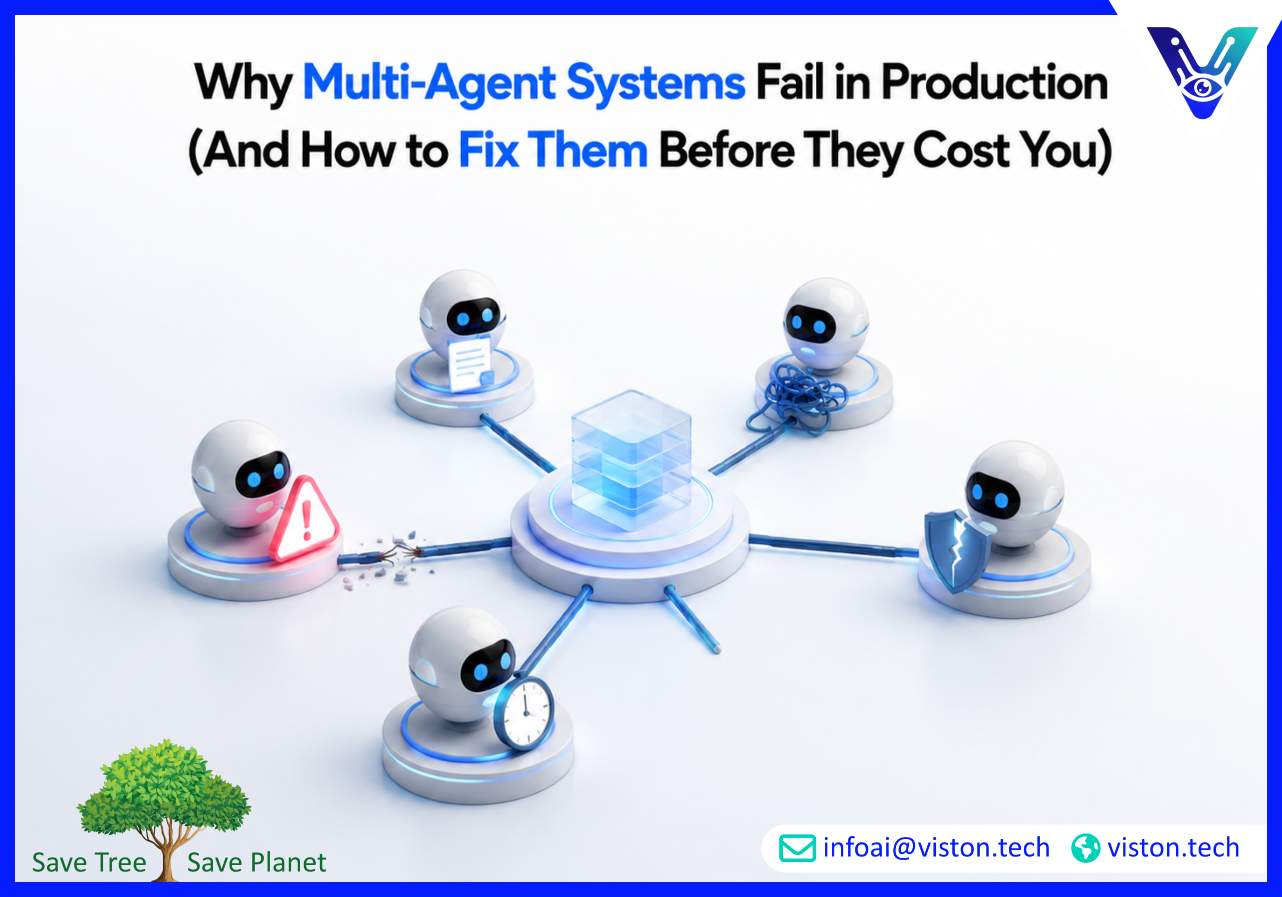
Moving from a single AI agent to a multi-agent system promises autonomy at scale—one agent researches, another analyzes, a third executes. But in production, these systems break in predictable and expensive ways. Understanding those failure patterns before they reach a customer or compromise a decision is now a core operational requirement for any serious AI deployment.
Most multi-agent failures are not model failures. They are coordination failures. When multiple agents share a task, the system inherits every vulnerability of distributed computing—race conditions, partial completion, state inconsistency—layered on top of the non-deterministic behavior of large language models. The result is a class of problems that traditional software engineering alone cannot solve.
A system that works flawlessly with three test queries can unravel with three hundred concurrent ones. One agent waits for a response that another agent never sends. A handoff drops. An assumption made in prompt logic turns into a silent error that propagates across four subsequent steps. These are the failures that erode trust in agentic architectures—not because the core intelligence is weak, but because the orchestration layer was treated as an afterthought.
By 2026, multi-agent systems are handling tasks with genuine business consequence—supply chain decisions, compliance checks, customer contract generation. The tolerance for “agent got confused” has evaporated. Regulators in financial services, healthcare, and insurance are asking direct questions about agentic decision trails. Insurers are scrutinizing multi-agent workflows for auditability. The orchestration layer is no longer just a technical convenience; it is a governance necessity.
The most insidious failure happens slowly. Agent A interprets a request and passes a transformed version to Agent B, which adds its own interpretation before handing to Agent C. By the third handoff, the original business intent has shifted—sometimes subtly, sometimes completely. An instruction to “summarize contract risk” becomes a general risk assessment that misses jurisdiction-specific clauses. The output looks plausible. It is wrong in ways only a domain expert would catch.
This is not a prompt engineering problem. It is an intent preservation problem that sits in the orchestration layer. Without explicit intent anchoring and verification gates between agent transitions, drift is inevitable at scale.
A single agent hallucinating is manageable. When that hallucinated output becomes the input for the next agent, which then reasons on false premises and passes its own confabulated result downstream, the compounding effect is devastating. By the fourth or fifth agent, the system is producing confident, well-structured, entirely fabricated conclusions.
Standard hallucination mitigation—better prompts, retrieval-augmented generation, temperature tuning—addresses individual agent behavior. It does nothing to stop a hallucination that has already entered the agent-to-agent communication pipeline. Stopping cascading hallucinations requires inter-agent validation logic, source-grounding checks at handoff points, and circuit breakers that halt chains when confidence drops below defined thresholds.
Multi-agent systems often assume transaction-like behavior, but LLM-based agents are inherently non-transactional. An agent may complete three of five subtasks, pass partial results forward, and leave the system in a state no downstream agent can recover from. The user receives an output that is half-complete and presented as final.
This failure is especially common in systems where agents operate in parallel branches that must converge. One branch finishes. Another times out. A third returns a format the merging agent cannot parse. The orchestration layer either blocks indefinitely or, worse, proceeds with incomplete data. Production-grade systems need explicit state management, timeout handling, and graceful degradation paths that alert humans when automated recovery fails.
A single agent calling a single API endpoint is a known failure surface. In a multi-agent system, the surface multiplies. Agent A calls a vector store. Agent B queries a CRM. Agent C hits a third-party enrichment API. Each dependency carries its own latency profile, rate limit, authentication flow, and error response format.
When one tool fails, the orchestrator faces a difficult question: retry, skip, substitute, or abort the entire chain? Most early implementations have none of this logic. The agent simply fails, often silently, returning an incomplete or default response that the user cannot distinguish from a legitimate one. Multi-agent orchestration requires centralized tool governance—standardized error handling, retry policies with backoff, circuit breaking, and fallback routing—that individual agents cannot provide on their own.
The most dangerous failure is the one you cannot see. In a linear chatbot interaction, it is relatively straightforward to trace what went wrong. In a multi-agent system where messages bounce between five agents, three tools, and two vector stores, reconstructing the chain of reasoning after a bad output is extraordinarily difficult without purpose-built observability.
Teams often discover production failures through customer complaints, not dashboards. They lack agent-level tracing, handoff logging, confidence scoring at transition points, and diff-like comparisons between intended and actual outputs. By 2026, multi-agent observability is not optional. Without it, organizations are running business-critical processes through systems they cannot debug, audit, or improve with confidence.
Fixing these failures is not about better models. The frontier models from every major lab are capable enough. The gap is in the orchestration layer—the software that governs how agents communicate, how state is managed, how intent is preserved, and how failures are caught before they cause harm.
Effective multi-agent orchestration in 2026 means implementing guardrails that operate between agents, not just around them. It means intent contracts that define what must be preserved across handoffs. It means confidence thresholds that trigger human review when agents disagree or when outputs drift from validated ground truth. It means treating agent chains as auditable business processes, not experimental pipelines.
Organizations that treat orchestration as a first-class engineering discipline—with defined failure modes, recovery procedures, and observability from day one—are the ones running multi-agent systems reliably in production. Those that bolt orchestration on after the fact are the ones quietly pulling agentic features back from customer-facing deployments.
Viston AI specializes in multi-agent orchestration designed for production environments where failure is measured in revenue loss, regulatory exposure, and customer trust. The company’s work focuses on the coordination layer that sits between agents—not the agents themselves—addressing the exact failure patterns that cause production breakdowns.
The orchestration framework includes intent anchoring at every handoff point, ensuring that the business objective specified at the start of a chain remains intact regardless of how many agents transform the data. Inter-agent validation logic checks outputs against source data and defined confidence thresholds, stopping hallucination chains before they propagate. State management protocols handle partial completions and timeouts with defined recovery paths rather than silent failures or blocked processes.
For organizations deploying multi-agent systems in regulated industries or customer-facing applications, Viston AI provides the observability infrastructure that makes agentic workflows auditable—tracing decisions across agents, logging handoff reasoning, and surfacing anomalies before they become customer incidents. The result is a multi-agent architecture where failures are visible, manageable, and continuously improvable rather than hidden and discovered too late.
Coordination failure between agents—not individual model performance—is the leading cause. This includes goal drift across handoffs, cascading hallucinations when one agent passes bad output to the next, and state inconsistency when agents complete tasks partially and pass incomplete results downstream.
No. Improved prompting helps individual agent behavior but does not address inter-agent problems like intent drift, hallucination propagation, or state management. These failures live in the orchestration layer and require purpose-built coordination logic, validation gates, and observability tooling.
Simple chaining passes output from one agent to the next sequentially. Production orchestration adds intent preservation, confidence-based gating, failure recovery, parallel branch coordination, state management, and full observability across the entire agent workflow. It treats the system as a governed business process rather than a sequence of API calls.
At minimum, production observability should include agent-level tracing, handoff logging with input-output diffs, confidence scoring at transition points, latency tracking per agent and tool, anomaly detection for output drift, and audit trails that support regulatory review. Without these, debugging and compliance become nearly impossible.
Typically, yes. A single-agent failure produces one bad output. A multi-agent failure can compound across multiple steps, embed errors in systems of record, trigger incorrect downstream business actions, and be significantly harder to detect and trace. The blast radius is larger, and the mean time to detection is often longer without proper orchestration controls.
As soon as a multi-agent system moves beyond internal experimentation and into any workflow that affects customers, revenue operations, compliance, or material business decisions. Early specialist involvement prevents the accumulation of architectural debt that becomes expensive and disruptive to unwind once the system is live and depended upon.
Multi-agent systems represent a genuine advance in what AI can automate, but their failure modes are distinct, predictable, and preventable. The organizations succeeding with agentic architectures in 2026 are not those with the best individual models—they are those that invested in the orchestration layer that keeps agents coordinated, auditable, and safe. For businesses evaluating or scaling multi-agent deployments, specialist orchestration expertise is not a premium add-on. It is the difference between a system that works in demos and one that works in production. Viston AI focuses precisely on that coordination layer, helping organizations run multi-agent workflows that are reliable, observable, and built for real business accountability.
