
As businesses accelerate AI adoption, automation and orchestration are often discussed together. While both improve operational efficiency, they solve different challenges. Understanding the difference is critical for organizations investing in AI Data & Automation Solutions, particularly when building scalable, intelligent business processes in 2026.
Automation focuses on completing individual tasks with minimal human intervention. It follows predefined rules, triggers, and workflows to perform repetitive activities consistently and efficiently.
Examples of business automation include:
The primary goal of automation is to reduce manual effort, improve speed, and eliminate repetitive work. Most automation systems operate within a specific process or application and execute actions according to predefined logic.
Automation works exceptionally well when processes are structured, consistent, and require minimal contextual judgment.
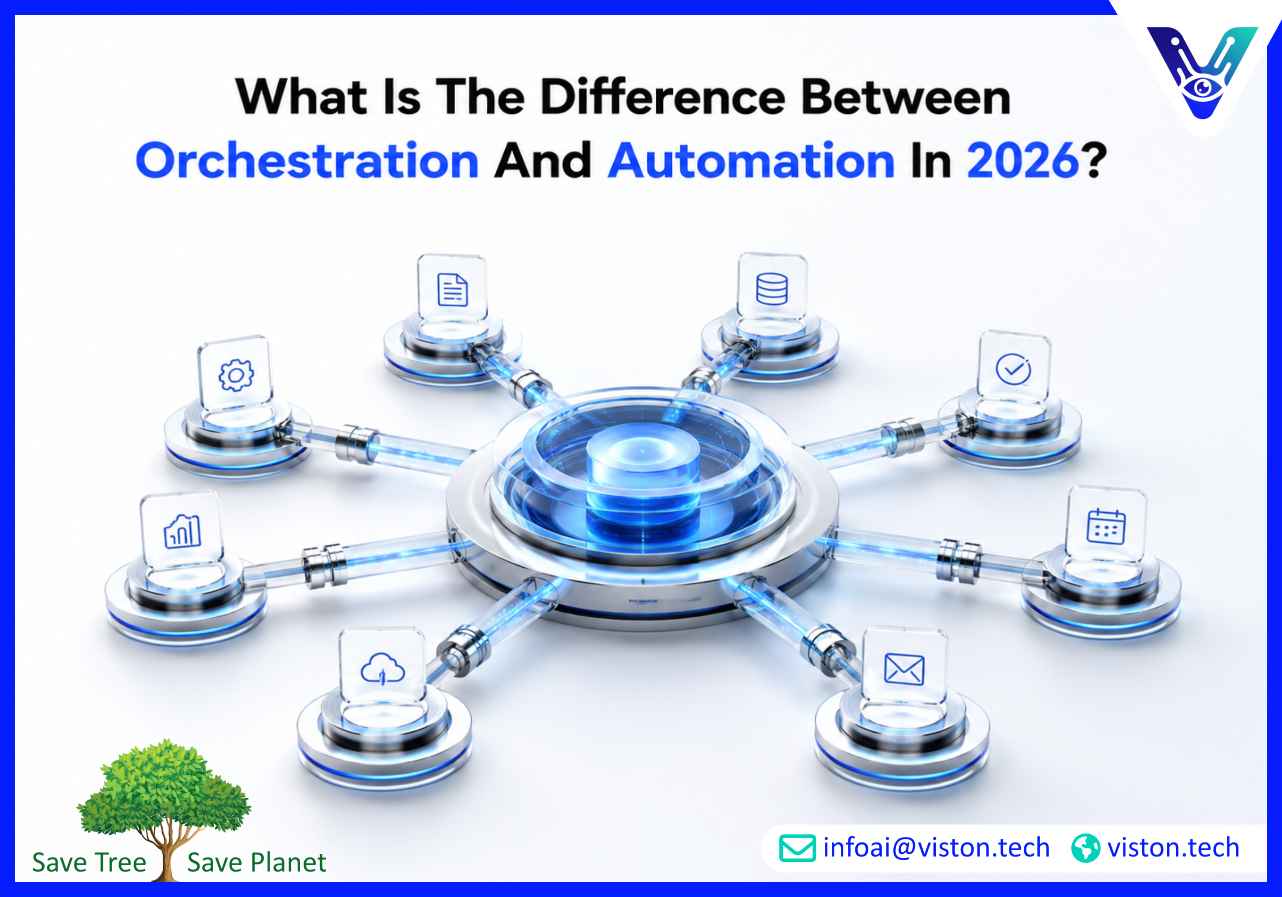
Orchestration operates at a higher level. Instead of focusing on a single task, orchestration coordinates multiple systems, workflows, applications, data sources, AI agents, and automations to achieve a larger business outcome.
Think of orchestration as the conductor of an orchestra. Individual automation tools perform specific tasks, but orchestration ensures those tasks happen in the correct sequence, share information properly, handle exceptions, and achieve a unified objective.
For example, a customer onboarding process may involve:
Orchestration coordinates all of these activities across different systems and teams while maintaining visibility and control throughout the process.
In modern AI environments, orchestration often governs how AI agents, machine learning models, databases, APIs, and business applications work together.
The simplest way to understand the distinction is that automation performs tasks, while orchestration manages the overall process.
Automation is often a building block. Orchestration brings those building blocks together into a cohesive operational framework.
Without automation, orchestration has nothing to coordinate. Without orchestration, automation can become fragmented and difficult to scale.
In 2026, organizations are deploying AI agents, intelligent workflows, predictive analytics, and advanced automation at unprecedented scale. As the number of automated systems grows, coordination becomes increasingly important.
Businesses now need to manage:
Each system may function effectively on its own, but business value is maximized when these technologies work together as part of a coordinated strategy.
This is where orchestration delivers significant value. It creates structured workflows that connect people, AI systems, business applications, and data across the organization.
Organizations that successfully combine orchestration and automation often achieve stronger operational outcomes than those relying on isolated automation projects.
Leaders gain a complete view of workflow performance, bottlenecks, dependencies, and outcomes across multiple systems.
New automations, AI agents, and business applications can be added without creating disconnected processes.
Coordinated workflows ensure the right data reaches the right systems and stakeholders at the right time.
Orchestration helps manage approvals, exception handling, compliance requirements, and governance controls.
Integrated workflows reduce delays, eliminate information silos, and create more seamless customer interactions.
For organizations exploring AI Data & Automation Solutions, understanding the relationship between orchestration and automation is essential. Viston AI focuses on helping businesses implement intelligent automation strategies that extend beyond isolated task execution.
Modern AI initiatives often require more than simple workflow automation. They involve coordinating AI agents, integrating enterprise systems, managing data flows, enabling real-time decision support, and creating scalable operational frameworks. These capabilities align closely with orchestration-driven approaches.
By combining AI automation, workflow intelligence, data integration, and process coordination, businesses can move from disconnected automation projects toward more comprehensive digital operations. This approach helps organizations improve efficiency, gain visibility into workflows, and create systems that adapt as business requirements evolve.
As AI adoption continues to expand across industries, orchestration is becoming a critical layer that enables automation investments to deliver broader business value.
No. Automation executes individual tasks, while orchestration coordinates multiple automated processes, systems, and workflows to achieve a broader business objective.
Yes. Many organizations start with standalone automation projects. However, as automation expands across departments and systems, orchestration becomes increasingly important.
No. Orchestration can coordinate traditional software systems and workflows. However, AI-powered orchestration is becoming more common as organizations deploy intelligent agents and advanced automation technologies.
Both are important. Automation improves task efficiency, while orchestration ensures multiple automated processes work together effectively to support business goals.
Viston AI provides AI Data & Automation Solutions that help businesses integrate automation capabilities, coordinate workflows, manage data processes, and build scalable AI-driven operations.
The difference between orchestration and automation comes down to scope and coordination. Automation focuses on performing individual tasks efficiently, while orchestration manages how multiple tasks, systems, applications, and AI technologies work together. In 2026, organizations increasingly need both. Automation reduces manual effort, while orchestration creates the structure required for scalable, intelligent business operations. For companies investing in AI Data & Automation Solutions, understanding this distinction is essential for building workflows that deliver measurable operational and strategic value.
