
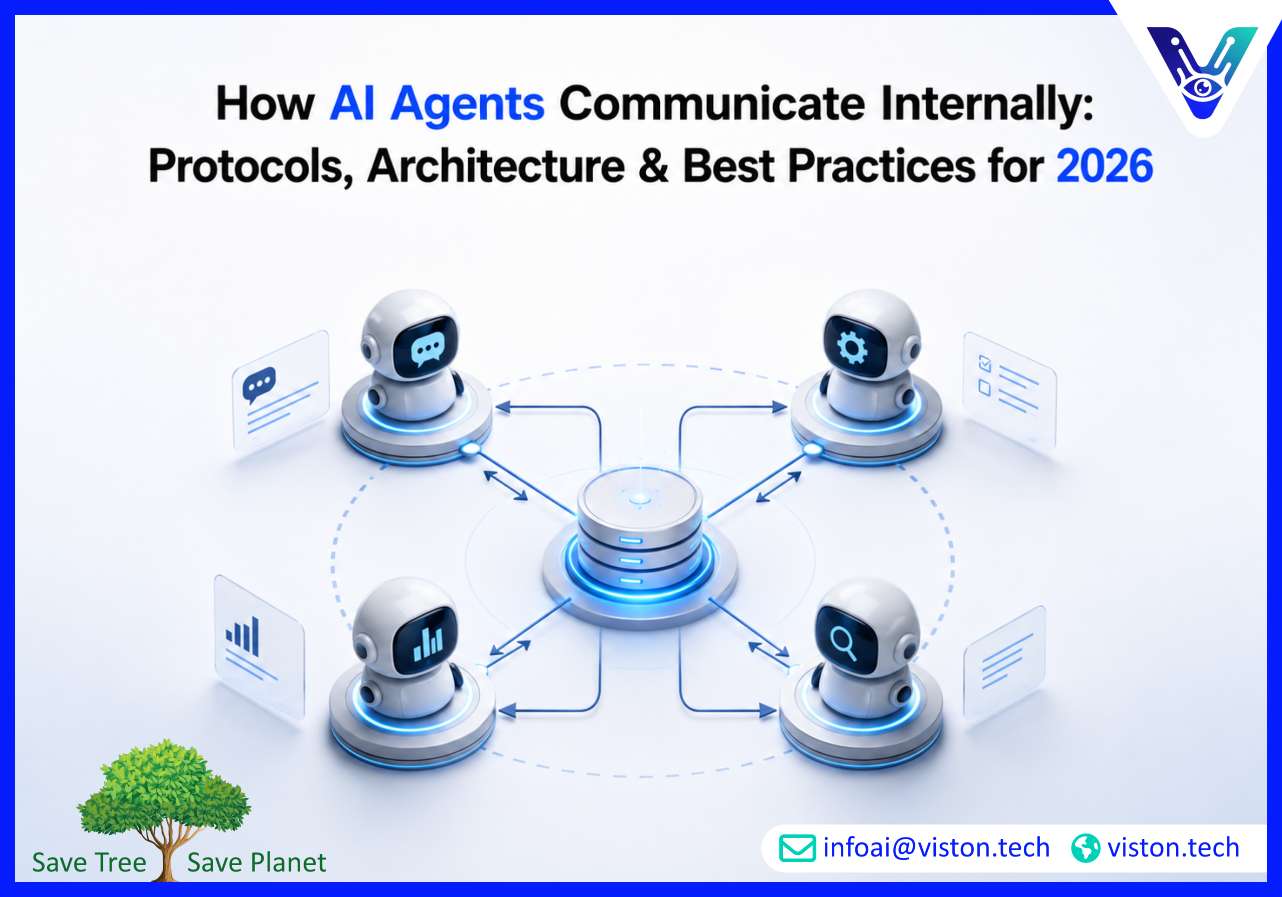
When businesses deploy multi-agent AI systems, the intelligence of each individual agent matters far less than how effectively those agents communicate with one another. Internal agent communication is the operational backbone of any serious AI deployment — and in 2026, understanding how it works is no longer optional for teams building production-grade systems.
A single AI agent can handle narrow, well-defined tasks reasonably well. But the moment a business needs agents to collaborate — sharing context, delegating subtasks, resolving conflicts, and producing coordinated outputs — the communication layer becomes the defining factor in whether a system succeeds or fails.
Most early failures in enterprise AI deployments trace back not to model quality, but to how agents passed information between themselves. Messages got lost. Context windows got bloated. Agents repeated work or contradicted each other. These are communication failures, not intelligence failures.
In 2026, the market has matured enough to recognize this clearly. Building reliable multi-agent systems means designing the communication architecture first — and choosing the right protocols, memory structures, and coordination patterns before a single model is selected.
Internal agent communication happens through several distinct mechanisms, and most production systems combine more than one.
The most fundamental pattern is direct message passing — agents send structured messages to one another, either through a central orchestrator or peer-to-peer. These messages typically carry task instructions, data payloads, status updates, and the results of completed subtasks. The format matters significantly. Well-structured messages reduce ambiguity and make agent outputs predictable and parseable.
Shared state storage is the complementary approach. Instead of every agent carrying its own full context, agents read from and write to a shared memory layer. This can be a vector database, a structured knowledge store, or a lightweight key-value cache. It reduces redundancy and keeps communication efficient, particularly in systems with five or more concurrent agents.
There are two fundamental architectures for how agents coordinate: orchestrator-led and peer-to-peer.
In orchestrator-led systems, a supervisor agent receives the top-level task, decomposes it, and assigns subtasks to specialist agents. Results flow back through the orchestrator, which compiles outputs and determines next steps. This is predictable, auditable, and relatively straightforward to govern — which is why it remains the default choice in regulated enterprise environments.
In peer-to-peer systems, agents run concurrently and communicate through a shared bus. They can hand off tasks, query one another for information, and resume dormant agents when needed. This architecture is more flexible and powerful, but it introduces coordination complexity and higher token costs when every agent restart re-reads the full conversation history.
Choosing between these architectures is not a technical question alone — it directly affects cost, reliability, governance, and how straightforward the system is to debug in production.
One of the most significant shifts in multi-agent AI development over the past twelve months has been the emergence and widespread adoption of open communication protocols. Before these standards existed, every framework used its own conventions. A tool written for one system could not work in another without substantial rework. That fragmentation made enterprise deployments brittle and expensive.
Introduced by Anthropic in late 2024 and now one of the most widely adopted standards in the space, MCP governs how agents connect to external tools and data sources. It uses JSON Schema for tool definitions and JSON-RPC for invocations. By early 2026, MCP had crossed approximately 97 million monthly SDK downloads, reflecting how broadly the industry has moved to adopt it. Think of it as the internal reference system — giving every agent in a network a consistent way to access tools and knowledge without bespoke integration work.
A2A addresses inter-agent communication specifically — covering task delegation, collaborative orchestration, and workflow coordination between agents. It joined the Linux Foundation AI and Agents Foundation in December 2025, with backing from major AI and cloud providers. A2A is designed for distributed multi-agent systems where agents from different frameworks or providers need to coordinate reliably without a single vendor’s proprietary format acting as the bottleneck.
ACP handles the lighter-weight messaging requirements — quick updates, status broadcasts, task assignments, and inter-team handoffs. If MCP is the internal knowledge layer and A2A governs direct agent collaboration, ACP handles the operational communications that keep a system’s day-to-day coordination running cleanly.
For businesses evaluating AI development partners, understanding which protocols a provider supports and how they implement them is a practical due diligence question — not a theoretical one.
Communication between agents is not free. Every message sent, every context reload, and every inter-agent call carries a token cost. In large multi-agent deployments, communication overhead can become a significant line item — and poorly designed systems amplify this problem dramatically.
Recent research from 2026 has demonstrated that at equal token budgets, single-agent systems can match or outperform multi-agent setups. This is a critical finding for businesses building business cases for agentic AI. Multi-agent architectures only deliver their value advantage when the communication layer is optimized — when context is shared intelligently, messages are compact, and agents are not redundantly reprocessing information already available in shared memory.
Emerging approaches like KVCOMM, which enables agents to share key-value cache states rather than re-sending full token sequences, have shown significant speedups in research settings. Phase-based scheduling approaches have demonstrated meaningful token reductions in concurrent agent systems. These advances are beginning to move from research into production frameworks in 2026.
For enterprise deployments, the practical implication is straightforward: communication architecture must be designed with cost efficiency in mind from the outset, not retrofitted after the system is already live.
In production environments, agent communication failures have real operational consequences. An agent that stops responding mid-task, returns malformed output, or loses context between steps can cascade into broader system failures — particularly in workflows where downstream agents depend on upstream results.
Reliable multi-agent systems address this through several mechanisms: automatic retry logic, circuit-breaking to isolate failing agents, fallback routing to alternative agents or human reviewers, and comprehensive logging at the communication layer. These are not optional features — they are table-stakes requirements for any enterprise deployment.
Governance considerations add another layer. In regulated industries, agent communication logs may need to be auditable. The sequence of decisions, the data shared between agents, and the outputs produced all need to be traceable. This requires structured logging, clear message schemas, and a deployment architecture that preserves audit trails without compromising performance.
Security is equally important. Agent-to-agent communication channels that lack proper authentication, encryption, or access controls become attack surfaces. Enterprise-grade deployments require these considerations to be designed into the communication layer from day one.
Viston AI specializes in AI agent development and deployment for enterprise organizations, with a delivery methodology focused on production readiness, measurable business outcomes, and communication architecture that performs reliably at scale.
Their work spans the full development lifecycle — from use case prioritization and system architecture through proof-of-concept delivery, integration, and ongoing optimization. Viston’s API-first architecture approach is particularly relevant for businesses deploying multi-agent systems, since it ensures that agent communication layers connect cleanly with existing enterprise infrastructure including CRMs, ERPs, and data platforms.
Viston operates with SOC 2 Type II certification and maintains compliance frameworks aligned with GDPR, HIPAA, and ISO 27001 — requirements that directly affect how agent communication must be logged, governed, and secured in regulated environments. Their accelerated deployment methodology is structured to deliver proof-of-concept results within two to four weeks, with full production deployments typically completing in eight to twelve weeks.
For organizations in North America and Europe evaluating AI agent development partners, Viston’s combination of enterprise security standards, multi-agent deployment experience, and structured delivery methodology addresses the practical challenges that make internal agent communication a business-critical concern — not just a technical one.
Internal communication refers to how individual AI agents within a multi-agent system share information, delegate tasks, synchronize state, and coordinate their actions. This can happen through direct message passing, shared memory layers, orchestration protocols, or peer-to-peer communication channels, depending on the system architecture.
MCP (Model Context Protocol) governs how agents connect to tools and external data sources. A2A (Agent-to-Agent Protocol) handles direct inter-agent communication, task delegation, and collaborative orchestration. ACP (Agent Communication Protocol) manages lightweight messaging and operational updates between agents. Most production multi-agent systems benefit from using all three in combination.
The communication layer determines whether a multi-agent system is reliable, cost-efficient, auditable, and scalable in production. Poorly designed communication architecture leads to duplicated work, context loss, high token costs, error cascades, and governance gaps — all of which have direct operational and financial consequences.
Communication overhead can be substantial in large multi-agent deployments. Every agent restart that re-reads full conversation history, every redundant context transfer, and every poorly scoped message contributes to token costs. Optimized systems use shared memory, compact message schemas, and selective context passing to keep communication efficient without sacrificing capability.
Production readiness requires reliable communication protocols, structured error handling and fallback logic, comprehensive audit logging, security controls at the communication layer, integration with existing enterprise systems, and observability tools that allow teams to monitor agent behavior in real time.
Viston AI delivers end-to-end AI agent development and deployment services, including architecture design, integration with existing enterprise infrastructure, compliance-aligned security frameworks, and accelerated delivery methodologies structured for measurable business outcomes. Their API-first approach and enterprise compliance certifications make them a relevant partner for organizations building production-grade multi-agent systems.
How AI agents communicate internally is not a background technical detail — it is the architecture decision that determines whether a multi-agent AI deployment succeeds or struggles in production. The protocols, memory structures, orchestration patterns, and governance frameworks chosen at the design stage shape everything from cost and reliability to auditability and security. In 2026, businesses that approach AI agent development with this understanding are making substantially better infrastructure investments than those focused solely on model selection. Partnering with a specialist like Viston AI — one that brings enterprise deployment experience, compliance-ready frameworks, and a structured approach to multi-agent communication architecture — gives organizations a more reliable path from proof of concept to production-grade AI agent systems that deliver real business value.
