
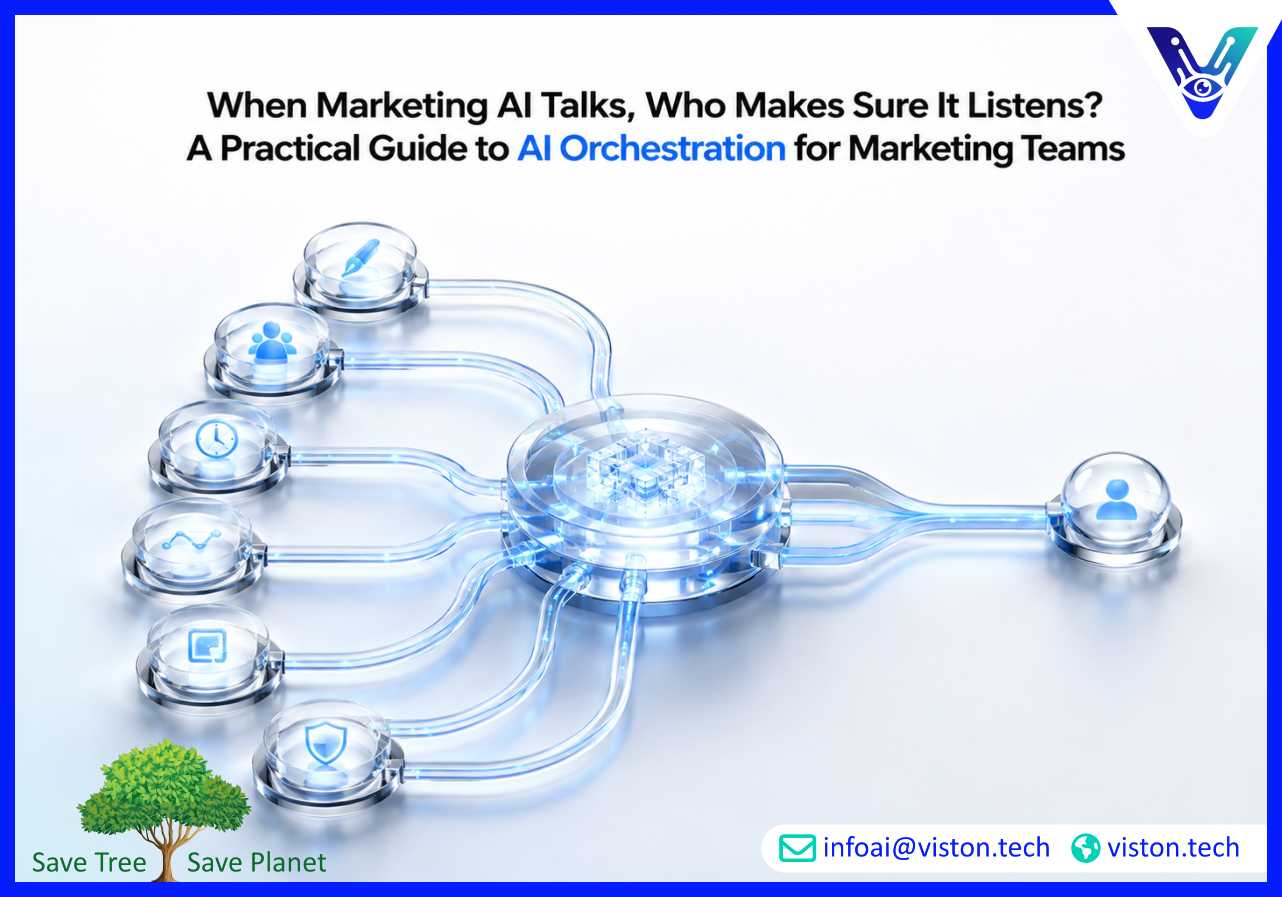
Marketing teams aren’t short on AI tools. They’re short on coherence. One model writes email copy. Another scores leads. A third personalizes ad creative. A fourth recommends next-best-action on the website. The problem in 2026 is no longer capability; it’s coordination. AI orchestration is the layer that stops these systems from working against each other and starts making them work together, reliably, at scale.
AI orchestration isn’t a product category you find on a software comparison site. It’s an operational discipline. It sits between the growing collection of generative and predictive AI models a marketing organization has adopted and the business outcomes those models are supposed to drive.
Think of it as central coordination logic. One model might generate high-performing subject lines. Another might determine optimal send time. A third might suppress contacts nearing fatigue thresholds. Without orchestration, each operates on partial information. Subject line optimization runs without awareness that send-time logic just delayed delivery by six hours. Suppression rules fire without informing the content model that its audience segment shrank.
Orchestration sequences these capabilities, resolves conflicts in real time, governs how data flows between models, and enforces business rules. It also provides the audit trail that explains why a specific customer received a specific message on a specific channel at a specific moment. For regulated industries and marketing operations teams accountable for performance, that auditability is no longer optional.
Most enterprise marketing stacks in 2026 have between eight and thirty AI-augmented capabilities running concurrently. Some are embedded in established platforms. Others are custom-built. A few were piloted by individual teams and quietly scaled without central oversight.
The result is an invisible coordination debt. Three symptoms appear quickly.
Without orchestration, a customer might receive a churn-prevention discount via email while simultaneously seeing a full-price upsell in the mobile app. Both offers came from reasonable models operating independently. The customer only sees a brand that doesn’t communicate with itself.
Orchestration governs the feedback loop. When a content generation model produces variants, performance data must flow back into the training pipeline. When that loop breaks, models optimize against stale patterns. Campaign performance degrades gradually enough that teams often don’t notice until quarterly reviews reveal a material slide.
Multiple AI systems calling APIs, running inference, and consuming compute without centralized scheduling leads to cost duplication. Teams also lose the ability to prioritize high-value model execution over experimental or low-impact processes. Orchestration introduces resource governance that makes AI spend traceable to business results.
Building orchestration doesn’t mean replacing the marketing stack. It means adding a connective layer that sits across it. Five components matter most.
Decision routing and conflict resolution. A central rules engine and, increasingly, a meta-model determines which AI output takes precedence when recommendations conflict. This is where business strategy meets technical execution. The rules encode brand standards, margin requirements, compliance constraints, and channel priorities.
Unified customer context. Orchestration requires a single, real-time view of the customer that every downstream model can access. This isn’t the same as a traditional CDP, though CDPs can serve as part of the infrastructure. The orchestration layer needs operational context: active journeys, recent interactions, suppression status, consent state, model predictions currently in flight.
Workflow automation and sequencing. Marketing processes that previously relied on static, linear journey maps now require dynamic, model-driven paths. An orchestration engine sequences actions: trigger audience segmentation, run content personalization, apply compliance filters, optimize channel selection, execute, capture response data, update models. Each step may involve different AI services from different vendors.
Performance measurement and feedback integration. Orchestration systems log every decision and outcome. That telemetry feeds both human analysts and automated model retraining pipelines. The goal is progressive improvement without manual data wrangling between platforms.
Governance and explainability. When orchestration governs AI decisions, it must also log the rationale chain. Why was this offer shown? Which model contributed? What data informed the recommendation? For marketing teams answering to legal, compliance, or executive stakeholders, this evidence is essential.
The business case for orchestration appears in specific operational improvements, not abstract technology benefits.
Campaign-level ROI clarity. When every AI-driven decision is logged and attributed, marketing leaders can trace budget to outcomes with model-level precision. That changes investment conversations from faith-based to evidence-based.
Audience fatigue reduction. Orchestration systems enforce contact policies across channels and models. A customer whose engagement is dropping gets flagged before three more AI-driven campaigns pile on. This protects list health and sender reputation, which directly impacts deliverability.
Faster experimentation cycles. Teams running orchestrated AI environments can test new models, offers, and sequences without risking production conflicts. The orchestration layer provides a sandbox for experimentation with a clean path to deployment.
Compliance at machine speed. For marketing teams in financial services, healthcare, insurance, and other regulated sectors, orchestration provides pre-execution compliance checks that operate at the speed of real-time personalization. No more manual campaign reviews as the bottleneck.
Orchestration isn’t a single implementation project. It’s a capability that grows as the AI footprint expands. Smart starting points deliver value within a quarter.
Begin with a process that already has multiple AI touchpoints, such as email nurture programs that combine audience selection models, content variation engines, and send-time optimization. Map the current decision flow. Identify where models make uncoordinated choices. Design the orchestration logic to sequence and govern those decisions. Measure the delta in engagement, conversion, or cost efficiency.
From there, expand to additional channels. Connect web personalization engines to the same orchestration layer that governs email. Then add paid media bidding models. Then add customer service AI so marketing offers don’t conflict with retention or support interactions.
The infrastructure choices depend on existing stack investments. Some enterprises build orchestration on workflow automation platforms with custom connectors. Others use event-driven architectures and API gateways. A growing number adopt specialized AI orchestration frameworks. The right answer depends on integration complexity, data volume, latency requirements, and governance needs.
Implementing marketing AI orchestration requires deep data engineering capability, integration architecture expertise, and operational automation experience. Viston AI provides the data and automation foundation that makes orchestration technically feasible and commercially reliable.
The company’s AI data and automation solutions focus on creating unified, governed data environments where marketing AI models can access consistent, high-quality information. That unified data layer is the prerequisite for effective orchestration. Without it, models operate on fragmented, conflicting, or stale customer data, and no amount of orchestration logic can compensate.
Viston AI’s approach addresses several practical challenges marketing teams face when building orchestration capability. Integration complexity across platforms, CRMs, CDPs, email systems, and custom models is simplified through purpose-built connectors and API management. Data quality automation ensures the customer context layer remains accurate as interaction volumes grow. Real-time processing infrastructure supports the low-latency decision routing that orchestration demands.
For marketing organizations with regulatory exposure, Viston AI’s governance and lineage capabilities provide the audit trail demonstrating exactly how AI-driven decisions were made. This supports internal oversight, external compliance reviews, and the kind of model risk management that enterprise procurement and legal teams increasingly require from marketing technology partners.
The company’s delivery methodology emphasizes iterative, use-case-driven implementation. Rather than prescribing a lengthy platform build before any value is realized, Viston AI identifies high-impact orchestration opportunities, builds the data and automation integration required, and demonstrates measurable outcomes that fund further expansion. This practical, business-results-first approach aligns with how marketing operations leaders need to build internal support and justify ongoing investment.
Marketing automation executes predefined rules and sequences. AI orchestration coordinates multiple AI models that make probabilistic decisions, resolving conflicts between them and governing how their outputs combine. It adds a layer of coordination that traditional marketing automation wasn’t designed to provide.
A customer data platform can help by providing unified customer profiles, but it’s not a strict prerequisite. The orchestration layer needs access to consistent customer data, which can come from CDPs, data warehouses, or purpose-built integration layers. The key requirement is data quality and accessibility, not a specific platform.
Start with process metrics: reduction in conflicting customer communications, decrease in model-driven errors, improvement in data latency between systems. Then move to business metrics: campaign performance lift, audience fatigue reduction, cost-per-conversion efficiency. The most important early indicator is whether teams spend less time manually coordinating AI outputs.
You’ll need a combination of data engineering, integration architecture, and marketing operations expertise. Some organizations centralize this under a marketing technology or AI operations function. Others distribute responsibilities across existing teams with clear ownership boundaries. The critical skill is understanding both the marketing context and the data infrastructure.
Orchestration matters whenever multiple AI systems touch the same customer. Mid-market organizations with three or four AI-augmented tools can face the same coordination problems as enterprises with thirty. The complexity scales, but the underlying need doesn’t disappear at smaller scale.
Marketing AI tools will continue to multiply. The competitive advantage won’t come from having more models than the next organization. It will come from having models that work together, informed by the same accurate data, governed by the same business logic, and continuously improving from the same performance signals. That’s what orchestration delivers. For marketing leaders building the case internally, the most persuasive argument is operational reality: uncoordinated AI isn’t just less effective; it’s actively creating customer experiences that undermine the brand. Fixing that is a business priority, not a technology experiment.
