
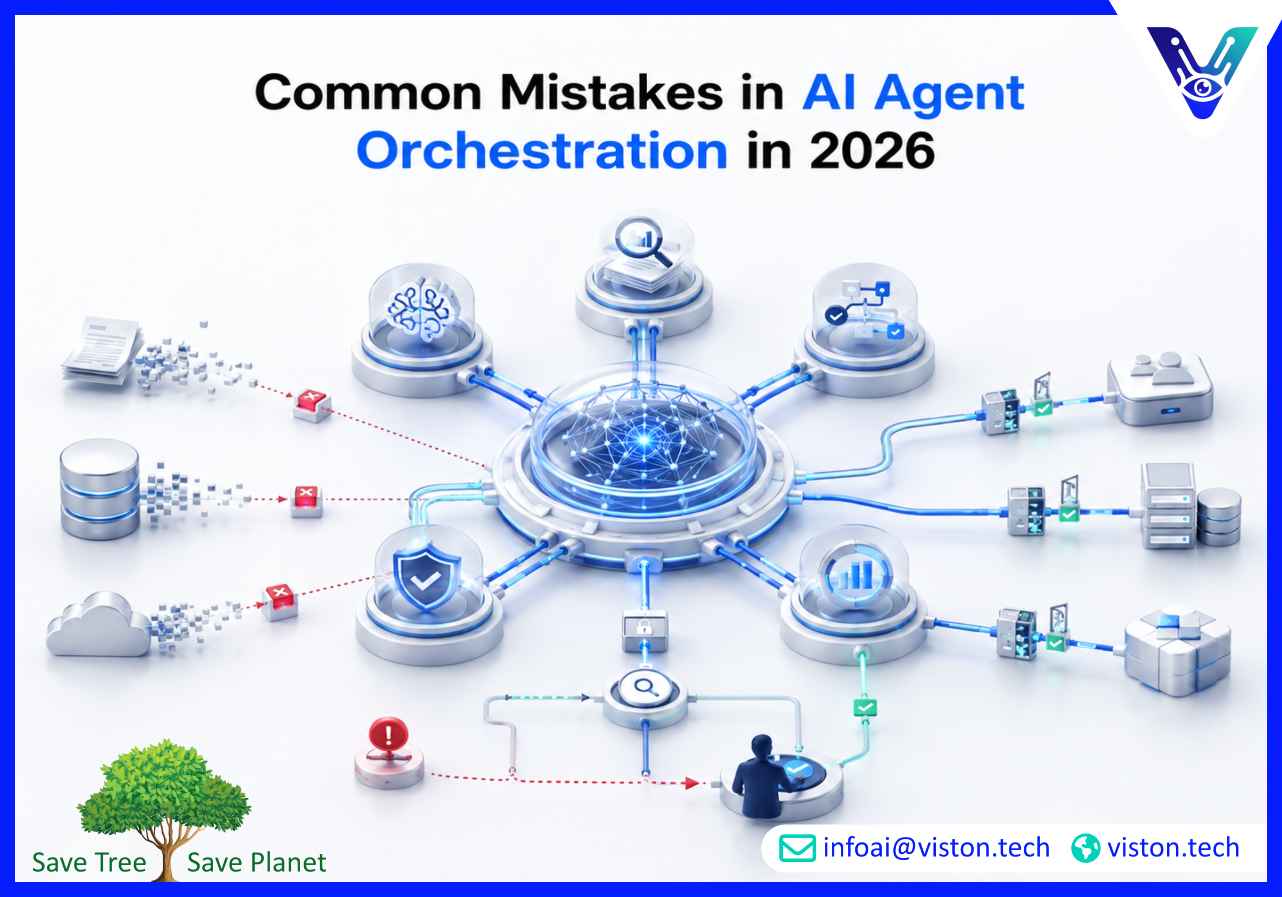
AI agent orchestration is becoming a core capability for organizations deploying intelligent automation at scale. While AI agents can automate research, decision support, workflow execution, and business operations, many projects fail to deliver expected outcomes due to orchestration mistakes rather than model limitations. Understanding these challenges helps businesses build reliable, scalable, and business-focused AI systems.
AI agents are no longer limited to answering questions or generating content. Modern organizations are deploying agent-based systems that interact with business applications, databases, customer records, APIs, internal knowledge bases, and operational workflows.
Orchestration is the framework that allows multiple agents to work together effectively. It controls communication, task allocation, context sharing, decision-making processes, escalation rules, approvals, and workflow execution.
Without proper orchestration, even highly capable AI agents can create inefficiencies, inaccurate outputs, operational risks, and poor user experiences.
As organizations increase investment in AI Agent Development & Deployment during 2026, avoiding common orchestration mistakes has become essential for achieving measurable business value.
One of the most frequent mistakes is starting with technology rather than business requirements.
Organizations often focus on creating sophisticated agents before identifying the specific business outcomes they want to achieve. As a result, agents perform tasks but fail to generate meaningful operational improvements.
Successful orchestration projects begin with clear objectives such as:
When orchestration is tied directly to measurable business goals, implementation becomes significantly more effective.
Many organizations attempt to build one agent that handles research, analysis, decision-making, execution, validation, and reporting.
This approach often creates complexity, inconsistent outputs, and reduced reliability.
Effective AI agent orchestration relies on specialized agents with clearly defined responsibilities. For example:
Specialized agents are easier to manage, test, improve, and scale.
AI agents rely heavily on context to make informed decisions.
A common orchestration failure occurs when agents operate with incomplete, outdated, or inconsistent information.
Without proper context-sharing mechanisms, agents may:
Organizations should establish centralized memory systems, knowledge repositories, and context-management frameworks that ensure agents have access to relevant and current information.
Some businesses attempt to automate every decision without considering risk levels.
While AI agents can operate autonomously in many situations, certain actions require human review. Examples include:
Organizations that neglect human-in-the-loop controls often face operational, compliance, and reputational risks.
Well-designed orchestration systems clearly define when agents can act independently and when human intervention is required.
AI agents rarely operate in isolation.
They typically interact with CRM platforms, ERP systems, customer support tools, databases, document repositories, analytics systems, and external APIs.
Poorly designed integrations create bottlenecks that limit orchestration effectiveness.
Common integration issues include:
Robust integration planning is a critical part of successful AI Agent Development & Deployment initiatives.
Many organizations deploy AI agents and assume they will continue performing effectively without oversight.
In reality, agent performance should be continuously evaluated.
Businesses should monitor:
Without monitoring, problems often remain hidden until they affect customers or operations.
Testing is frequently underestimated in orchestration projects.
Many businesses validate only ideal workflow scenarios while ignoring edge cases and operational exceptions.
Comprehensive testing should include:
Thorough testing significantly improves reliability and business confidence.
AI agents should only access the systems and data necessary to perform their assigned tasks.
Overly broad permissions increase security risks and expand the potential impact of errors.
Organizations should implement:
Strong governance helps maintain trust and operational security.
No orchestration system can handle every scenario autonomously.
When agents encounter uncertainty, missing information, or policy conflicts, they need predefined escalation procedures.
Without escalation mechanisms, workflows may stall, generate errors, or make inappropriate decisions.
Clear escalation rules improve resilience and ensure business continuity.
Organizations operating in regulated industries must ensure AI workflows comply with applicable requirements.
Compliance considerations may involve:
Compliance planning should be incorporated into orchestration design from the beginning rather than added later.
Organizations that achieve strong results from AI agent orchestration typically follow several proven practices.
These practices help organizations move beyond experimentation and create reliable, production-ready AI systems.
Organizations exploring AI agent orchestration often discover that success depends on far more than selecting a foundation model. Effective implementation requires workflow analysis, agent architecture design, integration planning, governance frameworks, testing methodologies, monitoring systems, and long-term optimization.
Viston AI specializes in AI Agent Development & Deployment, helping businesses build practical agent-based solutions aligned with operational objectives. Rather than focusing solely on individual AI agents, the emphasis is placed on creating coordinated systems that support real business workflows.
For organizations implementing intelligent automation, this includes defining agent responsibilities, establishing orchestration logic, integrating enterprise systems, managing context flow, implementing security controls, and creating scalable deployment frameworks.
As businesses increasingly adopt agentic systems in 2026, a structured development and deployment approach helps reduce implementation risks while improving reliability, governance, and long-term business value.
AI agent orchestration is the process of coordinating multiple AI agents, workflows, tools, data sources, and decision paths to complete business tasks efficiently and reliably.
Common causes include unclear business objectives, poor context management, weak integrations, inadequate testing, insufficient governance, and lack of monitoring.
Not always. High-risk decisions involving finance, compliance, legal matters, or customer impact often benefit from human review and approval mechanisms.
Industries such as healthcare, finance, technology, manufacturing, logistics, professional services, and customer support can benefit significantly from orchestrated AI workflows.
Viston AI supports AI Agent Development & Deployment through architecture design, workflow planning, integrations, orchestration frameworks, governance implementation, testing, and optimization.
Understanding the common mistakes in AI agent orchestration is essential for organizations investing in intelligent automation in 2026. Challenges such as unclear objectives, poor context management, weak integrations, insufficient governance, and inadequate testing can significantly reduce project success. Businesses that adopt structured orchestration strategies, implement proper controls, and focus on measurable outcomes are more likely to achieve scalable and reliable results. As AI Agent Development & Deployment continues to evolve, organizations that prioritize orchestration quality will be better positioned to unlock the full value of agent-based systems. Viston AI helps businesses approach this transformation with practical, business-focused implementation strategies.
