
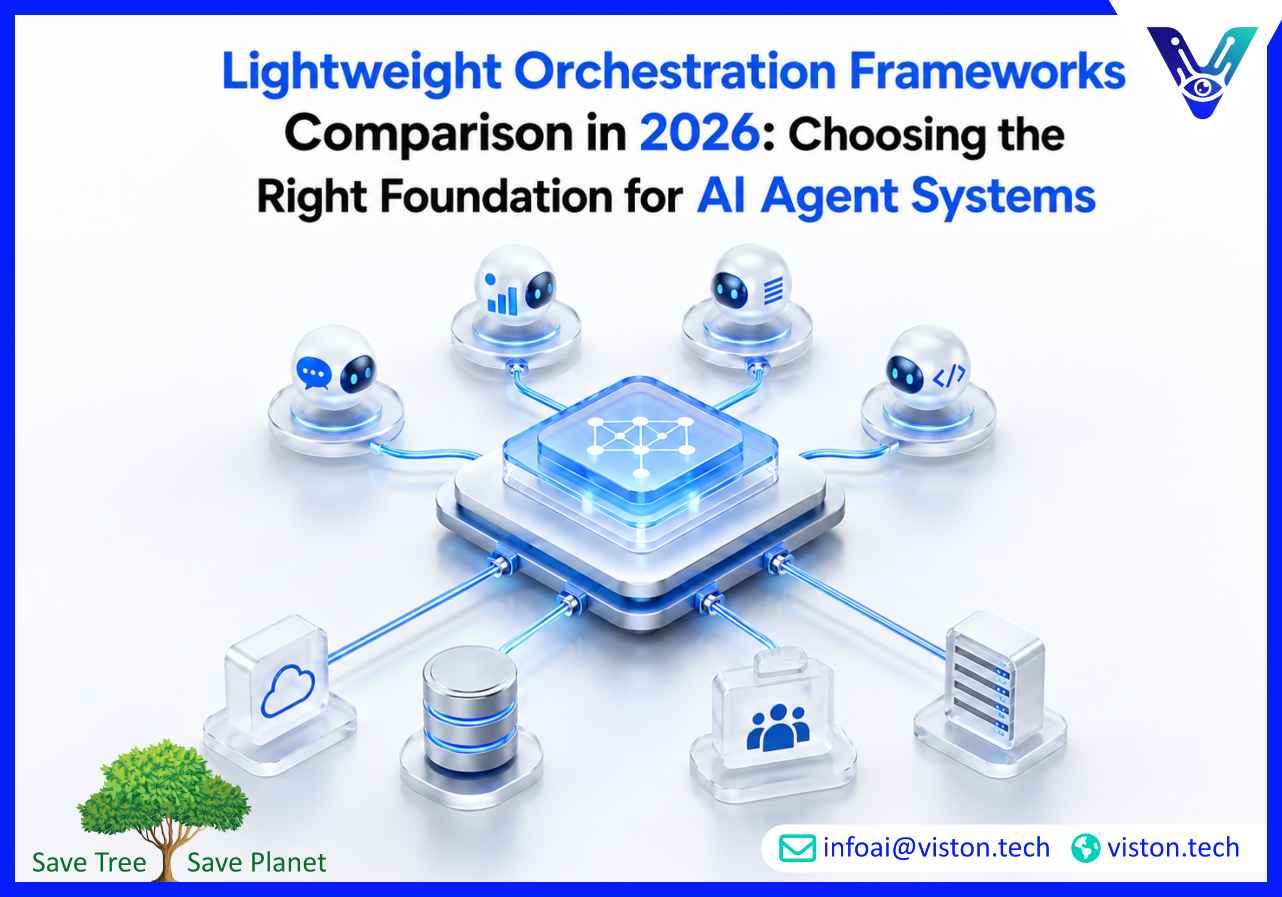
As businesses increasingly adopt AI agents and workflow automation, selecting the right orchestration framework has become a strategic technology decision. Lightweight orchestration frameworks help organizations coordinate AI agents, tools, APIs, data sources, and workflows without the complexity of large enterprise platforms. Understanding their strengths, limitations, and ideal use cases is essential for building scalable AI systems in 2026.
AI adoption has evolved beyond standalone chatbots and simple automation. Organizations now deploy AI agents that retrieve information, interact with business applications, make decisions, and execute multi-step workflows. Orchestration frameworks provide the structure that enables these capabilities.
Lightweight orchestration frameworks are particularly attractive because they reduce implementation overhead while maintaining flexibility. They allow businesses to rapidly prototype, test, and deploy AI workflows without committing to highly complex infrastructure.
For organizations evaluating AI investments, lightweight orchestration frameworks offer several advantages:
These benefits make them especially valuable for organizations exploring AI-driven process automation, multi-agent collaboration, and operational efficiency improvements.
Several frameworks have emerged as popular choices for building agentic workflows and AI-powered business processes. Each addresses orchestration differently, making framework selection highly dependent on business objectives and technical requirements.
LangGraph focuses on stateful workflow orchestration for AI agents. It allows developers to define workflows as graphs, making it easier to manage branching logic, agent collaboration, and long-running processes.
Strengths:
Best suited for: Multi-agent workflows, complex reasoning systems, and AI applications requiring controlled task handoffs.
CrewAI is designed specifically around collaborative AI agents. It emphasizes role-based agent coordination where specialized agents work together to achieve business goals.
Strengths:
Best suited for: Organizations building collaborative AI teams for research, content generation, customer support, and operational workflows.
AutoGen enables conversational interactions between multiple agents and tools. It supports sophisticated communication patterns and autonomous task execution.
Strengths:
Best suited for: Research-focused projects, collaborative problem-solving environments, and advanced agent experimentation.
Flowise provides a visual orchestration environment that allows teams to design AI workflows through graphical interfaces rather than extensive coding.
Strengths:
Best suited for: Businesses seeking faster deployment with minimal engineering effort.
Haystack focuses heavily on retrieval-augmented generation (RAG), search systems, and knowledge-driven AI workflows.
Strengths:
Best suited for: Internal knowledge assistants, enterprise search, and information retrieval workflows.
Comparing frameworks solely on features can lead to poor implementation decisions. Businesses should evaluate orchestration frameworks based on operational requirements and long-term scalability goals.
Simple workflows may require only lightweight orchestration capabilities, while multi-agent systems handling dynamic decision-making often benefit from more sophisticated workflow management.
Most AI workflows depend on connections with CRMs, ERP platforms, databases, APIs, communication tools, and analytics systems. Framework flexibility in supporting integrations should be a major consideration.
Organizations should assess whether anticipated workflow volume, agent count, and transaction frequency can be supported without significant redesign.
Production AI systems require visibility. Workflow monitoring, audit logs, observability, version control, and error handling become increasingly important as deployments expand.
Businesses operating in regulated industries must evaluate access controls, data handling policies, permission management, and compliance support before selecting an orchestration platform.
Many organizations focus too heavily on framework popularity rather than business suitability. This often results in unnecessary complexity or limited scalability.
Common evaluation mistakes include:
Successful AI initiatives typically begin with business objectives and workflow design before technology selection occurs.
Organizations should also recognize that no single orchestration framework is universally superior. The most effective choice depends on workflow requirements, technical resources, risk tolerance, and expected outcomes.
Choosing among lightweight orchestration frameworks is not simply a technical exercise. It requires understanding business processes, AI maturity, operational objectives, governance requirements, and future scalability needs.
Viston AI supports organizations through Strategic AI Consulting Services that help businesses evaluate orchestration options, design AI adoption roadmaps, and identify practical implementation opportunities. Rather than focusing solely on technology selection, the consulting approach aligns orchestration decisions with measurable business outcomes.
For organizations exploring multi-agent systems, workflow automation, AI-powered operations, or enterprise AI initiatives, selecting the right orchestration framework requires balancing flexibility, governance, performance, and maintainability. Strategic guidance can help avoid costly architectural mistakes while accelerating deployment readiness.
Whether evaluating LangGraph, CrewAI, AutoGen, Flowise, Haystack, or emerging orchestration solutions, businesses benefit from a structured assessment process that considers technical capabilities alongside organizational priorities and long-term growth plans.
A lightweight orchestration framework coordinates AI agents, workflows, tools, and data sources while minimizing infrastructure complexity and implementation overhead.
Frameworks such as LangGraph, CrewAI, and AutoGen are commonly considered for multi-agent environments due to their support for agent collaboration and workflow management.
Yes. Many organizations use lightweight frameworks for production workloads when combined with proper governance, monitoring, security controls, and scalable infrastructure.
Key factors include workflow complexity, integration requirements, scalability needs, governance capabilities, security requirements, developer expertise, and long-term maintenance considerations.
Most modern orchestration frameworks support integration with APIs, databases, CRM platforms, ERP systems, communication tools, and cloud services.
Through Strategic AI Consulting Services, Viston AI helps organizations assess business requirements, evaluate orchestration options, design AI roadmaps, and align technology decisions with operational goals.
A thorough lightweight orchestration frameworks comparison reveals that the best framework is not necessarily the one with the most features, but the one that aligns most effectively with business objectives, workflow requirements, and long-term AI strategy. As organizations expand their use of AI agents and automation in 2026, orchestration becomes a critical foundation for reliability, scalability, and governance. Strategic AI Consulting Services can help businesses navigate framework selection, avoid implementation risks, and build AI ecosystems that deliver meaningful operational value. For organizations evaluating agentic architectures, Viston AI provides expertise that supports informed orchestration and AI transformation decisions.
