
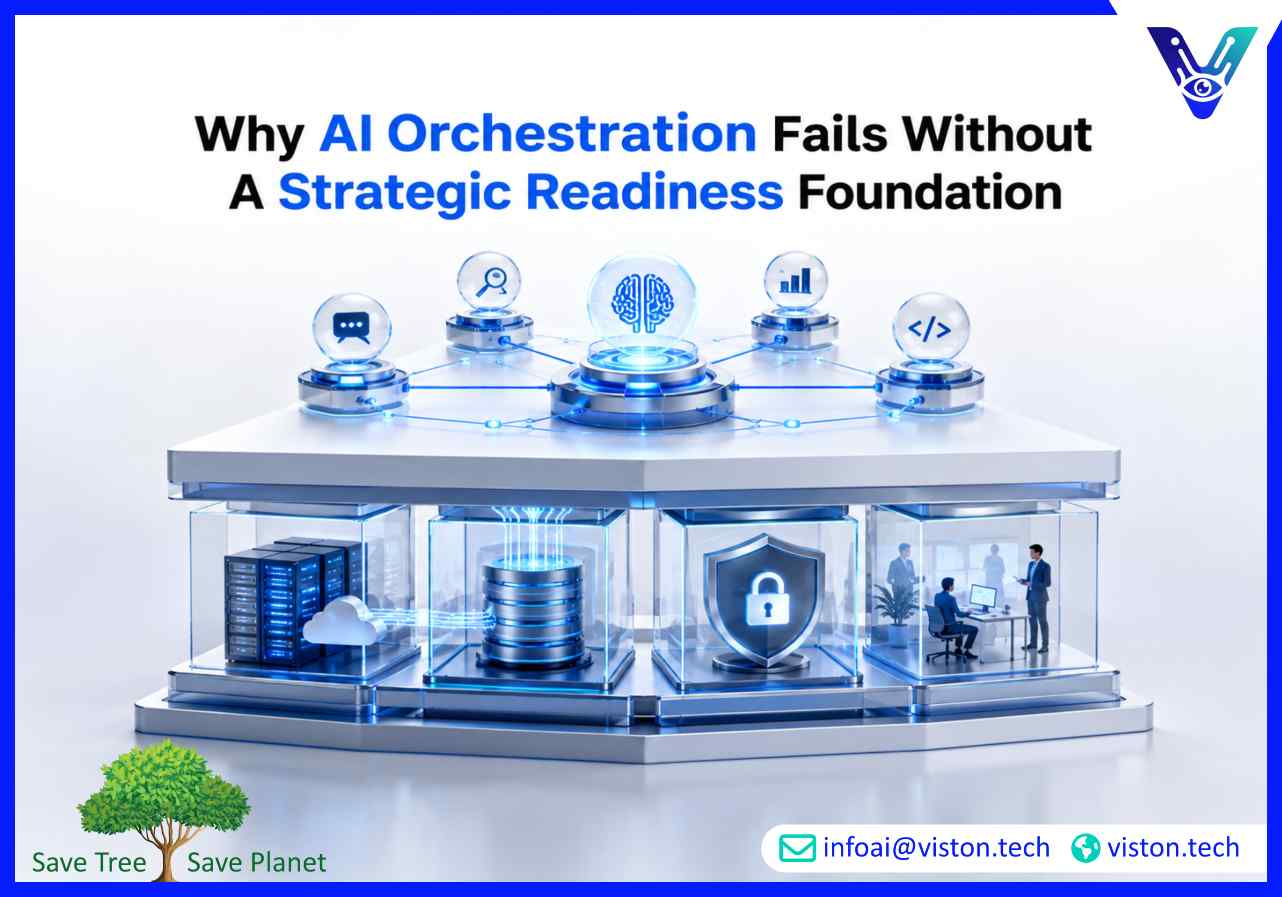
Most enterprises discussing AI orchestration in 2026 are asking the wrong first question. They’re evaluating platforms, comparing integration capabilities, and mapping agent workflows before confirming whether their organization can actually support coordinated AI operations. An AI readiness assessment answers the question that matters before orchestration begins: is your business prepared to govern, secure, and extract value from interconnected AI systems, or are you building coordination layers on an unstable foundation?
AI orchestration refers to the coordinated management of multiple AI models, agents, and automated workflows working together to execute complex business processes. Rather than running isolated AI tools for separate tasks, orchestration platforms connect these systems so they hand off tasks, share context, and operate as a unified intelligence layer across departments.
This sounds compelling in vendor demonstrations. In practice, orchestration multiplies every existing weakness in your data infrastructure, governance framework, and operational processes. When three AI systems coordinate a supply chain decision, any gap in data quality propagates across all three simultaneously. When an orchestrated agent makes an autonomous procurement commitment, unclear accountability structures become immediate legal concerns.
The technical requirements extend beyond selecting an orchestration platform. Organizations need API-ready architectures, standardized data formats, identity and access management protocols that span multiple AI systems, logging and monitoring capable of tracking decisions across agent chains, and rollback mechanisms when coordinated AI actions produce unintended outcomes. None of these prerequisites appear in orchestration vendor pricing sheets, but all of them determine whether orchestration delivers value or creates operational risk.
Two years ago, AI orchestration meant connecting a handful of internal models. Today’s enterprise environments are fundamentally different. Regulatory frameworks including the EU AI Act’s high-risk classification requirements now apply to coordinated AI systems. Insurance carriers increasingly require documented AI governance before covering AI-related operational losses. Enterprise procurement teams have standardized AI capability verification as part of vendor due diligence.
The technical landscape has shifted as well. Multi-agent architectures now operate across cloud, edge, and on-premise environments simultaneously. Foundation models from different providers need to coordinate while maintaining separate compliance postures. Retrieval-augmented generation systems introduce knowledge base dependencies that orchestration layers must manage. Organizations deploying orchestration without understanding these interdependencies create fragile systems that fail at coordination points rather than individual component failures.
Security considerations have grown proportionally. Each orchestrated connection between AI systems represents a potential attack surface. Prompt injection attacks can now cascade through agent workflows. Data leakage risks multiply when multiple models access shared context. Organizations that haven’t mapped these risk vectors before deployment find themselves retrofitting security controls into operational systems, an expensive approach that still leaves gaps.
Organizations that move directly to AI orchestration platform selection without a structured readiness evaluation encounter predictable problems. The most common is integration failure, where existing systems can’t support the API throughput, data standardization, or authentication requirements orchestration demands. The cost of rearchitecting infrastructure mid-implementation routinely exceeds the original orchestration platform investment.
Governance gaps create more serious exposure. When orchestrated AI systems make coordinated decisions affecting customers, employees, or financial operations, organizations need clear accountability structures, audit trails, and human oversight mechanisms. Without these in place before deployment, businesses face regulatory penalties, contract disputes, and reputational damage that can’t be resolved through technical fixes alone.
Data readiness issues compound across orchestrated systems. A single model operating with incomplete data produces contained errors. Orchestrated models sharing poor-quality data amplify inaccuracies across entire business processes. Organizations discover these problems after deployment, when the cost of data remediation and model retraining has multiplied across interconnected systems.
Workforce readiness is frequently overlooked entirely. Orchestration changes how employees interact with AI outputs, requires new supervision skills, and demands understanding of coordinated system behavior rather than individual model performance. Teams unprepared for these changes resist adoption, work around orchestrated workflows, or make decisions based on misunderstood system outputs.
A structured AI readiness assessment examines the foundational capabilities organizations need before AI orchestration can succeed. Unlike technology selection processes that start with platform features, readiness assessment begins with business objectives, existing capabilities, and the gap between current state and orchestration requirements.
The assessment typically evaluates infrastructure readiness, examining whether existing systems can support the API volumes, latency requirements, and integration patterns orchestration demands. This goes beyond basic cloud readiness to examine specific technical prerequisites: can your identity management system handle machine-to-machine authentication at orchestration scale? Do your logging systems capture the granularity needed for multi-agent audit trails? Can your network architecture support the data flows between coordinated AI components?
Data readiness evaluation examines data quality, accessibility, and governance structures. Orchestration systems need consistent data formats, clear provenance tracking, and quality controls that work across data sources. Assessment identifies where data silos, inconsistent formats, or quality issues will create orchestration bottlenecks before they become production problems.
Governance assessment maps existing policies, accountability structures, and compliance requirements against what orchestrated AI operations demand. This includes examining whether current review processes can handle the volume and speed of coordinated AI decisions, whether liability structures address multi-agent decision chains, and whether oversight mechanisms can meaningfully monitor coordinated system behavior.
Workforce and organizational readiness evaluation identifies skill gaps, change management requirements, and cultural readiness for AI-augmented operations that span departmental boundaries. Orchestration often requires collaboration between teams that previously operated independently, creating organizational challenges that technical solutions alone cannot address.
The tangible outputs from a proper readiness assessment directly inform orchestration strategy and reduce implementation risk. Organizations receive a prioritized gap analysis identifying what must be addressed before orchestration deployment, ranked by business impact and remediation complexity. This prevents the common pattern of discovering critical gaps mid-implementation when they’re most expensive to fix.
A realistic implementation roadmap emerges from assessment findings, reflecting actual organizational capabilities rather than vendor implementation timelines. This roadmap accounts for prerequisite infrastructure work, data remediation, governance framework development, and workforce preparation, creating a sequence that builds foundational readiness before orchestration deployment begins.
Risk identification specific to the organization’s operating context helps leadership understand what orchestration means for their particular business. A healthcare organization faces different orchestration risks than a financial services firm or a manufacturing operation. Assessment identifies the specific regulatory, operational, and technical risks that apply, enabling informed decisions about orchestration scope and governance requirements.
Vendor and technology selection criteria become clearer when readiness is understood. Organizations can evaluate orchestration platforms based on their actual requirements rather than generic feature lists, avoiding investments in capabilities they can’t support or don’t need while ensuring critical requirements aren’t overlooked.
Viston AI delivers structured AI readiness assessments designed specifically for organizations evaluating AI orchestration deployment. The assessment methodology examines the technical, data, governance, and organizational dimensions that determine whether orchestration initiatives will succeed or create operational risk.
The approach begins with business objective alignment, ensuring readiness evaluation connects directly to what the organization needs orchestration to achieve. Rather than applying generic maturity models, the assessment measures readiness against specific orchestration use cases the business intends to deploy. This practical framing means recommendations address real deployment requirements, not theoretical best practices.
Technical evaluation covers infrastructure, integration, security, and operational readiness with sufficient depth to identify specific architectural changes needed before orchestration deployment. The assessment examines API strategy, authentication frameworks, monitoring capabilities, network architecture, and disaster recovery planning as they relate to coordinated AI operations. Organizations receive actionable findings they can hand directly to technical teams for remediation planning.
Governance and compliance assessment maps organizational policies and regulatory obligations against orchestration requirements, identifying where existing frameworks need extension or revision. This work addresses accountability structures, audit requirements, human oversight mechanisms, and risk management processes that coordinated AI systems demand. For organizations in regulated industries or operating across multiple jurisdictions, this assessment component often identifies risks that would otherwise surface during audits or incidents.
Workforce readiness evaluation examines the skills, organizational structures, and change management requirements orchestration will demand. Viston AI identifies where teams need development, how roles may need to evolve, and what communication and training approaches will support adoption. This organizational dimension of readiness is frequently the determining factor in whether technically sound orchestration deployments deliver business value.
Organizations engaging Viston AI for readiness assessment receive a prioritized action plan with clear sequencing that respects business constraints. The output connects directly to vendor selection and implementation planning, giving leadership confidence that orchestration investments will build on a foundation capable of supporting them.
Comprehensive AI readiness assessments for orchestration planning typically require four to eight weeks, depending on organizational complexity and scope. The timeline reflects the need to examine infrastructure, data environments, governance frameworks, workforce capabilities, and specific orchestration use cases. Accelerated assessments are possible but necessarily limit depth in certain areas.
Any organization coordinating multiple AI systems across business processes benefits from structured readiness evaluation. While enterprise-scale operations face the most obvious complexity, mid-market organizations often have less mature infrastructure and governance structures, making assessment equally important. The determining factor is the coordination complexity of planned AI deployments, not company size alone.
Organizations can perform internal readiness evaluations, though objectivity and specialized expertise in AI orchestration requirements often prove challenging to maintain. Internal teams may not have experience with the specific failure modes orchestration creates, leading to gaps in risk identification. External assessment brings exposure to cross-industry patterns and emerging requirements internal teams haven’t yet encountered.
Assessment findings that identify readiness gaps provide exactly the information organizations need to avoid failed deployments. The output includes prioritized remediation recommendations, enabling leadership to address critical gaps before committing orchestration resources. This outcome saves organizations from the far more expensive process of fixing problems in production systems.
Readiness assessment directly informs vendor evaluation by clarifying actual technical and operational requirements. Organizations can evaluate platforms against their specific integration needs, governance requirements, and deployment constraints rather than generic feature comparisons. This leads to platform selection decisions based on fit rather than marketing, significantly reducing implementation risk.
Organizations typically treat initial readiness assessment as a one-time activity supporting orchestration planning, though periodic reassessment becomes valuable as infrastructure, regulatory requirements, and organizational capabilities evolve. Organizations expanding orchestration scope into new business areas often reassess readiness for those specific use cases, even when foundational readiness has been established.
AI orchestration represents genuine operational potential for organizations that approach it with clear-eyed understanding of their current capabilities. The platforms, frameworks, and technologies available in 2026 can coordinate AI systems in ways that meaningfully improve business outcomes, provided the foundation supports what orchestration demands. Organizations that skip readiness evaluation and move directly to platform selection risk expensive implementation failures, regulatory exposure, and systems that create operational problems faster than humans can resolve them.
An AI readiness assessment provides the structured evaluation organizations need to make informed orchestration decisions. By examining infrastructure, data, governance, and workforce readiness before platform selection begins, businesses identify what must be addressed, sequence work appropriately, and proceed with orchestration deployment on a foundation capable of supporting coordinated AI operations. Organizations working with Viston AI for readiness assessment gain clarity on their specific prerequisites for orchestration success, enabling confident investment decisions and implementation planning grounded in organizational reality rather than technology optimism.
