
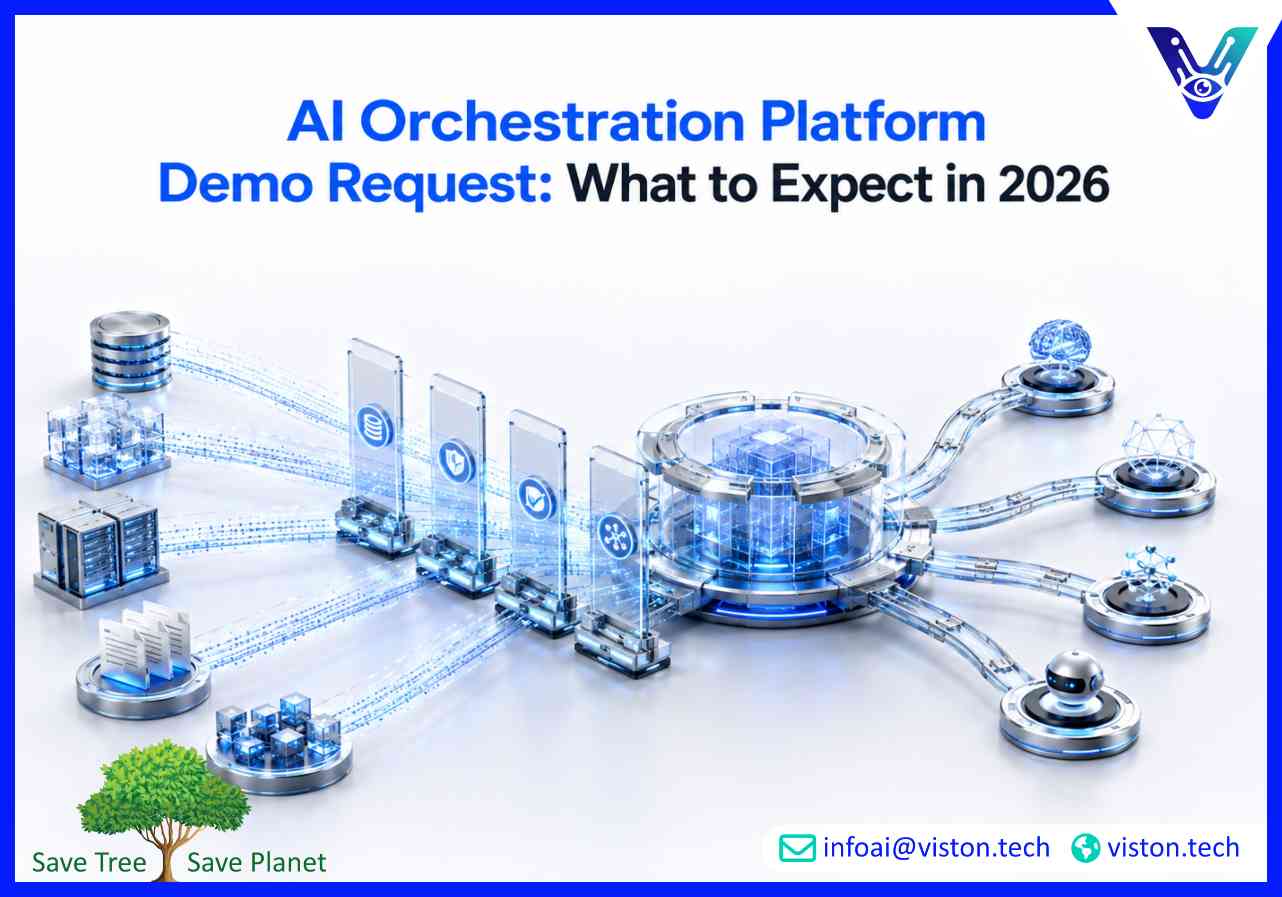
Businesses evaluating an AI orchestration platform demo request need to understand what preparation ensures a valuable evaluation. In 2026, AI orchestration coordinates multiple AI models, agents, and data sources to execute complex workflows—but without proper AI readiness, deployments fail at alarming rates. An AI Readiness Assessment determines whether your organization can successfully implement and scale AI orchestration.
When your team requests a demo of an AI orchestration platform, you’re investigating how to coordinate multiple AI systems working together. AI orchestration platforms manage workflows where different AI models, agents, APIs, and data sources interact to complete business tasks autonomously. This includes routing requests to appropriate models, managing context across conversations, handling errors, and ensuring consistent outputs.
The search intent behind “AI orchestration platform demo request” is commercial investigation. Decision-makers are actively researching vendors and comparing solutions before purchase. They want to see the platform in action, understand implementation requirements, and evaluate whether it solves their specific automation challenges. However, requesting a demo without assessing organizational readiness often leads to wasted evaluation time and failed pilots.
Research shows 95% of generative AI pilots fail to deliver measurable business impact because infrastructure gaps prevent production deployment. Organizations that request demos without first understanding their data architecture, governance maturity, and technical capabilities frequently discover post-evaluation that they cannot implement the solution effectively.
An AI Readiness Assessment evaluates seven critical dimensions that determine orchestration success: business strategy alignment, AI governance and security, data foundations, AI strategy and experience, organizational culture, infrastructure for AI, and model management. Without addressing gaps in these areas, even the most sophisticated orchestration platform will underperform.
Data fragmentation represents the most common barrier. Most enterprises operate with ERP systems, CRM platforms, and operational data stores that barely interoperate. When AI orchestration systems query across fragmented sources, they receive inconsistent information rather than complete context, leading to hallucinations or incorrect decisions. Only 14% of organizations classify their architecture as fully AI-ready, with 86% running production AI on improvised integrations.
Unstructured data presents another critical gap. Approximately 80% of business-critical information exists in unstructured formats—emails, contracts, transcripts, presentations—while only 20% sits in structured databases. AI orchestration systems need access to both structured and unstructured data to make accurate decisions. Organizations accessing both achieve 20-40% accuracy improvements compared to those relying on structured data alone.
Governance and compliance controls often lag behind AI deployment velocity. While organizations deploy AI use cases in weeks, governance approval processes traditionally operate on quarterly cycles. This creates “shadow AI”—unsanctioned systems deployed without proper oversight, creating compliance exposure in regulated industries. Only one in five companies has a mature governance model for autonomous AI agents.
Organizations that request AI orchestration platform demos without first conducting an AI Readiness Assessment face several concrete risks. Failed pilots consume budget and erode stakeholder confidence. A typical pilot evaluation costs $50,000 to $150,000 when including vendor time, internal resources, and infrastructure setup. When pilots fail due to readiness gaps rather than platform capability, this investment yields no return.
Security and compliance exposure becomes critical in regulated industries. Financial institutions face regulatory penalties if AI systems making lending decisions cannot explain their reasoning. Healthcare organizations face liability if AI systems affecting patient care lack proper validation. Deploying orchestration platforms without governance frameworks creates audit trail gaps that regulators penalize heavily.
Technical debt accumulates when organizations implement orchestration on fragmented data architectures. Fixing integration problems post-deployment costs three to five times more than addressing them during the assessment phase. Organizations often discover too late that their current infrastructure cannot support real-time data access required for agentic AI workflows, forcing costly re-architecture.
Operational unpredictability emerges when AI agents make inconsistent decisions due to semantic fragmentation. When three business teams define “customer lifetime value” differently, orchestration systems receive conflicting inputs and make contradictory recommendations. This undermines stakeholder trust and forces manual intervention, negating the automation benefits orchestration promises.
An AI Readiness Assessment identifies specific gaps preventing orchestration success and provides a prioritized remediation roadmap. The assessment analyzes your current environment across five to seven critical dimensions, delivering a comprehensive report with data-driven recommendations you can execute immediately.
The assessment evaluates data accessibility latency—what percentage of enterprise data you can query within 24 hours. Level one organizations have 0-20% accessible; level five organizations achieve 100% real-time accessibility. This metric directly predicts orchestration system performance, as agents need immediate access to current information for autonomous decision-making.
It measures system integration breadth by inventorying every mission-critical data source and determining which connect to your AI infrastructure. Typical mid-market enterprises store customer information in three different systems showing three different addresses. The assessment quantifies this fragmentation and recommends federation principles or integration architectures to present unified data to orchestration systems.
Governance maturity assessment evaluates whether you have formal AI governance committees, policy frameworks addressing data privacy and model risk management, and automated governance checks embedded in development platforms. Organizations embedding governance into technology enable approval in minutes while maintaining rigor, whereas manual review boards create bottlenecks where approval takes weeks.
The assessment also evaluates organizational AI literacy and change readiness. Even perfect technology fails when workforce skills and culture cannot support adoption. The assessment gauges your organization’s ability to successfully implement enterprise AI and provides insight into how to avoid common pitfalls during orchestration deployment.
Viston AI delivers custom, enterprise-focused artificial intelligence solutions that help organizations turn complex data into practical business outcomes, including comprehensive AI strategy and consulting services that prepare businesses for successful AI orchestration implementation. Based in Ahmedabad, India, Viston AI serves global enterprises across finance, healthcare, retail, manufacturing, logistics, and supply chain industries with measurable ROI and faster time-to-value.
For organizations requesting AI orchestration platform demos, Viston AI’s AI Readiness Assessment identifies the seven architectural gaps preventing orchestration from scaling beyond pilots. The assessment evaluates your data foundation, technical infrastructure, governance and compliance frameworks, and organizational capabilities before you invest in platform evaluation. This advisory-led engagement delivers a prioritized roadmap you can act on immediately, ensuring your orchestration deployment succeeds rather than joins the 95% of failed AI pilots.
Viston AI’s approach emphasizes ISO-certified security, data governance, and compliance for enterprise deployments—critical for orchestration platforms managing autonomous workflows across sensitive data. The company’s AI/ML development and integration expertise ensures assessed recommendations are technically feasible and align with your existing technology stack. Their innovation lab and interactive demos accelerate learning, testing, and adoption, helping your team understand orchestration capabilities before vendor selection.
Before requesting a demo, conduct an AI Readiness Assessment to evaluate your data architecture, governance maturity, and technical capabilities. Document your specific use cases, identify which data sources the orchestration system must access, and define success metrics. Organizations that prepare this way extract 3-5x more value from demo evaluations and avoid wasting time on platforms incompatible with their infrastructure.
A comprehensive AI Readiness Assessment typically requires 2-4 weeks for structured, advisory-led engagements. The assessment evaluates strategy, data, governance, and infrastructure readiness, delivering a comprehensive report with prioritized recommendations. Some organizations use quicker 15-question scorecards for initial screening, but detailed assessments providing actionable roadmaps require the full engagement timeline.
The assessment identifies: (1) fragmented data architecture preventing unified context, (2) unstructured data left outside AI processing pipelines, (3) inconsistent business logic creating semantic fragmentation, (4) inadequate data quality governance creating cascading errors, (5) governance and compliance controls lagging behind deployment, (6) missing real-time data access for agentic AI requirements, and (7) missing explainability and grounding preventing trust. Each gap includes measurable criteria and remediation steps.
AI pilots fail primarily due to infrastructure gaps, not model inadequacy. Organizations deploy sophisticated models on fragmented data architectures never designed for AI-scale operations, creating accuracy crises preventing production deployment. MIT research shows 80% of business-critical information exists in unstructured formats inaccessible to AI systems. The 5% succeeding fix data infrastructure first, then build AI on that foundation.
Complete an AI Readiness Assessment before requesting vendor demos. The assessment takes 2-4 weeks and identifies whether your organization can successfully implement orchestration. Requesting demos first often leads to evaluating platforms you cannot implement, wasting $50,000-$150,000 on failed pilots. Assessment-first ensures you evaluate vendors with realistic implementation expectations and know which capabilities matter for your specific gaps.
Viston AI provides vendor-neutral assessment focused on your organizational readiness rather than selling a specific platform. As an AI strategy and consulting specialist delivering enterprise-focused solutions, Viston AI evaluates your environment across all seven critical dimensions and recommends whatever solution fits your needs. Vendor assessments often emphasize their platform’s strengths while downplaying infrastructure requirements your organization must meet first.
Requesting an AI orchestration platform demo without first conducting an AI Readiness Assessment significantly increases your risk of failed implementation. In 2026, 95% of AI pilots fail due to infrastructure gaps—fragmented data, missing governance, and inadequate readiness—not platform capability. An AI Readiness Assessment evaluates your organization’s preparation across seven critical dimensions and delivers a prioritized roadmap for successful orchestration deployment.
The practical takeaway is clear: assess before you evaluate. Invest 2-4 weeks in understanding your data architecture, governance maturity, and technical capabilities before investing in vendor demos. This approach saves budget, prevents failed pilots, and ensures you select orchestration platforms compatible with your infrastructure. Viston AI’s AI Readiness Assessment provides the enterprise-focused expertise needed to prepare your organization for successful AI orchestration implementation.
