
Multi-agent AI systems have moved from research labs into production environments faster than most businesses expected. For organisations evaluating agentic AI workflows, understanding what these systems actually look like in practice — not just in theory — is the difference between making a confident investment decision and stalling indefinitely on proof-of-concept work.
A multi-agent workflow is a system in which multiple AI agents — each assigned a specific role, toolset, or area of responsibility — collaborate to complete a broader task. Rather than a single model attempting to handle everything sequentially, each agent contributes its specialisation to a shared goal, passing outputs, triggering actions, and making decisions based on defined logic and real-time context.
What separates this from standard automation is reasoning. Each agent can interpret goals, evaluate context, and adapt its next action based on what it finds — rather than simply executing a fixed script. When agents work in concert, the system can handle processes that are too complex, too variable, or too data-intensive for conventional tools.
For business leaders considering agentic AI, the practical question is straightforward: what does this look like when it runs inside my organisation?
The following examples illustrate how multi-agent systems operate across common enterprise scenarios. These are not edge cases reserved for technology companies. They represent the kind of operational work that consumes significant time across sales, finance, operations, HR, and customer service teams every day.
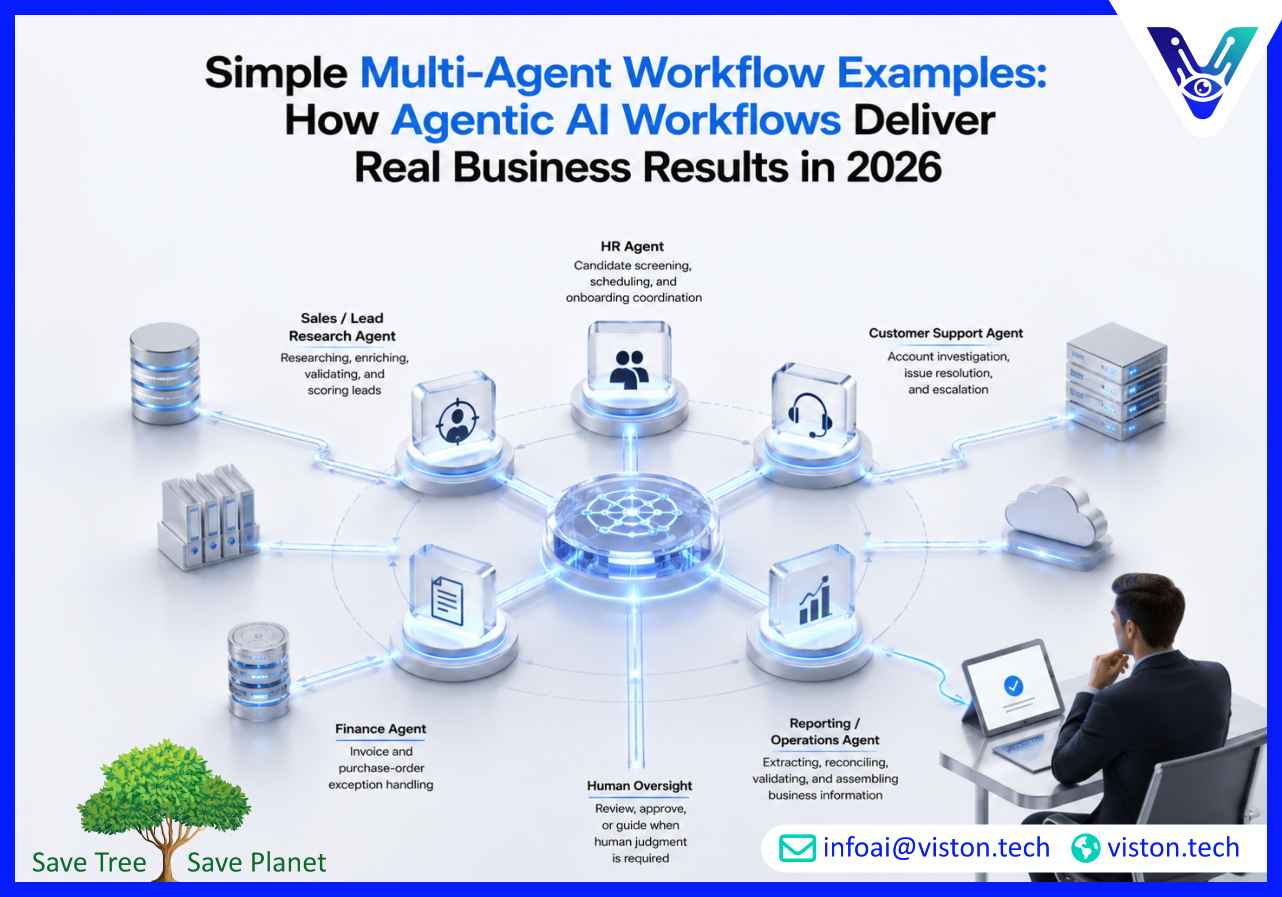
A sales team needs qualified leads enriched with company data, decision-maker contacts, and preliminary scoring before a representative picks up the phone. In a multi-agent workflow, one agent searches and compiles company profiles from public sources. A second agent cross-references those profiles against the CRM to remove duplicates and flag existing relationships. A third agent scores each lead based on fit criteria defined by the sales team and writes a brief summary for the representative. The output lands in the CRM automatically, ready for action — without a human compiling a spreadsheet.
Finance teams routinely encounter invoices that do not match purchase orders. Investigating each one manually pulls analysts away from higher-value work. In an agentic workflow, one agent detects the mismatch and retrieves the relevant PO, contract terms, and payment history. A second agent evaluates whether the variance falls within an approved threshold. If it does, it routes the invoice for standard processing. If it does not, a third agent prepares a summary and escalates to a human reviewer with all relevant context already assembled. Resolution time drops from hours to minutes.
A customer contacts support with an account issue. In a multi-agent system, one agent pulls the account history and identifies the problem type. A second agent checks system status, order records, or subscription data to understand the root cause. A third agent determines the correct resolution — whether that is processing a refund, resetting access, or escalating to a specialist — and either executes it directly or routes it with a full context summary. The customer receives a faster, more consistent response. The support team handles fewer repetitive escalations.
HR teams managing high-volume hiring face significant administrative overhead. A multi-agent workflow can coordinate across an applicant tracking system, HRIS, and email platform simultaneously. One agent screens applications against defined criteria and ranks candidates. A second agent schedules assessments and sends communications. A third monitors documentation completeness as candidates advance, proactively flagging gaps before they delay onboarding. Each handoff between stages happens without manual intervention, allowing HR professionals to focus on interviews and decision-making rather than administration.
Marketing and content teams often run parallel workstreams — research, drafting, review, and publishing — that require coordination across multiple tools and contributors. A multi-agent system can assign a dedicated agent to competitive research, another to drafting based on a defined brief, and a third to formatting and scheduling output for the relevant platform. Human review remains in the loop at defined checkpoints, but the volume of content a team can produce and manage scales significantly without proportional headcount increases.
Preparing management reports requires data from multiple systems — ERP, CRM, forecasting tools, and spreadsheets — that rarely align without manual reconciliation. An agentic workflow assigns agents to extract and normalise data from each source, identify discrepancies, apply the correct calculations, and assemble a structured draft report. A human reviewer receives a near-complete document rather than raw data, reducing preparation time from days to hours.
The examples above share several characteristics that make them effective and worth understanding before committing to implementation.
Role clarity. Each agent has a defined responsibility. Ambiguity in role design leads to duplicated effort, missed steps, or conflicting outputs. Clear agent roles are the foundation of a reliable system.
Tool access. Agents need access to the systems, APIs, and databases relevant to their task. A lead research agent that cannot query a CRM is only partially useful. Integration depth determines how much of a workflow can be genuinely automated rather than partially assisted.
Orchestration logic. Something must manage how agents communicate, in what order they act, and what happens when an agent fails or produces an unexpected result. Frameworks such as LangGraph, CrewAI, and AutoGen each handle orchestration differently, with meaningful implications for how reliably and predictably agents behave in production.
Human-in-the-loop design. Not every decision should be fully automated. Effective multi-agent systems define clearly which actions agents can execute autonomously and which require human review or approval. In regulated industries such as finance and healthcare, this distinction is not optional — it is a compliance requirement.
Observability. Production-grade agentic systems require logging, tracing, and monitoring. When something goes wrong — and in complex systems, something eventually will — teams need to identify exactly which agent failed, at which step, and why. Observability is not an add-on; it is part of responsible deployment.
Organisations that move too quickly from prototype to production often encounter predictable problems. Understanding them in advance prevents costly rework.
The most common mistake is building agents that are too broad. An agent assigned to “handle customer issues” has no clear scope. An agent assigned to “retrieve account history from Salesforce and summarise the last three interactions” has a testable, reliable function.
The second mistake is treating agent memory as implicit. Agents do not retain context between sessions unless memory is explicitly designed and managed. For workflows that span hours, days, or multiple touchpoints, state management is a core engineering concern — not an afterthought.
The third is underestimating integration complexity. Connecting agents to legacy ERP systems, proprietary databases, and internal APIs takes more effort than connecting them to modern SaaS tools with documented APIs. Organisations with older infrastructure need to plan for this carefully before committing to a deployment timeline.
Viston AI specialises in designing and deploying custom agentic AI workflows and multi-agent systems for organisations that need production-grade reliability — not proof-of-concept demos. With over 15 years of experience in data and machine learning engineering and more than 2,860 client deployments across the USA, Europe, the UK, and Australia, Viston brings deep practical expertise to the design decisions that determine whether an agentic system performs consistently in a live business environment.
Viston’s engineers work across leading frameworks including LangGraph, CrewAI, and AutoGen, selecting the right orchestration approach based on the specific control, memory, and integration requirements of each client’s workflow. Their development approach treats integration as a core deliverable — not a final step — ensuring that agents connect reliably to existing CRMs, ERPs, SQL and NoSQL databases, and internal APIs without requiring costly infrastructure overhauls.
For clients in regulated industries, Viston implements guardrail agent layers and human-in-the-loop validation checkpoints, ensuring that AI-driven decisions remain auditable and compliant. Observability is built in from the start using tools such as LangSmith, giving operations teams the tracing and logging visibility they need to manage systems confidently in production.
Businesses exploring multi-agent workflow development — whether starting with a specific use case or planning a broader agentic AI programme — can work with Viston to design, build, and scale systems that deliver measurable operational outcomes.
A single AI agent handles tasks sequentially on its own. A multi-agent workflow distributes responsibilities across several agents, each specialised for a specific role or function. Multi-agent systems are better suited to complex, multi-step processes that involve different data sources, tools, or decision types, because each agent can operate within its area of competence while an orchestration layer coordinates the overall process.
LangGraph, CrewAI, and AutoGen are among the most widely adopted frameworks for building multi-agent systems in 2026. LangGraph is well suited to workflows requiring deterministic control and stateful execution. CrewAI is designed for role-playing agent collaboration. AutoGen supports dynamic agent conversations. The right choice depends on the complexity, compliance requirements, and integration demands of the specific workflow.
Timelines vary significantly based on workflow complexity, the number of systems requiring integration, and the organisation’s existing infrastructure. Simple, well-scoped workflows with modern API-connected tools can reach production in a matter of weeks. Workflows requiring legacy system integration, custom tool development, or compliance validation typically take longer. Scoping carefully before committing to a timeline is essential.
In most business applications, yes — at least at defined points. Fully autonomous execution is appropriate for low-risk, well-tested processes. For decisions involving financial thresholds, customer commitments, regulatory compliance, or data privacy, human-in-the-loop checkpoints are standard practice and often a legal or compliance requirement. Well-designed agentic systems make it straightforward to define exactly where human approval is needed.
Yes. Viston designs agents to be tool-aware, meaning they interact with existing enterprise systems via APIs. This includes CRM platforms such as Salesforce, ERP systems such as SAP, proprietary databases, and internal tools — making it possible to automate workflows without replacing the infrastructure already in place.
Multi-agent workflows deliver measurable value across a wide range of industries, including financial services, retail, healthcare, SaaS, logistics, and professional services. The common factor is the presence of complex, data-intensive, multi-step processes that currently depend on significant human coordination. Any function where information must move between systems, be validated, and trigger downstream actions is a candidate for agentic automation.
The practical examples in this article illustrate a consistent pattern: multi-agent workflows deliver the most value when a process is genuinely complex, spans multiple systems, and currently depends on repetitive human coordination to move forward. Simple tasks do not need multi-agent architecture. But when a business process involves reasoning, integration, decision-making, and handoffs between functions, agentic AI workflows offer a fundamentally more capable approach than conventional automation.
Getting this right in production requires more than selecting a framework. It requires sound role design, integration depth, compliance-aware architecture, and proper observability. Organisations serious about deploying agentic AI workflows that perform reliably — not just in demos — benefit from working with specialists who have delivered these systems at scale. Viston AI brings that depth of experience to every engagement, from initial scoping through to production deployment and ongoing optimisation.
