
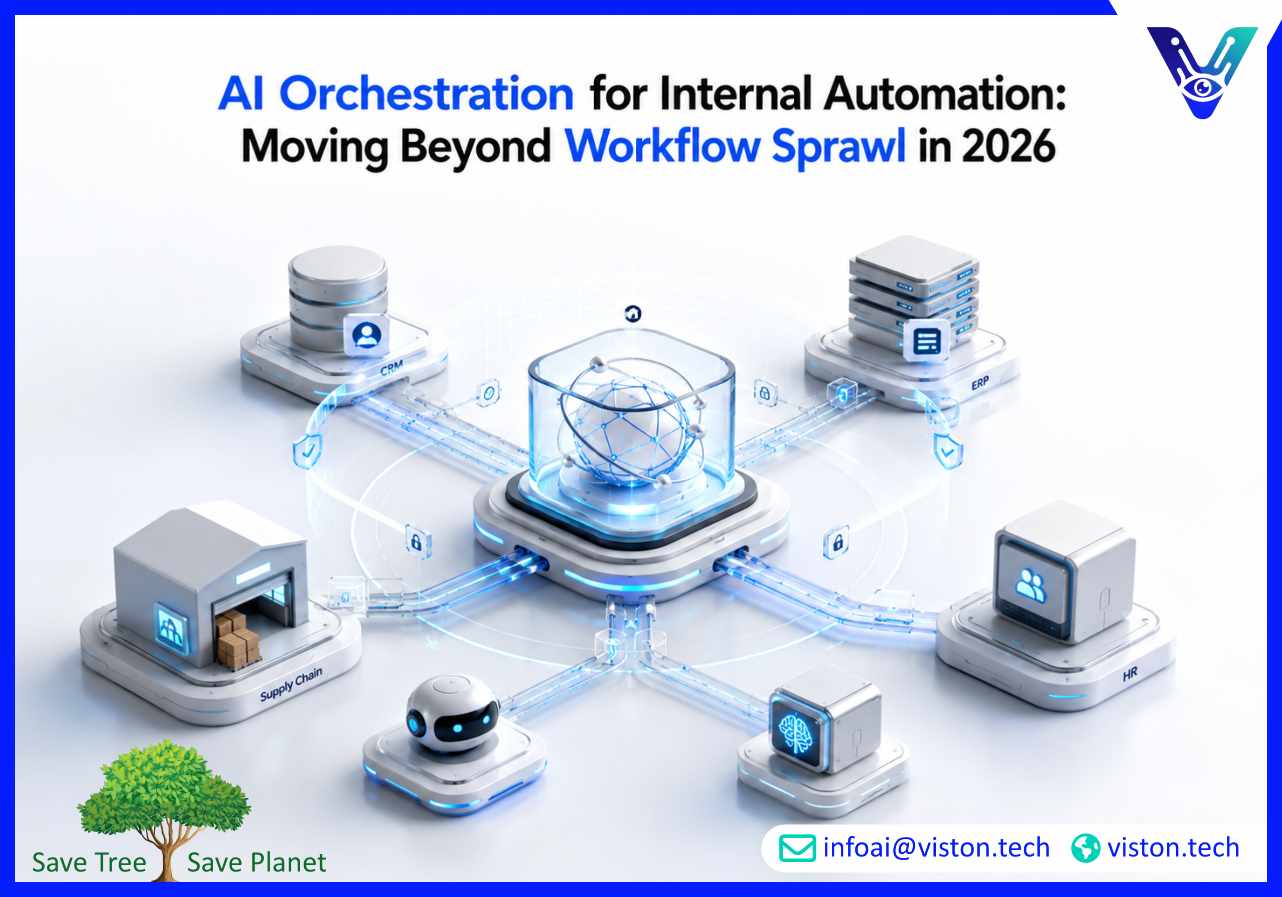
For most organizations, the last three years have been defined by the rapid adoption of automation point solutions. We’ve seen teams deploy robotic process automation (RPA) bots for data entry, separate AI agents for customer queries, and distinct workflow tools for internal approvals. The result is often the opposite of efficiency: data silos, fragmented logic, and a growing “sprawl” of digital tools that do not talk to each other . In 2026, the competitive advantage no longer belongs to the company with the most bots, but to the one that can coordinate them. AI orchestration for internal automation is the operational discipline required to connect these disparate systems into a single, intelligent, and reliable workflow.
Unlike standard automation, which executes a fixed, linear set of commands (if X happens, do Y), AI orchestration involves dynamic coordination. It is the “control plane” that sits above your existing infrastructure—managing how data flows between a CRM, an ERP, and an HR system . It allows AI agents to decompose complex requests, decide which tool or bot is best suited for a subtask, and sequence those actions to achieve a broader business goal without human intervention. As we move through 2026, we are seeing a definitive shift from siloed “copilots” to full-scale orchestration layers that treat AI agents as an operational workforce rather than just experimental tools .
Many business leaders assume that more automation equals higher efficiency. However, without a central orchestration strategy, enterprises often face what industry analysts call “agent sprawl” . This manifests as multiple AI systems working at cross-purposes, duplicate data processing, and significant security gaps. When each department buys its own solution, the end-to-end customer journey—from lead generation to billing—still requires manual handoffs between those systems. This fragmentation is a primary reason why over 40% of agentic AI projects are projected to be canceled by 2027 .
Recent advancements in platform engineering have allowed AI orchestration to move from theory to production reality. Major industry reports highlight that the “control plane” model, similar to what Kubernetes did for containers, is now solving the reliability gap for AI . We are seeing technology standards like the Model Context Protocol (MCP) emerge, allowing agents to interact seamlessly across different applications and vendors . In 2026, the conversation has matured from “Can agents work?” to “Can they be governed, measured, and scaled?” The answer lies in robust orchestration that includes built-in governance, audit trails, and fail-safe mechanisms .
For regulated industries, the fear of “black box” AI has slowed adoption. However, modern AI orchestration solves this through what experts call “governance-as-code” . When orchestration is built correctly, every action taken by an AI agent—every API call, data transformation, and decision—is logged and auditable. It allows businesses to set hard boundaries for AI, such as token budgets or permission scopes, ensuring that autonomous systems operate within safe guardrails . This transforms AI from a liability risk into a compliant, traceable business asset.
For internal operations—such as finance, HR, and supply chain—orchestration bridges the gap between legacy systems and modern AI. Consider the “Order-to-Cash” cycle. Uncoordinated automation might involve one bot checking inventory and another generating invoices. With true orchestration, an AI agent analyzes an incoming sales order, validates credit limits via the ERP, checks inventory levels in the WMS, assigns a delivery slot in the TMS, and only then triggers the invoicing bot. This hierarchical workflow reduces error rates and drastically improves cycle time, turning fragmented tasks into a cohesive business outcome .
Navigating the shift from isolated automation to intelligent orchestration requires a partner who understands both the technical architecture and the operational reality of enterprise systems. Viston AI specializes in designing AI automation and workflow bots that do not operate in a vacuum. Recognizing that 2026 demands interoperability, Viston focuses on deploying agents that fit within a unified orchestration framework. Their approach emphasizes security, governance, and measurable ROI, specifically tailoring AI solutions for complex sectors like finance, healthcare, and supply chain . By prioritizing clean data integration and standardized processes, Viston AI helps businesses move beyond pilot purgatory, ensuring that AI agents are not just intelligent, but also governable and scalable within existing enterprise environments. For organizations struggling with automation fragmentation, Viston provides the strategic expertise to turn disconnected bots into a reliable digital workforce.
What is the difference between AI orchestration and AI automation?
Automation typically refers to a single, specific task performed by a bot (e.g., moving a file). Orchestration refers to the coordination of multiple automated tasks, AI agents, and human decision points across a complete end-to-end business process. Orchestration manages the “flow” of work between different systems .
Is AI orchestration only for large enterprises?
While large enterprises face the most acute pain from automation sprawl, mid-sized businesses benefit from orchestration as well. It allows smaller teams to manage complex workflows without hiring massive operations staff, effectively acting as a force multiplier for existing talent.
How does orchestration handle security and compliance?
Modern orchestration layers act as a “control plane” that enforces security policies across every action. This means that if an AI agent needs to access sensitive data, the orchestration layer ensures that the request meets compliance standards (like SOC2 or GDPR) and logs the interaction for auditing before granting access .
Can AI orchestration integrate with my existing legacy software?
Yes. The primary value proposition of orchestration is that it creates an abstraction layer on top of legacy systems. Instead of replacing your ERP or CRM, orchestration uses APIs or secure connectors to allow modern AI agents to interact with your old systems without disrupting the underlying code .
What is “agentic orchestration”?
Agentic orchestration refers specifically to coordinating autonomous AI agents (which have the ability to reason and make decisions) versus simple scripted bots. It involves managing the handoffs between different specialized agents to solve a complex, multi-step goal that no single agent could solve alone .
How do I measure the ROI of orchestration?
ROI is typically measured by reduction in “swivel chair” labor (manual data transfer between systems), decreased error rates, faster processing times (e.g., invoice-to-pay cycles), and increased capacity for human employees to focus on strategic, high-value work rather than data entry.
As we progress through 2026, the intelligence of your AI matters less than the coordination of your agents. The biggest bottleneck in digital transformation is no longer the capability of large language models, but the ability to connect those models to real-world business systems safely and efficiently. AI orchestration for internal automation is the solution to the growing chaos of automation sprawl. By adopting a unified control plane, businesses can transform disjointed bots into a cohesive operational force. For organizations ready to move beyond pilot programs, partnering with experienced specialists like Viston AI offers a pathway to deploy AI that is not only powerful but also practical, governable, and aligned with strict business outcomes .
