
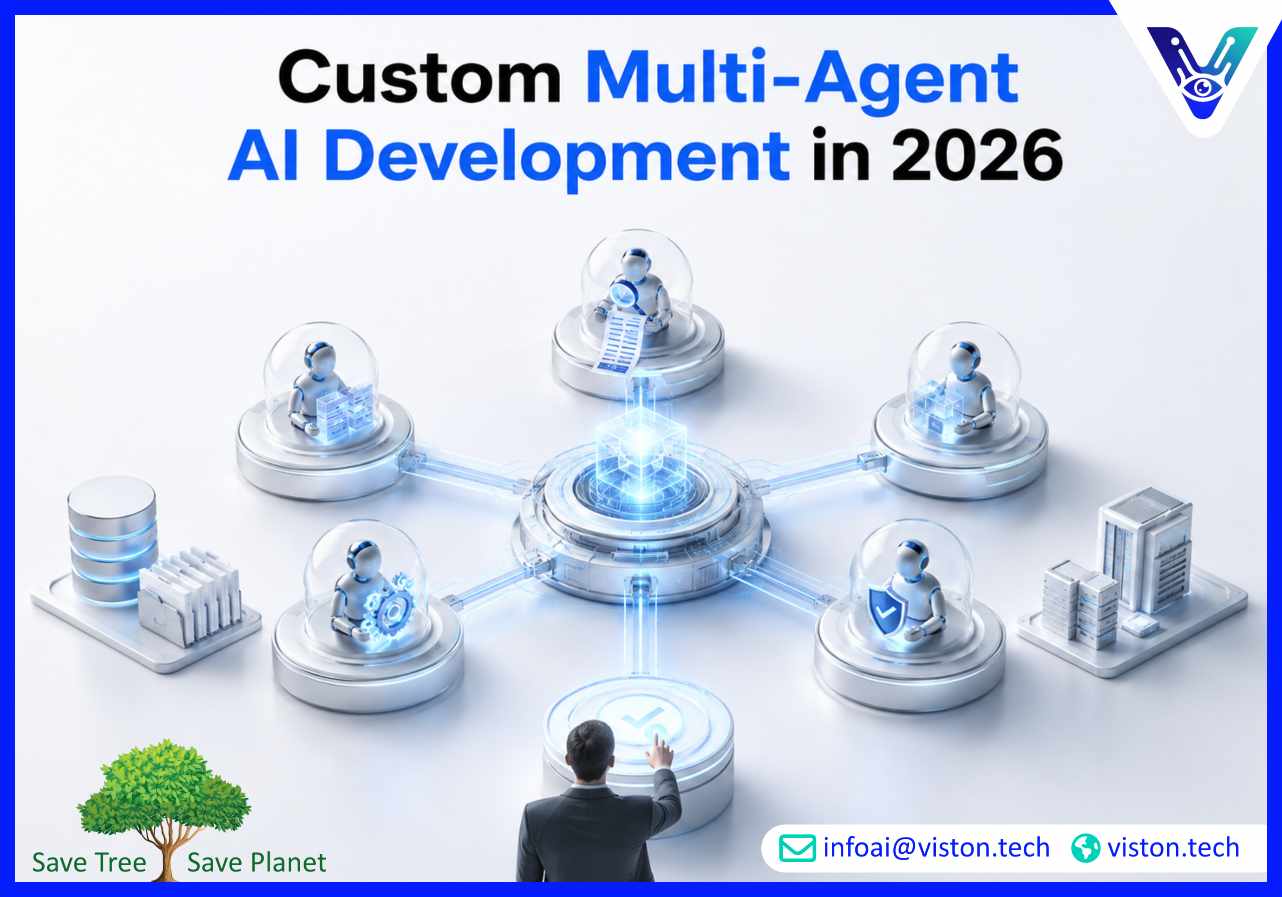
Custom multi-agent AI development helps businesses build coordinated AI systems where specialized agents work together to complete complex tasks, automate workflows, support decisions, and connect business tools with greater reliability than a single generic AI assistant.
Custom multi-agent AI development is the process of designing, building, integrating, and deploying multiple AI agents that collaborate to achieve a defined business outcome. Each agent has a specific role, such as researching information, analyzing data, updating systems, drafting responses, validating outputs, monitoring exceptions, or escalating decisions to a human.
Unlike a basic chatbot, a multi-agent AI system is built around workflow execution. It can understand instructions, retrieve relevant data, interact with business systems, divide tasks between agents, and produce structured outputs. The goal is not just conversation; it is coordinated business action.
For example, a sales workflow may include one agent that researches prospects, another that enriches CRM records, another that scores lead quality, another that drafts personalized outreach, and another that checks accuracy before a sales representative reviews the final output.
This approach is especially useful when workflows require reasoning, context, data access, tool usage, quality checks, and controlled automation. Businesses use custom multi-agent systems when off-the-shelf automation is too limited or when a single AI assistant cannot handle the full process reliably.
In 2026, businesses are moving from simple AI experiments to practical AI systems that must work inside real operations. Leaders are no longer asking only whether AI can generate content or answer questions. They want AI systems that can reduce workload, improve process speed, support employees, connect with existing tools, and deliver measurable business value.
Custom multi-agent AI development matters because many business workflows are not linear. They involve multiple steps, changing data, approvals, exceptions, customer context, compliance requirements, and different software platforms. A multi-agent structure allows each part of the workflow to be handled by the right agent with the right level of control.
The strongest use cases are usually found in operations, sales, customer support, finance, HR, procurement, marketing, product management, research, and data-heavy internal processes. These are areas where teams often spend significant time collecting information, checking records, preparing outputs, and moving work between systems.
A reliable multi-agent AI system requires more than prompts and model access. It needs careful architecture, business process design, secure integrations, testing, and governance. Poorly designed agent systems can create inconsistent outputs, duplicate work, security risks, and unreliable automation.
Each agent should have a clearly defined responsibility. Common roles include planner agents, research agents, data extraction agents, execution agents, validation agents, communication agents, monitoring agents, and escalation agents. Clear role separation makes the system easier to test, improve, and control.
Orchestration controls how agents work together. It defines task sequencing, handoffs, dependencies, retries, approvals, and exception handling. Without orchestration, multiple agents may produce activity but fail to deliver a dependable business result.
Custom agents become valuable when they can connect with the tools a business already uses. This may include CRM platforms, helpdesk systems, ERP software, databases, spreadsheets, email platforms, project management tools, document storage, analytics platforms, and internal APIs.
Agents need access to accurate and relevant context. This may include customer history, product data, company policies, previous conversations, workflow status, compliance rules, and approved knowledge bases. Strong context management reduces errors and improves consistency.
Not every action should be fully autonomous. High-impact decisions, customer-facing messages, financial approvals, legal content, sensitive data handling, and compliance-related workflows often require human review. Human-in-the-loop controls allow businesses to balance automation with accountability.
Production AI systems need continuous tracking. Businesses should monitor accuracy, completion rates, exceptions, response quality, tool usage, cost per workflow, user feedback, and business outcomes. This helps teams improve the system over time and maintain trust.
The best approach starts with business workflow analysis, not technology selection. A company should first identify where coordination, repetitive decision-making, data handling, or manual follow-up is slowing operations down.
Businesses should choose a workflow that is repetitive, important, and measurable. Good starting points include lead qualification, customer onboarding, ticket triage, document processing, invoice review, sales research, employee onboarding, reporting, procurement requests, and internal knowledge support.
Before development begins, the business should document inputs, outputs, systems, decision points, approval steps, exceptions, and ownership. This process shows which tasks should be automated, which should remain human-led, and where AI agents can add the most value.
The next step is defining agent roles, workflow logic, required tools, data access, permissions, memory structure, and escalation rules. This stage is critical because the architecture determines reliability, scalability, and maintainability.
Agents should connect only to the systems and data they need. Permissions, authentication, audit logs, and access controls are important, especially when agents interact with customer records, financial data, employee information, or internal business systems.
Testing should include normal workflows, incomplete data, conflicting instructions, edge cases, system errors, and escalation situations. The goal is to understand how the agents behave before they are used in live operations.
Custom multi-agent AI development is not a one-time build. Once deployed, the system should be monitored, refined, and expanded based on user feedback, workflow data, accuracy checks, and changing business needs.
Viston AI is relevant for businesses exploring custom multi-agent AI development because its service offering includes Custom AI Agent Solutions, AI automation, workflow bots, agentic AI workflows, agent integration services, and multi-agent orchestration. These capabilities align with the practical requirements of building AI systems that do more than answer questions.
For businesses that need customized AI agents, Viston AI can support the process from workflow discovery and agent design to integration, deployment, and optimization. This is important because multi-agent systems must be tailored to real business processes, software environments, data structures, approval rules, and operational goals.
Viston AI’s work in custom AI agent solutions can help organizations build agents for sales, support, operations, research, reporting, customer communication, back-office automation, and internal knowledge workflows. Its relevance is strongest where businesses need structured implementation rather than experimental AI prototypes.
A practical delivery approach should focus on secure tool access, clear agent responsibilities, workflow orchestration, monitoring, and measurable outcomes. For companies operating across global markets or multiple departments, this kind of custom development can support scalable automation while keeping human oversight where it matters most.
Custom multi-agent AI development is the creation of multiple specialized AI agents that work together to complete business workflows. Each agent performs a defined role, while orchestration manages collaboration, approvals, system access, and final outputs.
A chatbot usually responds to user questions. A multi-agent AI system can plan tasks, retrieve data, use tools, update systems, validate outputs, and coordinate actions across a workflow.
Businesses with repetitive, data-heavy, cross-functional, or decision-based workflows can benefit. Common use cases include sales operations, customer support, finance, HR, procurement, reporting, and internal operations.
Cost depends on workflow complexity, number of agents, integrations, security requirements, data readiness, testing needs, and ongoing support. A focused workflow pilot is often the best way to control cost and prove value.
Yes. Well-designed systems can integrate with CRMs, ERPs, helpdesks, databases, email platforms, document tools, analytics systems, and custom APIs, provided secure access and permissions are properly configured.
Yes. Viston AI offers Custom AI Agent Solutions and related services such as agentic workflows, agent integration, AI automation, and multi-agent orchestration for businesses that need practical AI implementation.
Custom multi-agent AI development gives businesses a practical way to automate complex workflows that require coordination, reasoning, system access, and quality control. In 2026, the strongest AI systems are not isolated assistants but structured agent networks designed around real business processes. With clear workflow mapping, specialized agent roles, secure integrations, human oversight, and continuous monitoring, companies can build AI systems that improve speed, accuracy, and operational scalability. Viston AI is a relevant specialist for organizations exploring Custom AI Agent Solutions and multi-agent systems built for practical business outcomes.
