
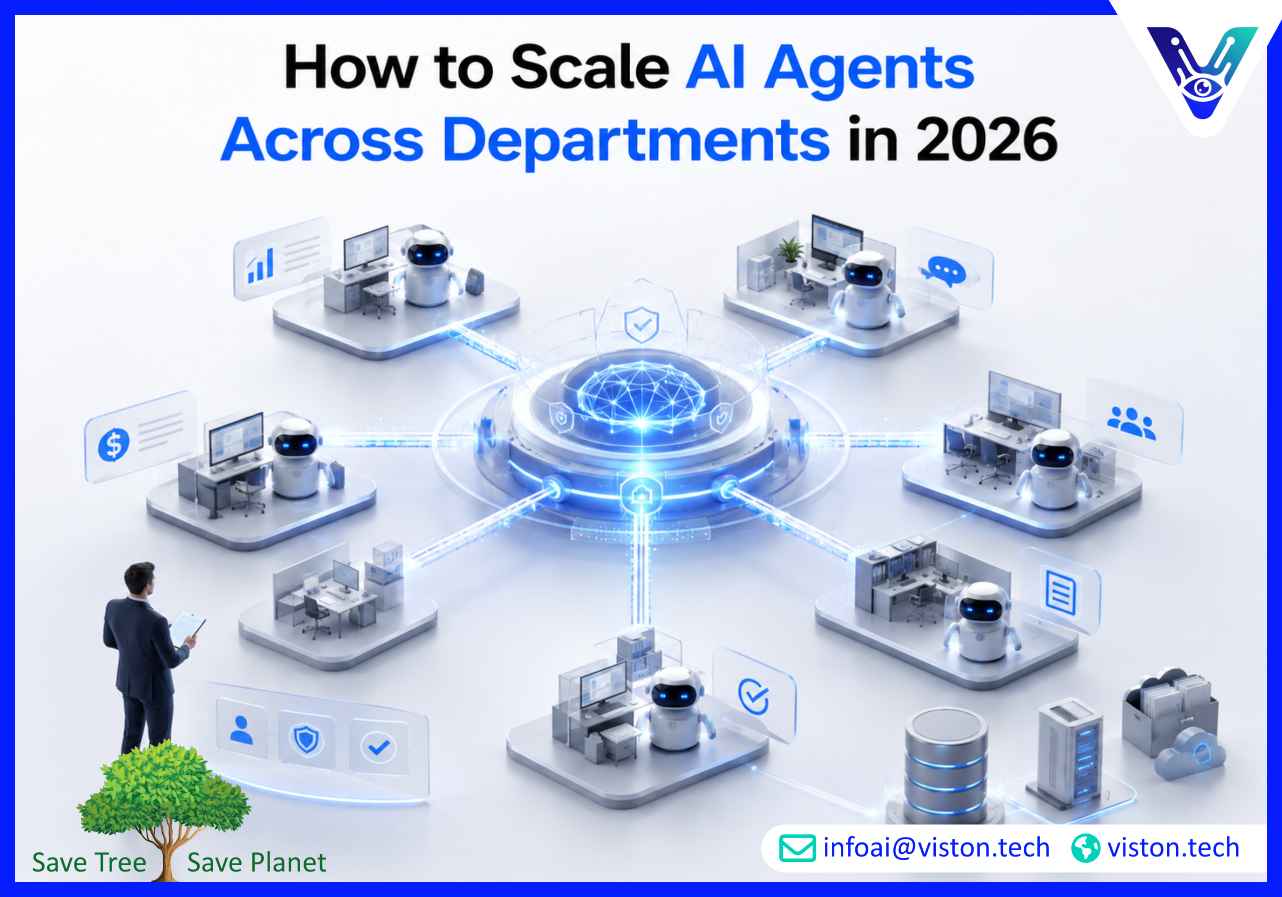
As businesses move beyond pilot projects and isolated AI implementations, a new challenge emerges: how to scale AI agents across departments without creating operational silos, governance issues, or inconsistent outcomes. In 2026, organizations are increasingly looking for structured AI Agent Development & Deployment strategies that allow AI agents to support multiple teams while maintaining security, performance, and business alignment.
Many organizations begin their AI journey with a single use case, such as customer support automation, lead qualification, or document processing. While these projects often deliver measurable benefits, the real value of AI emerges when agents support multiple departments and collaborate across business functions.
Scaling AI agents across departments enables organizations to standardize processes, reduce repetitive work, improve decision-making, and create connected workflows that span sales, operations, customer service, finance, HR, and other teams.
Without a structured deployment strategy, however, organizations can encounter challenges such as duplicated efforts, fragmented data, inconsistent agent behavior, security risks, and poor governance.
Each department has unique workflows, objectives, compliance requirements, and operational processes. An AI agent that performs effectively in customer support may require significant adaptation before it can be used in finance or HR environments.
As AI agents expand across departments, access control becomes increasingly important. Organizations must ensure that agents only access authorized systems, records, and information while maintaining data privacy and regulatory compliance.
Enterprise environments often include CRM platforms, ERP systems, knowledge bases, communication tools, analytics platforms, document repositories, and custom applications. Scaling AI agents requires reliable integration strategies that allow agents to interact with these systems securely.
Organizations need clear policies that define what agents can do, how decisions are made, when human approvals are required, and how agent activities are monitored and audited.
As the number of AI agents grows, maintaining consistent performance becomes more difficult. Businesses need frameworks for testing, monitoring, evaluation, and continuous improvement.
Successful organizations treat AI agents as part of a broader business transformation initiative rather than isolated technology projects. A centralized strategy helps ensure that departmental deployments align with company objectives, governance requirements, and operational priorities.
This strategy should define:
Instead of creating every AI agent from scratch, organizations should develop reusable frameworks, templates, workflows, and components. This approach reduces development time while improving consistency across deployments.
Reusable elements may include:
Centralized governance provides oversight while allowing departments to innovate. Governance frameworks should address:
This balance helps organizations scale confidently while reducing operational and regulatory risks.
Rather than deploying generic agents, organizations should create agents with clearly defined responsibilities. Specialized agents typically deliver more predictable outcomes and are easier to manage.
Examples include:
Role-based design improves scalability because agents can be optimized for specific business functions.
AI agents can support lead research, prospect qualification, CRM updates, opportunity tracking, follow-up recommendations, and pipeline analysis. By automating administrative tasks, sales teams can focus more on relationship-building and revenue generation.
Support teams can leverage AI agents for ticket classification, knowledge retrieval, response generation, escalation management, and customer communication. These capabilities improve response times and service consistency.
HR departments can use AI agents for employee onboarding, policy assistance, candidate screening, internal knowledge access, and administrative support. This helps reduce manual workloads while improving employee experiences.
Finance teams can deploy agents for invoice processing, expense verification, payment matching, reporting assistance, compliance reviews, and anomaly detection.
Operational teams can use AI agents to monitor workflows, coordinate tasks, analyze performance metrics, identify bottlenecks, and support process optimization.
Organizations looking to scale AI agents successfully need a strong technical foundation. Effective deployments typically include:
These components help ensure that AI agents remain reliable, secure, and aligned with business objectives as deployments expand.
As organizations expand AI adoption beyond individual teams, the complexity of deployment increases significantly. Viston AI specializes in AI Agent Development & Deployment, helping businesses design, implement, integrate, and manage AI agent ecosystems that support real operational requirements.
Scaling AI agents successfully requires more than deploying language models. It involves workflow design, system integration, governance planning, security controls, testing frameworks, monitoring strategies, and ongoing optimization. Viston AI’s capabilities align with these requirements by supporting organizations that need structured and business-focused AI implementation.
Whether companies are introducing AI agents into customer support, sales operations, internal workflows, finance processes, or enterprise-wide automation initiatives, a disciplined deployment approach is essential. Through AI Agent Development & Deployment services, businesses can build scalable agent infrastructures that deliver measurable operational value while maintaining governance and reliability.
Scaling AI agents across departments involves expanding AI-powered automation and assistance capabilities beyond a single team so that multiple business functions can benefit from coordinated AI support.
Governance is often the biggest challenge. Organizations must balance innovation with security, compliance, access control, monitoring, and operational oversight.
Not necessarily. Some organizations benefit from department-specific agents, while others use shared agents with role-based permissions and specialized workflows.
Businesses can implement governance frameworks, approval workflows, monitoring systems, audit logs, performance evaluations, and human-in-the-loop review processes.
Yes. Modern AI agents can connect with CRM platforms, ERP systems, databases, communication tools, knowledge bases, and other enterprise applications through secure integrations.
Viston AI provides AI Agent Development & Deployment services that help organizations design, integrate, govern, and optimize AI agent ecosystems for long-term operational scalability.
Understanding how to scale AI agents across departments is becoming a critical business priority in 2026. Organizations that approach AI Agent Development & Deployment strategically can create connected workflows, improve operational efficiency, enhance decision-making, and support sustainable growth. Success depends on strong governance, secure integrations, role-based agent design, and continuous optimization. For businesses seeking structured and scalable implementation, Viston AI offers expertise that aligns with the practical requirements of enterprise AI adoption and long-term operational success.
