
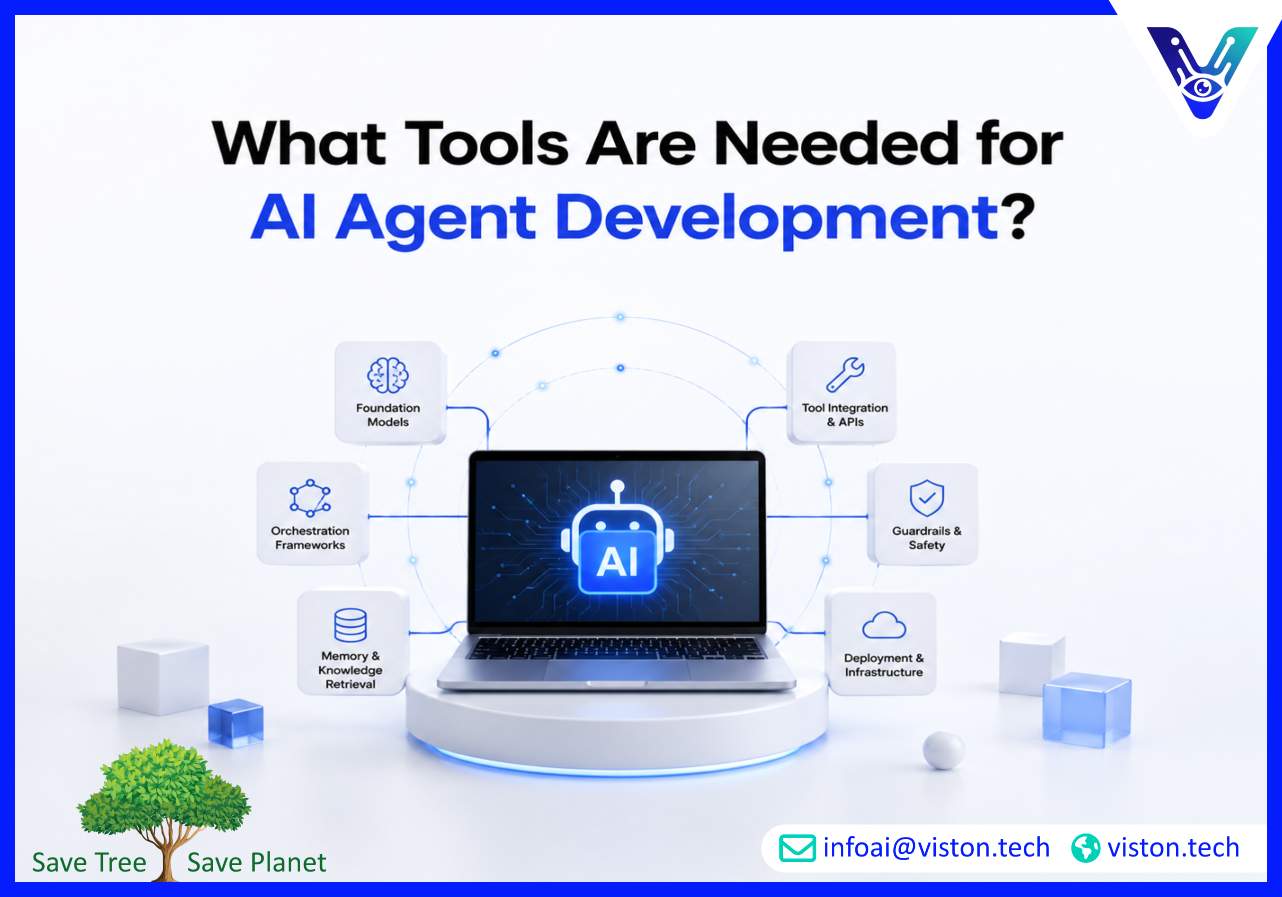
Businesses exploring autonomous AI systems quickly discover that the question isn’t about finding a single tool. AI agent development requires an integrated stack of technologies working together to create systems that reason, act, and learn independently. The tools you select shape everything from how the agent understands instructions to how reliably it executes complex workflows in production.
An AI agent differs fundamentally from a chatbot or traditional automation script. Agents maintain context across multi-step tasks, make decisions under uncertainty, use external tools autonomously, and operate with meaningful independence. This requires a deliberate combination of foundation models, orchestration frameworks, memory systems, tool interfaces, and deployment infrastructure. Each layer solves a distinct engineering challenge, and the quality of each choice compounds through the entire system.
Organizations that treat tool selection as a strategic decision rather than a technical afterthought build agents that deliver measurable business outcomes. Those that stitch together components without architectural clarity often end up with systems that work in demos but fail under real-world conditions.
Every AI agent depends on one or more large language models to interpret instructions, generate plans, and produce outputs. The choice of model directly affects reasoning quality, response speed, cost per task, and the complexity of tasks the agent can handle reliably.
The market in 2026 offers several paths. Organizations can access models through API providers including OpenAI, Anthropic, Google DeepMind, and Mistral AI, or deploy open-weight models like Llama and DeepSeek on their own infrastructure. Each approach involves different trade-offs between latency, data residency requirements, long-term cost, and control over model behavior.
Multi-model architectures have become standard practice for production agents. A capable frontier model handles complex reasoning and planning, while smaller specialized models manage classification, extraction, or routing tasks at lower cost and higher speed. This tiered approach aligns model capability with task complexity and directly improves unit economics for high-volume agent deployments.
Businesses should evaluate models based on function-calling reliability, instruction-following precision, and consistency across repeated runs. Model benchmarks provide directional guidance, but the only meaningful evaluation comes from testing models against your specific agent workflows with representative data.
Orchestration frameworks provide the structural logic that transforms a model’s raw output into reliable agent behavior. They manage conversation state, execute tool calls, implement guardrails, handle errors gracefully, and coordinate the flow between planning and action.
LangGraph, CrewAI, and Microsoft’s AutoGen represent the current generation of production-oriented frameworks. Each takes a different architectural approach. LangGraph uses explicit state graphs that make agent logic auditable and testable. CrewAI organizes agents into role-based teams with defined collaboration patterns. AutoGen emphasizes multi-agent conversations where specialized agents negotiate and verify each other’s outputs.
The framework you choose should align with how your organization tests, debugs, and maintains software. Teams with strong software engineering practices often prefer graph-based frameworks that produce deterministic, version-controllable agent definitions. Teams that prioritize rapid prototyping might start with higher-level abstractions while planning for a transition path to more controllable architectures as agents move toward production.
What matters most is that the framework gives you visibility into why an agent made a particular decision. Black-box orchestration becomes a liability the moment an agent handles customer-facing tasks or regulated processes.
Stateless agents that forget everything between interactions have limited business value. Effective agents need memory architectures that span short-term conversation context, long-term user preferences, and organizational knowledge.
Vector databases including Pinecone, Weaviate, Qdrant, and pgvector have become essential infrastructure for agent memory. They enable semantic retrieval that goes beyond keyword matching, allowing agents to find relevant information based on meaning rather than exact text matches. This capability directly improves how agents handle nuanced queries and maintain context across complex workflows.
The memory stack typically involves three layers. Short-term memory holds the active conversation and immediate task state, usually managed within the orchestration framework. Long-term memory stores user preferences, past interactions, and learned patterns in vector stores and structured databases. Knowledge retrieval connects agents to organizational documents, policies, and procedures through retrieval-augmented generation pipelines.
The engineering challenge lies in retrieval quality. Poor chunking strategies, inadequate metadata filtering, and weak re-ranking cause agents to retrieve irrelevant context that degrades output quality. Organizations that invest properly in their retrieval infrastructure consistently outperform those that treat RAG as a plug-and-play component.
An agent that cannot interact with business systems remains a conversation piece. The tools layer connects agent reasoning to real-world actions: querying databases, updating CRM records, sending communications, triggering workflows, and accessing specialized computation.
Function calling has become the standard interface between agents and tools. Models trained for function calling output structured JSON that orchestration frameworks parse and execute. The reliability of this mechanism depends heavily on clear function definitions, comprehensive descriptions of when each function should be used, and schemas that explicitly define required parameters and expected outputs.
Tool design principles matter more than most teams initially assume. Functions should have narrow, well-defined responsibilities. Descriptions should include not just what a function does but when it should be chosen over alternatives. Error responses need to be informative enough for the agent to self-correct. Authentication and authorization must be handled at the infrastructure layer so agents operate within clearly defined permission boundaries.
API gateways and integration platforms serve as the connective tissue. They handle authentication, rate limiting, retry logic, and monitoring so agent developers can focus on logic rather than infrastructure plumbing. Tools like LangChain’s Tool abstraction or direct API specifications in OpenAPI format provide structured ways to expose business capabilities to agents.
Testing an AI agent requires fundamentally different approaches than testing deterministic software. The same input can produce different outputs across runs. Failures are often subtle: an agent that almost always works correctly can still produce damaging errors in edge cases that deterministic systems would handle predictably.
Evaluation frameworks including LangSmith, Braintrust, and RAGAS provide structured approaches to measuring agent performance. They enable teams to run agents against curated test datasets, score outputs against defined criteria, and track performance changes as models and prompts evolve. Effective evaluation combines automated metrics for response accuracy and tool selection with human review for outputs that require qualitative judgment.
Observability platforms like Arize, Langfuse, and Weights & Biases give teams visibility into agent behavior in production. They trace each step of agent execution, log tool calls and their results, track latency and cost, and surface patterns that indicate degrading performance. Without this visibility, debugging production agents becomes guesswork.
Organizations serious about agent reliability implement continuous evaluation pipelines. Every change to prompts, models, or tool configurations triggers automated test suites before deployment. This engineering discipline separates production-grade agent deployments from experimental projects that never reach meaningful scale.
Viston AI provides end-to-end AI agent development and deployment services that help businesses navigate the full technology stack without needing to build internal AI engineering teams from scratch. The company works across the complete toolchain, from model selection and orchestration architecture through memory design, tool integration, and production monitoring.
What distinguishes the Viston AI approach is an emphasis on pragmatic, business-outcome-driven tool selection rather than technology adoption for its own sake. Every component in an agent stack must justify itself through reliability, cost-effectiveness, and maintainability in production. The company designs agent architectures that integrate with existing business systems and data infrastructure, reducing the friction that often delays deployment.
For organizations concerned about vendor lock-in, data residency requirements, or long-term control over their AI systems, Viston AI designs modular architectures that keep components replaceable. Model providers, vector databases, and orchestration frameworks can evolve without requiring complete system rebuilds. This architectural discipline directly supports the scalability and compliance requirements that enterprise deployments demand.
Viston AI’s engineering methodology emphasizes the evaluation and observability practices that separate reliable agents from unreliable ones. Every agent deployment includes comprehensive testing frameworks, monitoring dashboards, and defined operational procedures. Businesses receive not just a working agent but the infrastructure to maintain and improve it over time as models advance and requirements evolve.
A production agent requires at minimum a foundation model with reliable function-calling capability, an orchestration framework to manage state and tool execution, a vector database or knowledge retrieval system for contextual memory, secure API integrations to business systems, and observability tooling to monitor behavior in production. Attempting production deployment with fewer components typically results in agents that work in demonstrations but fail under real-world conditions.
Orchestration frameworks and managed services have significantly reduced the barrier to prototyping agents, but production deployment still requires expertise in software architecture, API design, testing methodology, and operational monitoring. The challenge shifts from model training to system engineering. Organizations without internal AI engineering capabilities typically accelerate their timelines by working with specialist development partners rather than attempting to build production systems through trial and error.
Model selection should be driven by testing against your specific agent workflows with representative data, not by benchmark scores alone. Key evaluation criteria include function-calling accuracy, consistency across repeated runs, instruction-following reliability for complex multi-step tasks, and cost per successful task completion rather than per token. Most production deployments benefit from a multi-model architecture that matches model capability to task complexity.
Vector databases enable agents to retrieve information based on semantic meaning rather than keyword matching. They store embeddings of documents, conversation history, and organizational knowledge so agents can find contextually relevant information during task execution. The quality of retrieval directly affects agent performance, making chunking strategy, metadata structure, and re-ranking methodology as important as the database technology itself.
Costs vary substantially based on agent complexity, task volume, and latency requirements. Model inference typically represents the largest variable cost, with frontier models costing more per task than smaller specialized models. Vector databases, orchestration infrastructure, and observability platforms add fixed operational costs. Organizations should model total cost of ownership based on projected task volumes rather than evaluating components in isolation.
The most frequent causes of production failure include inadequate testing against edge cases, tool descriptions that confuse the agent about which function to call, poor error handling that cascades through multi-step workflows, context windows that overflow during complex tasks, and changes in model behavior after provider updates. Structured evaluation pipelines and comprehensive observability catch these issues before they affect business operations.
The tools needed for AI agent development form an integrated system where each component’s quality affects the whole. Businesses that approach tool selection strategically, with clear evaluation criteria and production requirements in mind, build agents that deliver reliable automation at scale. Those that treat tool choices as purely technical decisions often discover the business cost of architectural shortcuts only after deployment.
The technology landscape will continue to evolve rapidly through 2026 and beyond. What remains constant is the engineering discipline required to build systems that businesses can depend on. Organizations that invest properly in evaluation infrastructure, modular architectures, and operational practices position themselves to benefit from model advances without rebuilding from scratch. Viston AI brings this disciplined approach to AI agent development and deployment, helping businesses navigate the tooling landscape with a focus on production reliability and measurable business outcomes.
