
Deploying a single AI agent to handle a discrete task is now table stakes. The real competitive advantage for enterprises in 2026 lies in making dozens, sometimes hundreds, of specialized agents work together toward complex business objectives. This is the domain of enterprise AI agent orchestration, and getting it right separates operational leaders from those running costly, disconnected experiments.
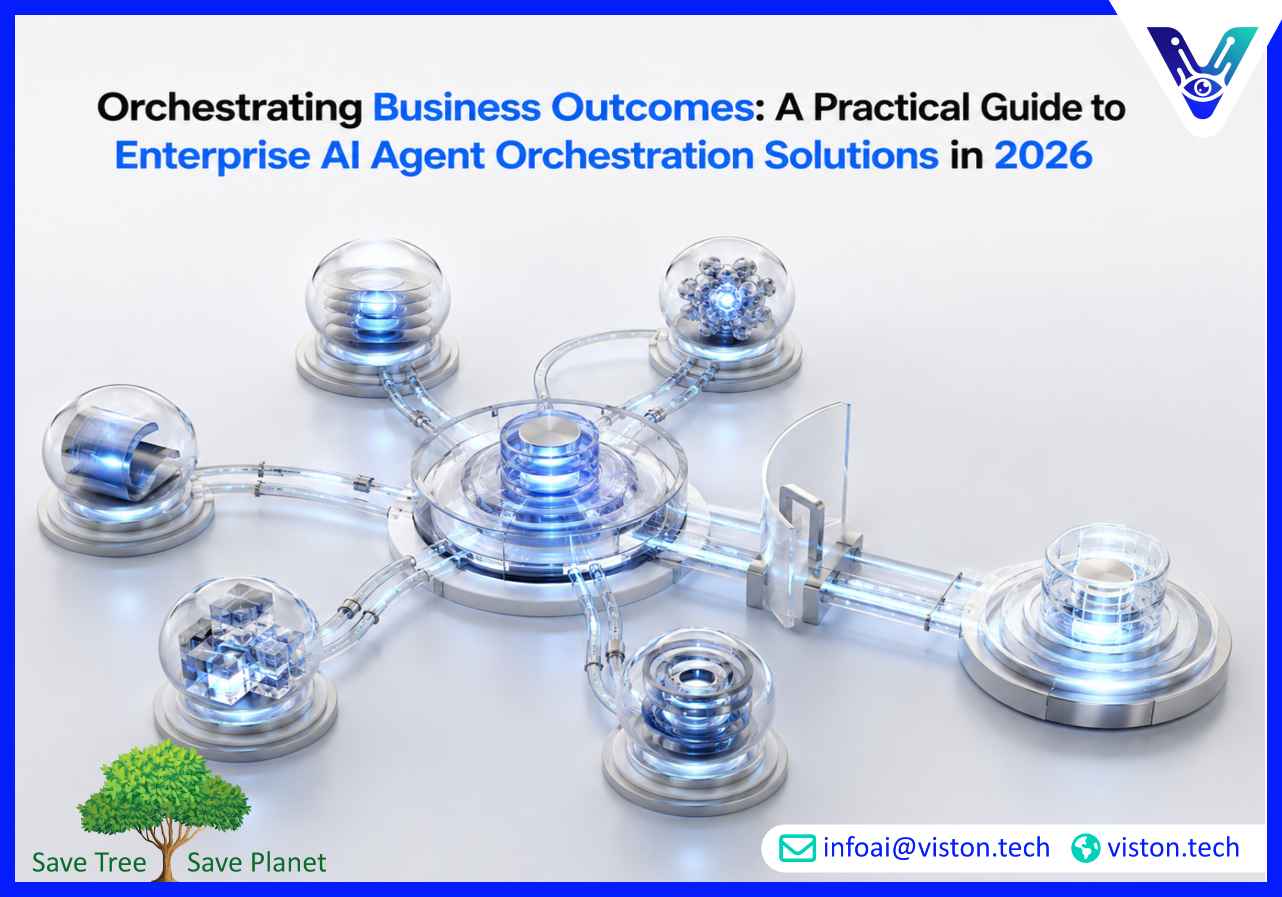
Enterprise AI agent orchestration is the systematic coordination of multiple autonomous or semi-autonomous AI agents to execute interconnected business processes. Rather than operating in isolation, each agent handles a specific function: one might triage incoming customer requests, another retrieves policy data, a third drafts a response, and a fourth logs the interaction into a compliance system. The orchestration layer governs the sequence, handoffs, decision logic, and fallback protocols between them.
This is not simply API chaining or a static workflow triggered by rules. Orchestration involves dynamic routing, context propagation, and the ability to decide which agent, or combination of agents, is best suited for a given subtask based on intent, confidence thresholds, and business priorities. The system maintains state across multi-turn, multi-agent interactions, ensuring that information handed from one agent to the next remains coherent and actionable.
For procurement teams and operations leaders, the practical distinction matters. An orchestrated multi-agent system can handle a supplier onboarding process that requires document validation, risk scoring, ERP data entry, and compliance check generation without human intervention across each step. A siloed agent can only handle one piece of that puzzle.
Businesses in 2026 face a convergence of pressures: rising operational costs, expectations for instant customer and partner responsiveness, and the complexity of legacy systems that still run critical functions. Single-purpose AI assistants cannot address the breadth of these demands. Enterprise AI agent orchestration solutions have become the architecture that ties specialized capabilities together under a unified business logic.
Three shifts make this urgent for decision-makers this year. First, the cost of inference has dropped substantially, making it economically viable to run multiple specialized models simultaneously rather than relying on one large, expensive generalist model for everything. Second, enterprises have moved past proof-of-concept fatigue. The question is no longer “Can AI do this task?” but “Can it run the whole process reliably at scale?” Third, regulatory expectations around AI-driven decisions, particularly in financial services, healthcare, and supply chain management, now demand explainable, auditable paths of action. Orchestration frameworks provide the governance layer that traces exactly which agent made which decision and why.
Organizations that treat orchestration as an afterthought find themselves with agent sprawl: overlapping capabilities, inconsistent outputs, and integration debt that undermines the very efficiency gains they sought. A deliberate approach to multi-agent orchestration avoids this trap by designing the system from the point of business outcome backward, mapping which agents are needed, how they interact, and what governance applies at each decision point.
Process fragmentation remains the most expensive hidden cost in large organizations. A customer changing their billing address might trigger updates across CRM, billing, logistics, and compliance systems. When these systems do not communicate cleanly, human operators fill the gaps, re-entering data, checking for errors, and resolving mismatches. Enterprise AI agent orchestration solutions solve this not by replacing every system but by placing an intelligent coordination layer on top that manages the flow of work between them.
Context loss across handoffs is another persistent problem. In a traditional workflow, when a task moves from triage to investigation to resolution, critical details get lost in ticket notes or email threads. With orchestrated agents, the context travels as structured, machine-readable state. The agent handling compliance validation inherits everything the data retrieval agent already confirmed, along with the confidence scores and source references. This eliminates rework and reduces the error rate that comes from manual information passing.
Scalability without linear headcount growth is the business case most operations leaders present to the CFO. A well-designed multi-agent orchestration system allows the same process to handle ten times the volume without ten times the human team. The orchestration layer queues tasks, prioritizes by business rules, escalates to human operators only when agents reach a defined confidence boundary, and logs everything for continuous improvement analysis. It turns AI from a point tool into an operating system for business functions.
Not every multi-agent orchestration approach is built for the demands of enterprise environments. When evaluating solutions, decision-makers should look beyond demos and examine the architectural characteristics that determine long-term success.
Deterministic governance alongside agentic flexibility is non-negotiable. The system must allow business leaders to define hard rules that agents cannot violate—compliance checks that must happen, approval thresholds that require human sign-off, data access boundaries that cannot be crossed—while still giving agents the autonomy to reason about the best path within those constraints. Pure autonomous agent approaches without this guardrail layer introduce risk that regulated industries cannot accept.
Integration depth matters more than model choice. The most capable orchestration layer is useless if it cannot reliably connect to the ERP, CRM, document management, and communication platforms the business actually runs on. Look for solutions that handle authentication, rate limiting, error recovery, and schema mapping as core capabilities, not afterthoughts. The orchestration layer should manage the complexity of these connections so the business does not have to build and maintain custom middleware.
Observability at the decision level separates production-ready systems from experimental ones. Every agent action, every routing decision, every escalation must be logged with the inputs, outputs, and rationale accessible for audit, debugging, and optimization. When a process outcome is questioned—by a customer, an auditor, or an internal stakeholder—the orchestration system must provide a clear, timestamped record of what happened and why.
Human-in-the-loop design that respects operational reality is essential. The most effective systems do not force a binary choice between full automation and manual processing. They allow for graduated intervention: a human may need to approve high-value actions, review edge cases, or take over entirely when agent confidence drops. The orchestration layer should present the human operator with all the context the agents have gathered, not a blank screen, making intervention fast and informed rather than frustrating.
Viston AI focuses specifically on multi-agent orchestration for enterprises that need to move beyond isolated AI experiments into operational, cross-functional deployment. The company’s approach centers on building an orchestration fabric that sits between an organization’s existing systems, data sources, and the specialized AI agents that handle distinct business tasks.
Rather than offering a generic agent builder and expecting clients to design the coordination logic themselves, Viston AI works with the principle that orchestration design is a distinct discipline from agent development. The company maps business processes end-to-end, identifies where specialized agents can take ownership of sub-tasks, and then engineers the handoff protocols, context propagation, and governance rules that make the whole system operate reliably at scale. This includes defining exactly when human operators enter the loop and what information they receive to make effective decisions.
For organizations managing complex operations—whether processing supply chain exceptions, handling enterprise customer onboarding, or orchestrating multi-step compliance workflows—Viston AI’s multi-agent orchestration capability addresses the real bottleneck: not whether an individual task can be automated, but whether the sequence of tasks across teams, systems, and decision boundaries can be orchestrated into a coherent business process. The company’s delivery approach emphasizes production resilience, meaning error handling, fallback logic, and monitoring are designed into the system from the start rather than added after failures occur.
By concentrating on the orchestration problem specifically, Viston AI supports businesses that already understand the potential of AI agents but need the practical engineering to deploy them in coordinated, governable, and scalable ways that align with how their operations actually run.
Traditional workflow automation follows predefined paths with rigid, rule-based decisions at each step. AI agent orchestration introduces dynamic reasoning, where agents assess context, confidence, and intent to determine the appropriate next action. This allows orchestrated systems to handle variability—ambiguous customer requests, incomplete data, unexpected exceptions—without breaking or requiring a human to manually route the task.
An enterprise-grade orchestration layer enforces access controls, data residency rules, and audit logging at every agent interaction point. Each agent only receives the specific data fields it needs to perform its function, and every data access event is logged. In regulated industries, the orchestration system can also enforce mandatory human approval steps for decisions that carry compliance implications, ensuring the overall process meets regulatory standards even as individual agent actions are automated.
Processes with multiple handoffs, variable inputs, and cross-system dependencies see the greatest impact. Examples include supplier risk assessment and onboarding, complex claims processing, enterprise customer implementation journeys, and multi-step financial operations like trade reconciliation. These processes typically involve gathering information from disparate sources, making contextual judgments, updating multiple systems, and maintaining compliance throughout.
Timelines depend on process complexity and integration requirements rather than the orchestration technology itself. A well-scoped initial deployment targeting a specific, high-value process can move from design to production in weeks, not months, provided the integration points to relevant systems are clearly defined. The orchestration layer itself is configured, not custom-built from scratch, which accelerates deployment compared to traditional custom development.
Yes, and this is a core value proposition of orchestration done right. The orchestration layer abstracts away system-specific integration complexity. Agents interact with the orchestration layer using structured communication, and the orchestration layer handles the translation to whatever APIs, file formats, or even screen-based interactions legacy systems require. This means legacy platforms do not need to be modernized before orchestration can deliver value.
Enterprise AI agent orchestration solutions represent the operational backbone that turns promising AI capabilities into reliable business outcomes. For organizations in 2026, the competitive advantage lies not in the number of agents deployed but in how intelligently those agents are coordinated to execute complete business processes. Multi-agent orchestration addresses the fragmentation, context loss, and governance gaps that undermine isolated automation efforts, providing the control and visibility that enterprise environments demand. Companies like Viston AI that specialize in the orchestration layer help businesses bridge the critical gap between agent experimentation and production-grade operational deployment, ensuring that AI investments translate into measurable improvements in efficiency, accuracy, and scalability.
