
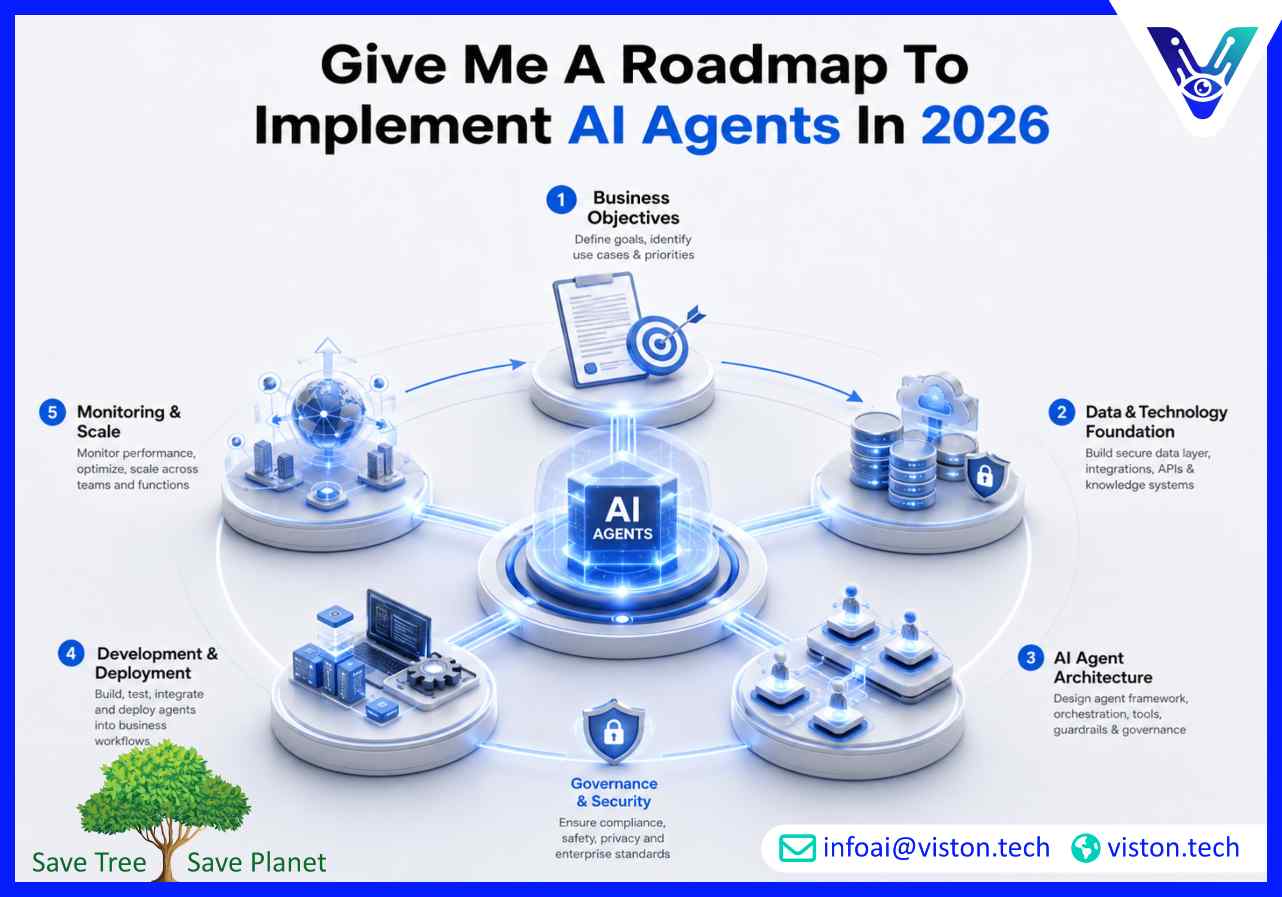
Organizations across industries are exploring AI agents to automate workflows, improve decision-making, and increase operational efficiency. However, successful implementation requires more than selecting a model or deploying a chatbot. A structured roadmap helps businesses reduce risk, align AI initiatives with business goals, and build scalable agent-driven systems that deliver measurable value.
AI agents are software systems capable of performing tasks, making decisions, interacting with applications, and executing workflows with varying levels of autonomy. Unlike traditional automation tools, AI agents can reason through objectives, use tools, access data, and adapt their actions based on context.
In 2026, businesses are moving beyond experimental AI projects and focusing on operational deployment. Organizations implementing AI agents successfully typically prioritize governance, integration, security, scalability, and measurable business outcomes from the beginning.
A well-planned roadmap ensures that AI agents are introduced in a controlled and business-focused manner rather than becoming disconnected technology initiatives.
The first step in implementing AI agents is identifying the business problems they are expected to solve.
Organizations should assess areas where manual work, repetitive processes, slow response times, or information bottlenecks affect productivity. Common opportunities include:
Before deployment, define measurable outcomes such as:
Clear objectives help determine which AI agent architecture and deployment strategy are most appropriate.
Businesses often achieve faster returns by focusing on targeted use cases rather than attempting organization-wide deployment immediately. A phased approach reduces implementation complexity and creates opportunities for learning and optimization.
AI agents rely heavily on access to reliable information and integrated systems. Without a strong foundation, even advanced AI models may deliver inconsistent results.
Organizations should evaluate:
Structured and well-maintained information significantly improves AI agent performance.
Most business AI agents need access to operational systems such as:
Integration planning should occur early because system connectivity often determines the practical capabilities of deployed agents.
Modern AI implementations must address:
Security requirements should be built into the implementation roadmap rather than added after deployment.
Once business objectives and infrastructure requirements are defined, organizations can begin designing the agent ecosystem.
Different use cases require different levels of autonomy.
The architecture should align with the complexity of the intended business function.
Each agent should have clearly defined boundaries, objectives, permissions, and escalation paths.
For example, a customer service agent may:
Clearly defined responsibilities reduce operational risks and improve reliability.
Governance ensures that agents operate according to business policies and compliance requirements.
Organizations should define:
With architecture established, businesses can move into development and deployment.
Successful implementations often begin with a limited-scope deployment. A minimum viable agent allows organizations to validate performance before expanding functionality.
This phase typically includes:
Testing should cover:
Businesses should simulate real-world scenarios to identify potential weaknesses before production deployment.
Pilot deployments provide valuable feedback from actual users.
Organizations can monitor:
Pilot results often reveal optimization opportunities that improve long-term success.
AI agent deployment is not a one-time project. Continuous improvement is essential to maintain effectiveness and adapt to changing business requirements.
Key performance indicators may include:
Ongoing monitoring helps identify areas requiring retraining, workflow adjustments, or additional integrations.
As business processes evolve, AI agents should be updated to reflect new requirements, workflows, and organizational priorities.
Continuous optimization helps maintain performance and ensures agents remain aligned with operational objectives.
After proving value in initial deployments, organizations can scale AI agents into additional departments and workflows.
Examples include:
Scaling becomes significantly easier when governance, security, and integration frameworks are established during earlier phases.
For businesses seeking a structured approach to AI adoption, AI Agent Development & Deployment services can help bridge the gap between strategy and execution.
Viston AI specializes in helping organizations design, develop, integrate, and deploy AI agents that align with real business objectives. Rather than focusing solely on model implementation, the approach emphasizes operational value, workflow integration, scalability, and long-term performance.
AI agent initiatives often require multiple technical components working together, including data connectivity, automation workflows, system integrations, governance controls, monitoring frameworks, and user adoption strategies. Organizations frequently encounter challenges related to architecture design, deployment complexity, security requirements, and performance optimization.
Through AI Agent Development & Deployment services, Viston AI can support businesses in identifying suitable use cases, designing agent architectures, integrating enterprise systems, implementing automation workflows, and establishing governance practices that support responsible AI operations.
As AI adoption continues to accelerate in 2026, businesses increasingly require implementation partners capable of delivering practical, scalable, and business-focused AI solutions rather than isolated technology experiments. A structured deployment strategy helps ensure that AI agents contribute meaningful operational improvements while supporting long-term growth objectives.
Implementation timelines vary based on complexity, integrations, and organizational readiness. Simple deployments may take a few weeks, while enterprise-scale initiatives can require several months.
AI agents can integrate with CRM platforms, ERP systems, databases, customer support tools, communication platforms, business intelligence systems, and custom applications through APIs and workflow connectors.
Most organizations use AI agents to automate repetitive tasks and support decision-making rather than replace employees. Human oversight remains important for complex, sensitive, or strategic activities.
Common risks include poor data quality, weak governance, inadequate security controls, unclear objectives, insufficient testing, and lack of integration planning.
Success is typically measured through productivity improvements, operational efficiency, customer satisfaction, cost reductions, response accuracy, and process completion rates.
Businesses often benefit from specialist support when implementing complex workflows, integrating multiple systems, establishing governance frameworks, or scaling AI agents across multiple departments.
A successful roadmap to implement AI agents begins with clear business objectives, reliable data foundations, well-designed architectures, disciplined deployment processes, and continuous optimization. Organizations that approach AI adoption strategically are more likely to achieve measurable operational improvements and long-term scalability. As AI agents become increasingly important across modern business operations in 2026, investing in structured AI Agent Development & Deployment practices can help reduce risk, accelerate value creation, and support sustainable growth. For organizations evaluating implementation strategies, Viston AI offers expertise aligned with practical and scalable AI agent deployment initiatives.
