
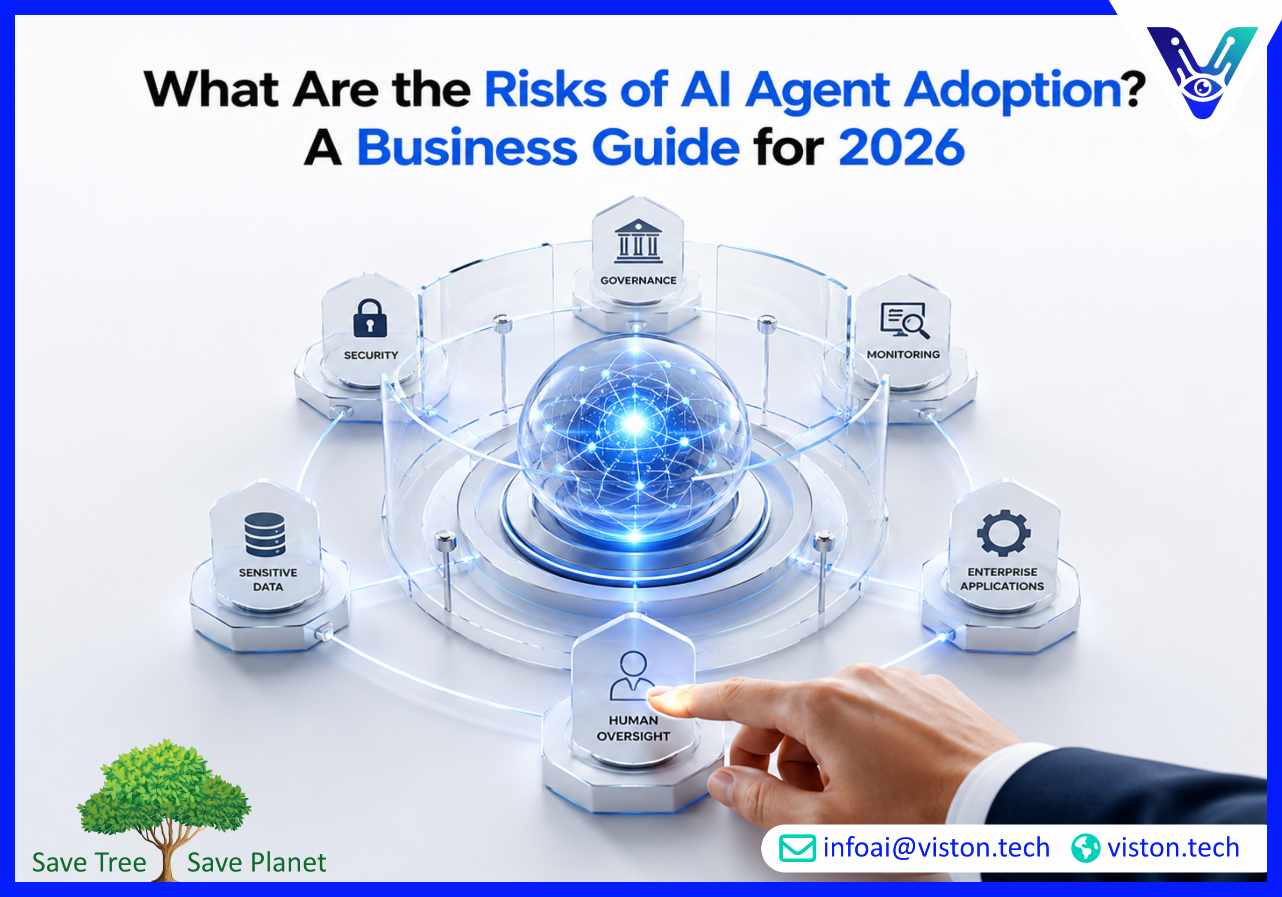
AI agents are rapidly moving from experimentation to operational deployment across businesses of all sizes. While autonomous systems can improve efficiency, decision-making, and scalability, organizations must also understand the risks associated with AI agent adoption. Identifying and managing these challenges is essential for achieving sustainable business value and avoiding costly implementation mistakes in 2026.
AI agents are software systems capable of perceiving information, making decisions, executing tasks, and interacting with systems or users with varying degrees of autonomy. Unlike traditional automation, AI agents can adapt to changing conditions and make contextual decisions.
While this capability creates significant business opportunities, it also introduces new categories of operational, technical, security, governance, and compliance risks.
Organizations adopting AI agents should evaluate risks across multiple dimensions rather than focusing solely on technology performance.
Many AI projects fail not because the technology is ineffective, but because businesses underestimate implementation complexity. AI agents often interact with sensitive data, critical workflows, customer communications, and enterprise systems.
Without proper planning, a poorly governed AI agent can create operational disruptions, reputational damage, security incidents, or regulatory concerns.
One of the most significant risks businesses face is overestimating the capabilities of AI agents while underestimating the need for human oversight.
AI agents rely on training data, prompts, workflows, and system instructions. If these inputs are flawed, incomplete, or outdated, the agent may make inaccurate recommendations or execute inappropriate actions.
Potential consequences include:
Organizations often deploy AI agents into complex workflows involving multiple departments and systems. Improper integration can disrupt established business processes, creating bottlenecks rather than efficiencies.
This risk is particularly relevant when agents are granted permissions to initiate actions automatically without sufficient validation controls.
Businesses may become overly reliant on AI-generated outputs. Excessive automation without appropriate human review can lead to decision quality issues, reduced accountability, and diminished organizational expertise over time.
The most successful AI agent deployments typically combine automation with human governance rather than replacing critical human judgment entirely.
As AI agents gain access to enterprise systems, databases, customer records, and internal workflows, security becomes a major consideration.
AI agents often require access to large volumes of information to perform effectively. Poorly configured permissions can expose confidential business information, customer data, intellectual property, or sensitive operational records.
Organizations should implement:
Regulatory requirements surrounding AI continue to evolve globally. Businesses operating in regulated sectors must ensure AI agents comply with applicable privacy, governance, and industry-specific regulations.
Key concerns may include:
AI agents can become targets for malicious actors. Prompt injection attacks, unauthorized access attempts, model manipulation, and workflow exploitation are increasingly recognized security concerns.
Organizations deploying AI agents should treat them as enterprise systems requiring the same security standards applied to other critical infrastructure.
Beyond business and security concerns, organizations often encounter technical challenges during AI agent deployment.
Modern businesses operate across numerous applications, databases, cloud platforms, and communication tools. Connecting AI agents to these systems can be more complicated than anticipated.
Common challenges include:
An AI agent that performs well during a pilot program may struggle under production workloads. Increased user demand, larger datasets, and more complex workflows can reveal scalability limitations.
Organizations should conduct thorough performance testing before expanding deployment across departments or regions.
AI agents are not set-and-forget solutions. They require ongoing monitoring, optimization, governance, and maintenance.
Business conditions change, systems evolve, and user expectations shift. Without regular updates, AI agent performance can decline over time.
Organizations should plan for:
While risks exist, they can be managed effectively through structured planning and responsible deployment practices.
Organizations should identify specific business outcomes before deploying AI agents. Well-defined objectives help establish governance requirements, performance expectations, and success metrics.
For high-impact decisions, human oversight remains critical. Review checkpoints, approval workflows, and escalation mechanisms can significantly reduce operational risk.
AI governance should cover:
Rather than automating entire business operations immediately, organizations should begin with controlled pilot programs. This approach allows teams to identify risks, optimize workflows, and build confidence before scaling.
Successful deployment often depends on implementation expertise. Businesses should evaluate providers based on technical capabilities, governance practices, integration experience, security standards, and long-term support capabilities.
As organizations evaluate the risks of AI agent adoption, implementation quality becomes a major factor in project success. Viston AI specializes in AI Agent Development & Deployment, helping businesses design, implement, integrate, and govern AI-powered solutions aligned with operational requirements.
Effective AI agent deployment involves far more than building conversational interfaces. It requires workflow design, system integration, security planning, governance controls, monitoring frameworks, scalability considerations, and ongoing optimization.
Viston AI’s focus on AI agent development enables organizations to address common adoption challenges such as integration complexity, process automation, workflow orchestration, data access management, and operational oversight. By emphasizing practical deployment strategies and business-focused implementation approaches, organizations can reduce deployment risks while improving adoption outcomes.
For businesses exploring autonomous workflows, intelligent automation, customer service agents, operational assistants, or multi-agent environments, specialized development and deployment expertise can help establish a stronger foundation for long-term success.
The biggest risk is often deploying AI agents without adequate governance, oversight, and clearly defined business objectives. This can lead to inaccurate decisions, security issues, and operational disruptions.
Yes. AI agents may interact with sensitive data and automated decision processes, making compliance with privacy, security, and industry regulations an important consideration.
Organizations can reduce risk through phased deployments, strong governance frameworks, human oversight mechanisms, security controls, and continuous monitoring.
Yes. AI agents require regular monitoring, optimization, security reviews, workflow updates, and performance evaluations to maintain effectiveness over time.
They can be, but mission-critical deployments typically require extensive testing, governance controls, redundancy planning, and human supervision to minimize operational risk.
Viston AI provides AI Agent Development & Deployment services that help organizations design, integrate, govern, and optimize AI agents while addressing common implementation, security, and scalability challenges.
Understanding the risks of AI agent adoption is just as important as understanding its benefits. Organizations that approach deployment strategically can unlock significant gains in efficiency, automation, and scalability while minimizing operational, security, compliance, and implementation challenges. Effective AI Agent Development & Deployment requires careful planning, governance, integration expertise, and continuous oversight. As businesses continue expanding AI initiatives in 2026, working with experienced specialists such as Viston AI can help create more reliable, secure, and sustainable AI agent ecosystems that support long-term business objectives.
