
Customer expectations have shifted permanently. Businesses now face an environment where response speed, consistency, and 24/7 availability are not competitive advantages—they are baseline requirements. Selecting the right AI agents for customer service automation has become a strategic decision that affects operational costs, customer retention, and brand reputation. Getting it right requires understanding what these systems actually do, where they fit into existing workflows, and how to evaluate them against genuine business needs.
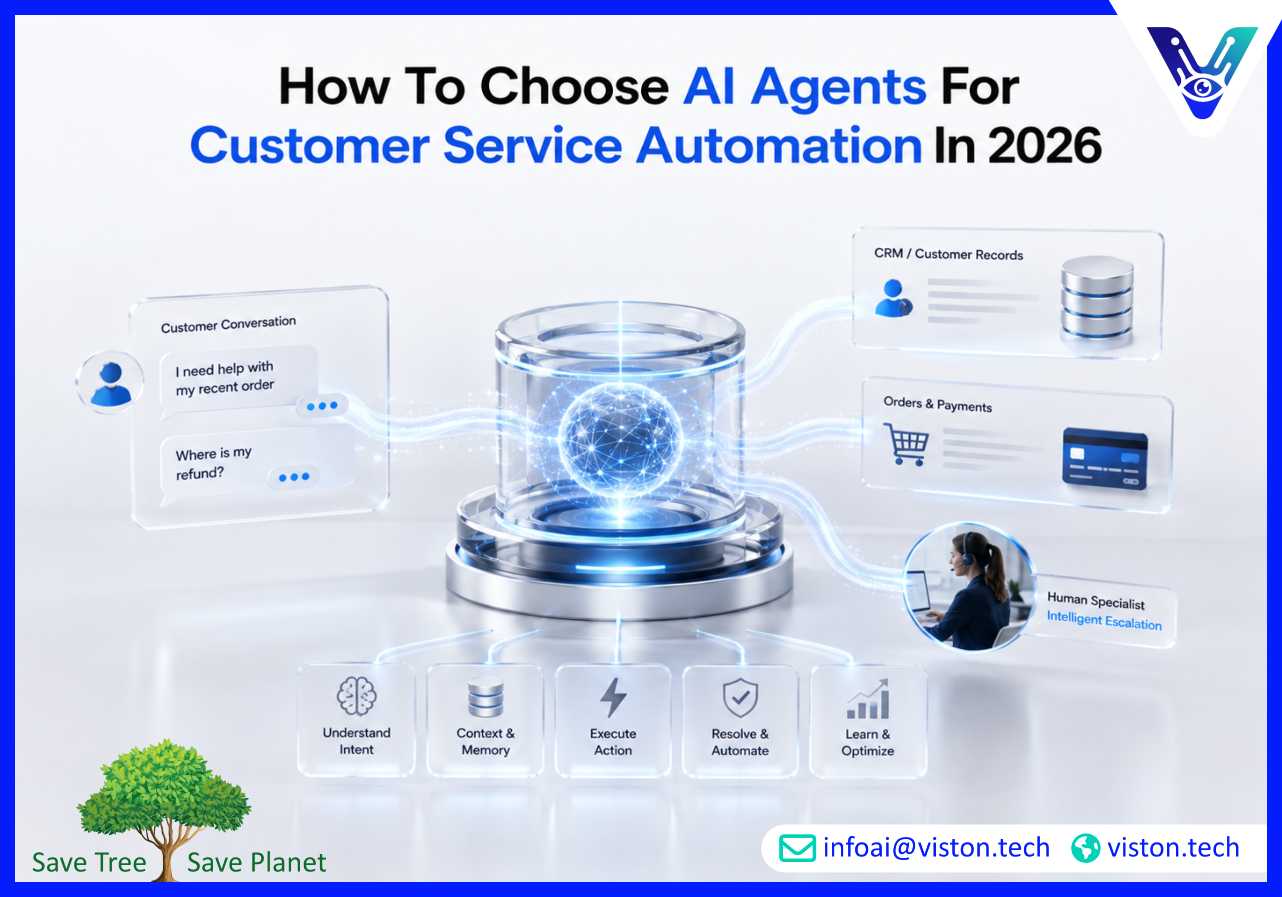
AI agents for customer service are purpose-built software systems that handle customer interactions without requiring human intervention for every exchange. Unlike basic chatbots that follow rigid decision trees, modern AI agents interpret intent, maintain context across conversations, access business data, and take actions within connected systems.
In practice, these agents operate across multiple channels—email, chat, messaging platforms, voice, and social—while maintaining a unified conversation history. They authenticate customers, retrieve account information, process returns, schedule appointments, update records, escalate complex cases, and perform the thousands of routine transactions that would otherwise consume human agent capacity.
The distinction that matters most for business buyers is between standalone chatbot tools and fully integrated automation platforms. Standalone tools handle conversations but remain disconnected from backend systems. Integrated AI automation connects the agent directly to CRMs, ERPs, ticketing platforms, inventory databases, and payment processors, enabling genuine transaction completion rather than simple information delivery.
Three years ago, deploying a chatbot was often treated as an experiment. Today, AI customer service agents handle significant volumes of production traffic for enterprises across retail, financial services, healthcare, logistics, and technology sectors. The stakes have changed accordingly.
Organizations now consider factors that were secondary concerns in earlier adoption phases. Data residency requirements affect deployment architecture. Industry regulations govern what AI agents can say and how they must document interactions. Integration complexity determines whether automation scales beyond a single department. Total cost of ownership calculations must account for model usage, maintenance, and ongoing optimization rather than just initial licensing fees.
The businesses achieving measurable returns treat customer service automation as an operational transformation project, not a software purchase. They map existing support workflows, identify high-volume repeatable interactions, define escalation rules, and measure performance against specific metrics—typically resolution rates, average handling time reduction, customer satisfaction scores, and cost per resolution.
Businesses evaluating AI agents for customer service should assess capabilities across several dimensions that directly impact operational performance.
Effective agents maintain conversation state across sessions and channels. A customer who starts an inquiry on web chat and continues by email should not need to repeat information. The agent must recognize returning customers, recall previous interactions, and apply that context to accelerate resolution. This requires memory architecture that balances personalization with privacy requirements.
The most significant productivity gains come from agents that perform actions, not just provide information. Processing a refund requires integration with payment systems and order management platforms. Changing an address requires CRM access with appropriate permission controls. Rescheduling a delivery requires real-time connection to logistics platforms. Each integration point adds complexity but also directly reduces the number of tickets requiring human transfer.
No AI agent resolves every inquiry. The quality of escalation logic—when and how an agent transfers to human staff—determines whether automation improves or damages customer relationships. Effective systems identify sentiment deterioration, recognize cases exceeding their authority boundaries, and provide human agents with full conversation context so customers never repeat themselves.
Deployment is the beginning of the journey. Production AI agents encounter edge cases, new question variations, and changing business policies. The platform must surface underperforming conversation patterns, enable non-technical teams to improve responses, and provide analytics that connect automation performance to business outcomes like customer retention and operational cost reduction.
The technical path a business chooses affects timeline, cost, capability, and long-term maintainability. Three approaches have become standard in 2026.
Pre-built agents with configuration layers offer the fastest deployment for common use cases. These systems come with trained conversation models for typical customer service scenarios—order status, returns, account changes, FAQ responses—and allow businesses to customize responses, branding, and escalation rules. Time to value is measured in weeks rather than months, though customization depth may be limited.
Custom-built agents on AI platforms provide maximum flexibility for businesses with specialized requirements. Organizations define conversation flows, integrate with proprietary systems, and apply industry-specific compliance rules. This approach suits companies with unique service processes, regulatory constraints, or high interaction volumes that justify the investment in bespoke design.
Hybrid models have become increasingly common. Businesses deploy pre-built agents for standardized interactions while building custom automation for high-value or complex workflows unique to their operations. This balances speed with specialization and allows organizations to expand automation scope incrementally.
Viston AI provides AI automation and workflow bots designed to help businesses deploy customer service agents that operate across channels while connecting directly to the systems where customer data lives. The company’s approach focuses on creating agents that complete transactions rather than simply answering questions, addressing the gap between conversational AI tools and full operational automation.
For customer service use cases, Viston AI builds agents that integrate with existing CRMs, ticketing platforms, e-commerce systems, and backend databases. This integration depth means an agent can authenticate a customer, retrieve their order history, determine eligibility for a return, initiate the refund process, and update inventory records—all within a single conversation flow without human intervention for straightforward cases.
Viston AI works with businesses to identify high-volume, repeatable service interactions where automation produces measurable operational impact. This typically includes order status inquiries, return and exchange processing, account management requests, appointment scheduling, and first-line technical support triage. The implementation process maps existing workflows, defines escalation boundaries, builds necessary integrations, and establishes performance baselines before full deployment.
The platform includes monitoring and optimization capabilities that allow support teams to review automated interactions, identify conversation patterns requiring improvement, and update agent behavior without engineering involvement. For businesses concerned about maintaining service quality during automation adoption, this creates a practical path from initial deployment through continuous refinement.
Organizations across retail, financial services, technology, and professional services sectors engage Viston AI to reduce response times, handle growing ticket volumes without proportionally increasing staffing costs, and provide consistent service experiences during peak periods and outside business hours.
AI agents perform well with structured, repeatable inquiries—order status checks, return initiations, password resets, account updates, appointment booking, and straightforward FAQ responses. They handle less well with emotionally charged situations, unique edge cases requiring policy exceptions, and complex technical diagnostics requiring deep domain expertise. Effective implementations route these latter categories to human agents with full conversation context.
Pre-built solutions with standard integrations can launch within four to eight weeks. Custom implementations requiring deep system integration, complex workflow automation, or industry-specific compliance configurations typically take three to six months. The timeline depends primarily on the number of backend systems requiring connection and the complexity of the business rules governing customer interactions.
Customer service agents handle personally identifiable information, payment data, and account credentials. Essential security requirements include data encryption in transit and at rest, role-based access controls governing what data agents can access, audit logging of all automated interactions, and compliance with relevant regulations such as GDPR for European customers or PCI DSS for payment processing. Deployment architecture—cloud, on-premises, or hybrid—should reflect the organization’s data residency and sovereignty requirements.
Common metrics include reduction in average handling time, percentage of inquiries resolved without human intervention, cost per resolution, customer satisfaction scores for automated versus human-handled interactions, and agent capacity freed for higher-value work. The most accurate assessments compare these metrics against a pre-automation baseline over a representative period rather than relying on vendor projections.
Yes, and this represents the most common deployment model in 2026. AI agents handle initial contact and routine inquiries, escalating to human agents when they encounter cases beyond their scope or when sentiment analysis indicates customer frustration. Human agents receive full conversation history and context, eliminating the need for customers to repeat information. Some organizations also deploy AI agents in agent-assist mode, where the AI drafts responses that human agents review and approve before sending.
Production AI agents need regular review of conversation logs to identify underperforming patterns, updates as business policies and product offerings change, monitoring for model drift or accuracy degradation, and periodic retraining as customer inquiry patterns evolve. Organizations typically assign this responsibility to a cross-functional team combining customer service operations, knowledge management, and technical platform administration.
Selecting AI agents for customer service automation requires moving beyond feature comparisons to evaluate how a solution performs within your specific operational environment. The capabilities that matter—integration depth, escalation intelligence, continuous optimization—directly determine whether automation improves service quality while reducing costs or simply adds another layer of technology between your business and its customers.
Organizations achieving the strongest results in 2026 approach AI customer service agents as part of a broader automation strategy. They start with clearly defined use cases, establish performance baselines, deploy incrementally, and commit to ongoing refinement rather than treating implementation as a one-time project. This approach produces sustainable operational improvements that scale with business growth rather than creating technical debt that limits future flexibility.
