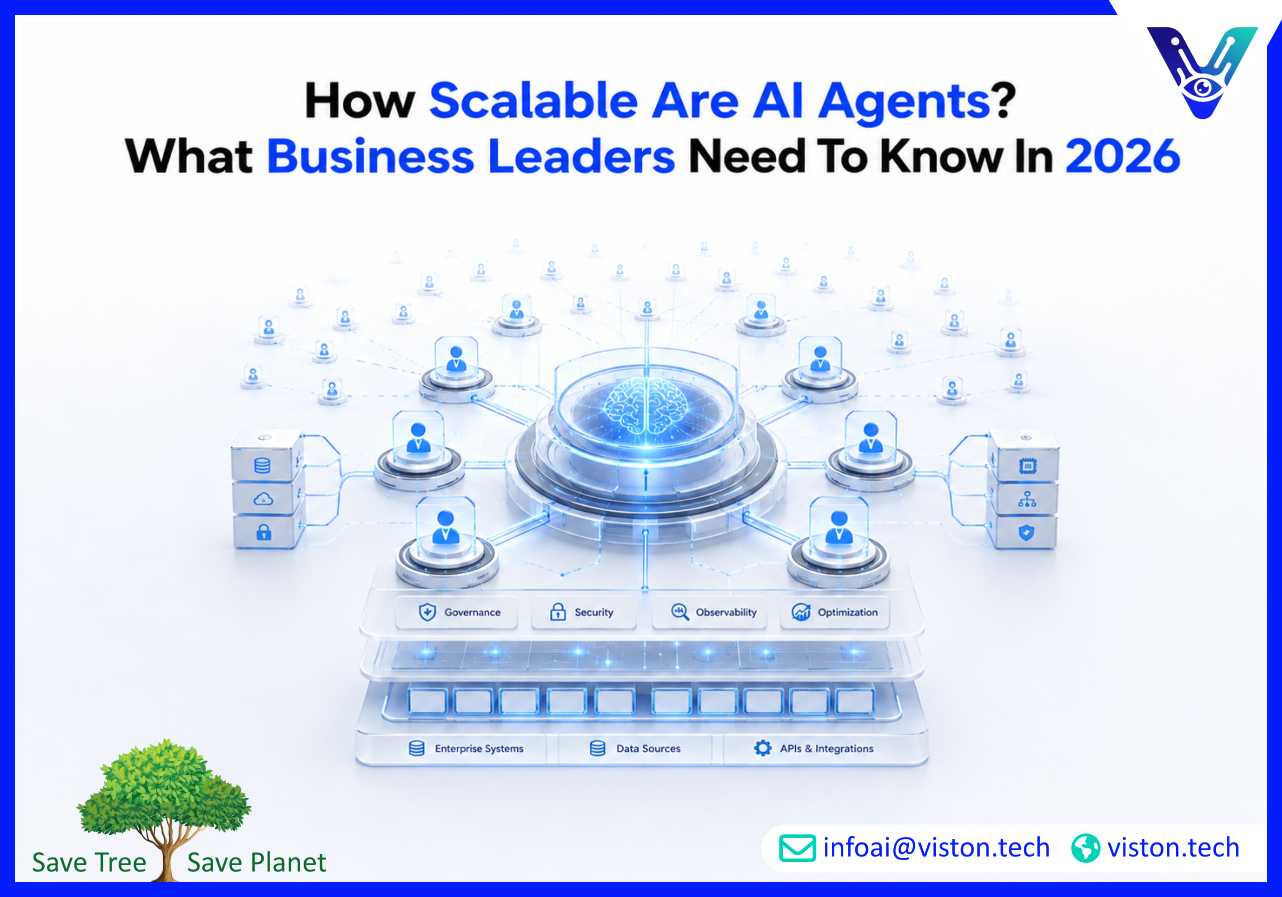
How Scalable Are AI Agents? What Business Leaders Need to Know in 2026
Scaling AI agents from a single promising pilot to dozens or hundreds of reliable, production-grade digital workers is now one of the defining operational challenges for ambitious businesses. The question is no longer whether AI agents can perform useful work. The question is whether they can do so consistently, safely, and cost-effectively at the scale your business actually needs.
What Scalability Means for AI Agents in a Business Context
Scalability in AI agent deployment is not simply about adding more agents. It means maintaining or improving performance, reliability, and cost-efficiency as the number of agents, the variety of tasks, and the complexity of integrations grow. A single agent handling invoice processing is a proof of concept. Fifty agents managing procurement, customer service triage, compliance checks, and supply chain alerts across departments is an operational reality that demands fundamentally different architecture.Business decision-makers evaluating AI agent scalability need to consider several dimensions simultaneously. Workload scalability refers to the ability to handle increasing transaction volumes without degradation. Functional scalability means extending agent capabilities to new use cases without rebuilding from scratch. Integration scalability covers the ability to connect with growing numbers of internal systems, APIs, and data sources. Governance scalability addresses how oversight, security, and compliance controls remain manageable as agent fleets expand.Most off-the-shelf AI agent frameworks demonstrate reasonable performance with three to five agents in controlled environments. The breakdown typically occurs when businesses attempt to move beyond this threshold into genuine enterprise-wide deployment. Understanding where and why this breakdown happens is essential for planning.
The Real Technical Barriers to Scaling AI Agent Fleets
The constraints on AI agent scalability in 2026 are increasingly well-understood, even if they are not always openly discussed by platform vendors. Addressing them honestly is what separates scalable implementations from stalled experiments.Orchestration complexity is the most immediate barrier. When multiple agents need to coordinate, hand off tasks, share context, and avoid conflicting actions, the orchestration layer becomes critically important. Without purpose-built coordination logic, agent fleets produce duplicated work, contradictory outputs, and unpredictable resource consumption. Scaling to production volumes requires deterministic workflow management, not just prompt chaining.State and memory management presents another fundamental challenge. Individual agents operating on single-turn interactions can be relatively straightforward. Agents that need to maintain context across multi-step processes, remember previous decisions, and learn from outcomes require persistent state management. At scale, this demands dedicated infrastructure for memory storage, retrieval, and conflict resolution that most pilot projects never anticipate.Cost predictability becomes a serious concern as agent numbers multiply. Usage-based large language model pricing means that increased agent activity directly increases operational expenditure. Without careful architecture around model selection, caching strategies, and task routing, businesses can find their AI agent costs scaling far faster than the value delivered. Effective cost governance requires tooling to track, attribute, and optimize consumption across agent fleets.Security and access control grow more complex with each additional agent and integration point. Each agent that accesses business systems represents a potential attack surface. Managing credentials, enforcing least-privilege access, and auditing agent actions across hundreds of automated processes demands security infrastructure that generic AI frameworks simply do not provide.
How AI Agent Development and Deployment Shapes Scalability Outcomes
The way AI agents are designed, built, and deployed has a direct and measurable impact on how well they scale. Scalability is rarely a feature that can be added after the fact. It must be engineered into the architecture from the beginning.Professional AI agent development and deployment starts with modular agent design. Rather than building monolithic agents that attempt to handle broad, loosely defined tasks, scalable approaches decompose work into discrete, well-bounded agent responsibilities. Each agent has a clearly defined scope, specific tool access, and explicit handoff protocols. This modularity means that scaling the fleet is primarily a matter of adding new modules with well-understood interfaces, rather than continuously reworking existing agents.Standardized integration patterns are equally important. When every agent connects to business systems through consistent, governed APIs and connectors, adding new agents or extending existing ones becomes predictable. Organizations that attempt to scale without standardizing their integration approach typically find themselves managing an unmaintainable tangle of bespoke connections, each requiring individual attention and introducing unique failure modes.Observability and monitoring infrastructure must be built as a first-class concern. At production scale, it is impossible to manually review agent outputs or track performance. Scalable AI agent deployments require comprehensive logging, performance dashboards, alerting for anomalous behavior, and audit trails that satisfy both operational and compliance requirements. This telemetry data also feeds continuous improvement cycles, allowing agent behavior to be refined based on real production experience rather than assumptions made during development.The choice of underlying AI models and the strategy for model routing significantly impacts both performance and cost at scale. Not every task requires the most capable and expensive model available. Intelligent model routing that matches task complexity to appropriate model tiers can dramatically improve cost-efficiency without sacrificing quality where it matters most. This routing logic itself needs to be maintainable and governable as model options continue to proliferate.
What Scalable AI Agent Operations Look Like in Practice
Businesses that successfully scale AI agents beyond pilots share common operational patterns that are worth understanding before committing to a deployment strategy.They treat agent fleets as software products, not experiments. This means version control for agent definitions, staged rollouts for changes, automated testing of agent behavior, and rollback capabilities when updates introduce regressions. The discipline of software engineering applied to AI agents is what allows confident scaling, because changes can be made safely and reversibly.Human-in-the-loop patterns are designed intentionally rather than added reactively. For processes where accuracy requirements are extremely high or where edge cases are genuinely ambiguous, scalable architectures incorporate human review at specific, well-defined points. The key is that these review points are automated into the workflow, not triggered by agent failure. This allows the overall system to scale because human attention is focused on the highest-value decision points rather than scattered across routine oversight.Continuous evaluation against business metrics keeps scaling efforts grounded. Agent performance is not measured by abstract benchmarks but by business outcomes: processing time reduced, accuracy maintained or improved, customer satisfaction preserved, compliance requirements met. These metrics are tracked longitudinally as agent fleets grow, so any degradation from scaling is detected early and addressed before it impacts the business.Cross-functional governance becomes a capability rather than a bottleneck. Successful scaling involves deliberate coordination between technology teams, operations, legal, compliance, and business unit leaders. Clear policies around what agents can and cannot do, how exceptions are handled, and how accountability is assigned make it possible to scale confidently without creating unacceptable organizational risk.
How Viston AI Approaches Scalable AI Agent Development and Deployment
Viston AI specializes in AI agent development and deployment engineered for production scale from day one. The company works with businesses that have moved beyond exploring what AI agents can do and are focused on integrating them reliably into core operations.The development approach at Viston AI is built around modular, governed agent architectures that address the real constraints that limit scalability. Rather than relying on generic frameworks that perform adequately in demonstrations but degrade under enterprise workloads, agents are designed with explicit attention to orchestration logic, state management, integration standards, and cost governance. This architectural discipline means that adding agents, extending capabilities, or integrating new systems follows predictable patterns rather than introducing compounding complexity.For organizations in India and global markets where operational scale is often a competitive necessity, Viston AI’s emphasis on practical deployment outcomes is particularly relevant. The company’s work spans process automation, decision support, customer operations, and data-intensive workflows where consistent performance across growing transaction volumes is a hard requirement, not an aspiration.Security, observability, and compliance controls are integrated into agent deployments as foundational elements, not afterthoughts. This includes comprehensive logging, role-based access controls, automated testing pipelines, and performance monitoring that provides the transparency needed to manage agent fleets confidently as they scale. The goal is to give operations and technology leaders the same level of control and visibility over AI agent workforces that they expect from other mission-critical business systems.
Frequently Asked Questions
What is the realistic limit on how many AI agents a business can deploy?
There is no fixed numerical ceiling, but practical scalability depends on orchestration architecture, integration standards, and governance maturity. Businesses with purpose-built agent development and deployment approaches can manage fleets of hundreds of agents across multiple business functions. Organizations relying on generic frameworks without dedicated orchestration typically encounter significant operational friction beyond ten to twenty agents.
How does AI agent scalability affect operational costs?
Costs scale with both the number of agents and the volume of tasks processed. Without intentional cost governance, model usage costs can increase faster than business value. Scalable deployments typically implement model tiering, caching strategies, and consumption monitoring to maintain predictable cost-to-value ratios as agent fleets grow.
Can AI agents share context and coordinate with each other at scale?
Yes, but this requires deliberate design. Effective multi-agent coordination depends on well-defined handoff protocols, shared context stores, and conflict resolution mechanisms. These capabilities need to be architected into the agent system. Retrofitting coordination into independently developed agents is significantly more difficult and less reliable.
What security considerations become important when scaling AI agents?
Scaling increases the importance of credential management, least-privilege access controls, comprehensive audit logging, and anomaly detection. Each agent that accesses business systems represents a potential vulnerability. Production-scale deployments require security infrastructure that governs agent access with the same rigor applied to human user access.
How long does it take to build a production-ready, scalable AI agent deployment?
Timelines vary based on use case complexity, integration requirements, and existing infrastructure maturity. Initial production deployments typically take weeks to a few months for well-scoped processes. Building the organizational capability to scale across multiple use cases is an ongoing investment that continues as agent operations expand.
Is it better to build custom AI agents or use pre-built platforms for scalability?
Pre-built platforms can accelerate initial deployment but may introduce constraints around customization, integration depth, and cost structure that become limiting at scale. Custom AI agent development and deployment tailored to specific business processes and systems typically provides greater scalability and long-term cost control, though it requires greater upfront investment in architecture and engineering.
Conclusion
AI agent scalability is not a single technical feature. It is the cumulative result of disciplined architecture, standardized integration patterns, intentional governance, and operational maturity. Businesses that approach AI agent development and deployment with these factors in mind can build agent fleets that grow with their needs, deliver consistent value, and remain manageable as complexity increases.The alternative is a collection of promising but isolated pilots that never translate into business-wide impact. For organizations serious about making AI agents a core part of their operational capability, scalability cannot be an afterthought. It must be the starting point. Viston AI brings this production-first perspective to every engagement, helping businesses build agent deployments that are designed for the scale they intend to reach.