
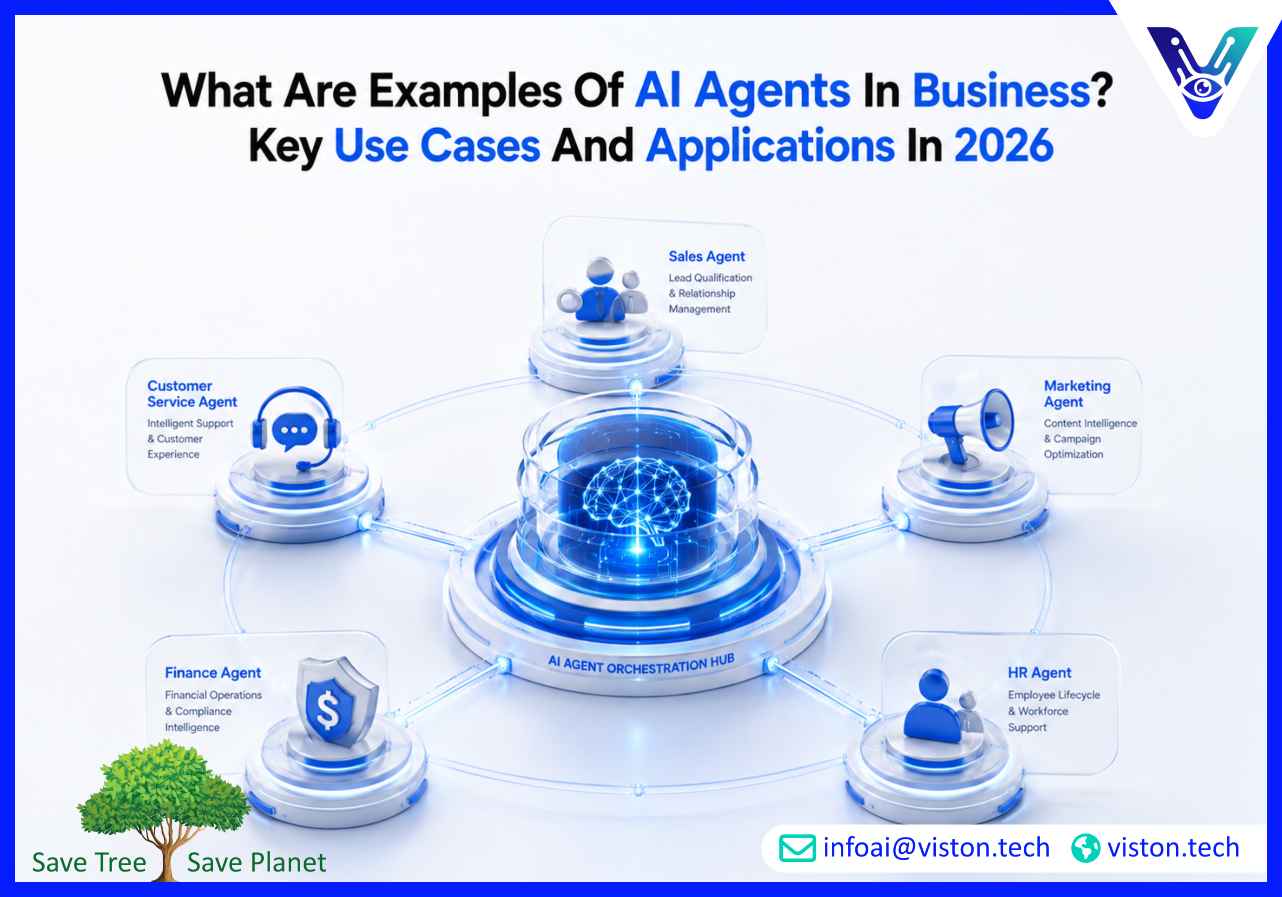
AI agents are becoming a practical business tool across industries, helping organizations automate decision-making, streamline operations, improve customer experiences, and support employees with intelligent task execution. As AI adoption accelerates in 2026, businesses are increasingly deploying specialized AI agents to handle workflows that previously required significant human involvement.
An AI agent is an intelligent software system capable of understanding goals, processing information, making decisions, and taking actions with limited human intervention. Unlike traditional automation tools that follow fixed rules, AI agents can analyze context, learn from interactions, use external systems, and adapt to changing business requirements.
Modern business AI agents often combine:
Organizations use AI agents to reduce manual work, improve operational efficiency, accelerate response times, and support data-driven decision-making.
Customer support remains one of the most common applications of AI agents. These agents can handle customer inquiries, provide product information, process service requests, and escalate complex issues to human teams when necessary.
Examples include:
Businesses benefit from faster response times, reduced support workloads, and more consistent customer experiences.
Sales teams increasingly rely on AI agents to identify opportunities, qualify leads, schedule meetings, and maintain prospect engagement.
Typical capabilities include:
These agents help sales teams focus on high-value activities while reducing administrative tasks.
Marketing departments use AI agents to manage content workflows, audience segmentation, campaign optimization, and customer engagement analysis.
Examples include:
AI agents enable marketers to scale campaigns while maintaining personalization and relevance.
Business leaders are no longer evaluating AI solely as an innovation initiative. In 2026, AI agents are increasingly viewed as operational assets that support productivity, scalability, and business resilience.
Several factors are driving adoption:
AI agents can work continuously, process large amounts of information quickly, and coordinate tasks across multiple systems, making them valuable in both customer-facing and internal operations.
Financial departments use AI agents to support routine processes and improve reporting accuracy.
Common use cases include:
These agents help reduce manual processing while improving visibility into financial operations.
HR teams use AI agents throughout the employee lifecycle.
Examples include:
By automating repetitive HR processes, organizations can improve employee experiences and reduce administrative workloads.
Healthcare organizations are implementing AI agents to improve patient experiences and operational efficiency.
Examples include:
Retail businesses use AI agents to personalize shopping experiences and optimize operations.
Manufacturers increasingly deploy AI agents to support production efficiency and predictive operations.
Financial institutions use AI agents to enhance compliance, customer service, and risk management.
One of the most significant developments in 2026 is the adoption of multi-agent systems. Rather than relying on a single AI assistant, organizations are deploying teams of specialized AI agents that collaborate to complete complex business tasks.
For example, a sales workflow might involve:
This approach enables businesses to automate entire workflows while maintaining greater accuracy and control.
As organizations move beyond experimentation and into production-scale AI adoption, successful implementation requires more than simply deploying a language model. Businesses need reliable architectures, workflow integration, governance frameworks, monitoring capabilities, and scalable deployment strategies.
Viston AI provides AI Agent Development & Deployment services focused on building, deploying, and managing business-ready AI agents across enterprise environments. Its capabilities include custom AI agent development, multi-agent orchestration, workflow automation, business system integration, and AI-powered operational solutions. According to its service offerings, the company works with technologies such as CrewAI, AutoGen, Vertex AI Agent Builder, workflow automation platforms, and enterprise AI infrastructure.
For businesses evaluating AI agents, deployment considerations often include scalability, security, compliance, integration with existing systems, monitoring, and long-term performance management. Viston AI positions its services around addressing these operational requirements while helping organizations implement AI agents aligned with specific business objectives and workflows.
This approach is particularly relevant for companies seeking to automate complex business processes while maintaining governance, reliability, and measurable business outcomes.
A chatbot primarily focuses on conversations and answering questions. An AI agent can reason, make decisions, interact with external systems, execute tasks, and manage workflows beyond simple conversations.
Yes. Modern AI agents can integrate with CRM platforms, ERP systems, databases, communication tools, ticketing systems, and other enterprise applications through APIs and workflow integrations.
Healthcare, financial services, retail, manufacturing, logistics, professional services, and technology companies are among the industries seeing significant value from AI agent adoption.
Yes. Many AI agent solutions can be customized for businesses of different sizes. Organizations often start with a specific workflow and expand deployment as they demonstrate value.
Common challenges include data quality, system integration, governance, compliance requirements, workflow design, monitoring, and ensuring human oversight where necessary.
Based on its published service offerings, Viston AI provides custom AI agent development, deployment, workflow automation, multi-agent orchestration, and enterprise AI integration services for organizations seeking tailored AI solutions.
Examples of AI agents in business now extend far beyond customer support chatbots. Organizations are using AI agents for sales, marketing, finance, HR, operations, manufacturing, compliance, and strategic decision support. As AI technologies mature in 2026, businesses are increasingly adopting both individual agents and multi-agent systems to automate complex workflows and improve operational performance.
For companies exploring AI Agent Development & Deployment, success depends on selecting practical use cases, integrating agents with existing systems, and implementing governance frameworks that support scalability and long-term value. Providers such as Viston AI help organizations move from AI experimentation to production-ready agent ecosystems that align with real business objectives.
