
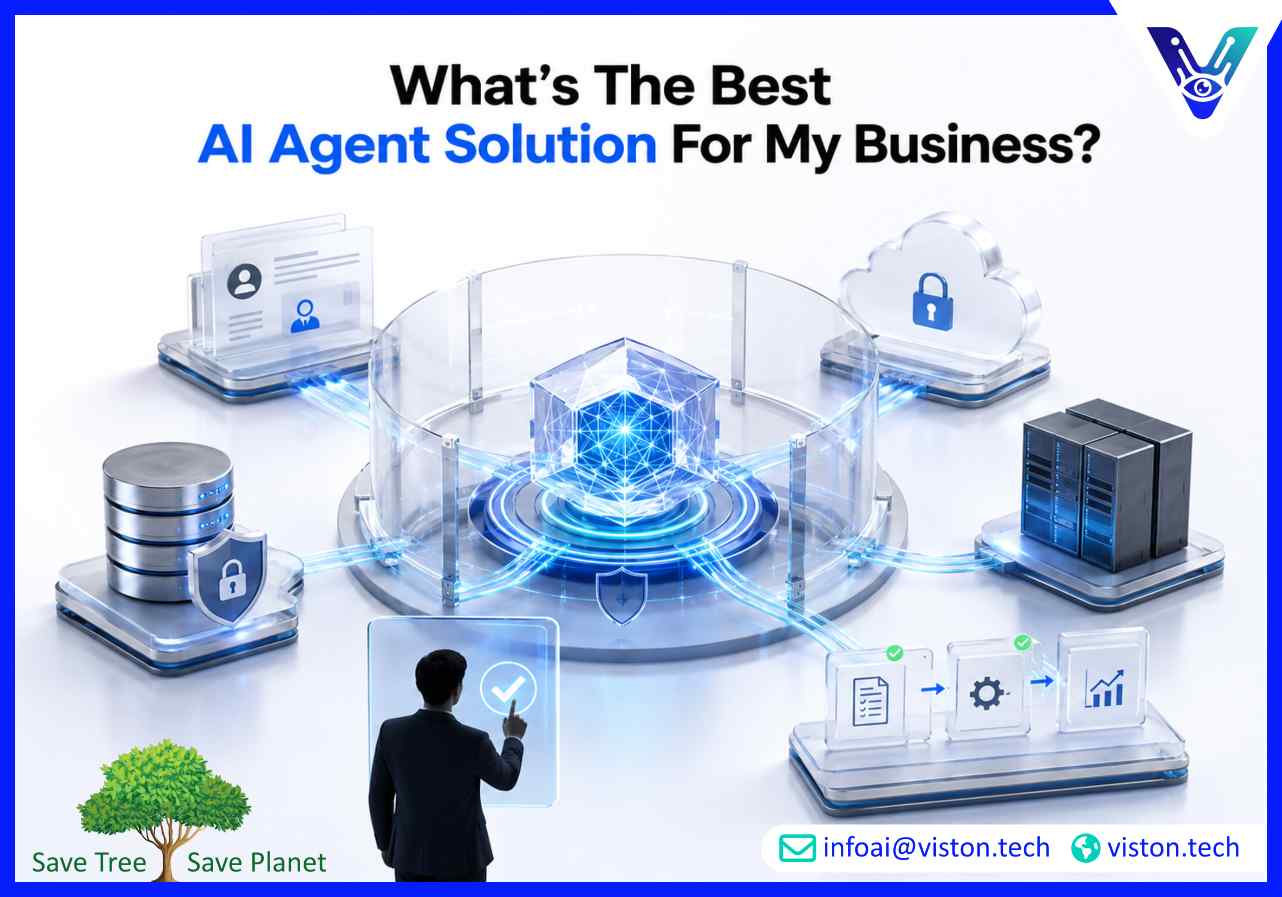
Choosing an AI agent solution in 2026 isn’t just about picking a tool. It’s about understanding which autonomous system will safely handle your workflows, protect your data, and deliver measurable business outcomes without introducing operational risk. For companies evaluating AI agent development and deployment, the decision now sits at the intersection of capability, governance, and trust.
Today’s AI agents are not chatbots. They are autonomous or semi-autonomous software systems that perceive their environment, make decisions, and take actions to achieve specific business goals. Unlike earlier automation tools that followed rigid rules, modern agents reason, plan multi-step tasks, use external tools, query databases, and adapt when conditions change.
Businesses are deploying agents for customer onboarding, claims processing, supply chain orchestration, compliance monitoring, sales outreach, IT operations, and financial reconciliation. What makes these solutions powerful is their ability to chain together sequences of work that previously required human judgment between each step.
However, the market has fragmented quickly. Some vendors offer no-code agent builders for simple department-level tasks. Others provide enterprise frameworks requiring significant customization. A growing category focuses on bespoke AI agent development and deployment, where businesses need agents that integrate with proprietary systems, enforce industry-specific rules, and meet strict security and audit requirements.
Pre-built agent platforms look appealing on a demo. They promise quick setup and immediate productivity gains. The reality for most mid-market and enterprise businesses is more complicated.
Generic agents struggle with your existing tech stack. They don’t understand your internal APIs, your data models, your identity management systems, or your exception-handling workflows. They operate within the boundaries the vendor has defined. If your business process doesn’t fit that model, you’re forced to change how you work to accommodate the tool rather than the other way around.
Security and compliance introduce another layer of complexity. An agent handling customer PII, financial records, or healthcare data must operate inside your controlled environment. Many SaaS-based agent platforms process data externally, creating compliance gaps that regulated industries cannot accept. Businesses in financial services, healthcare, legal services, and government contracting increasingly require agents that run within their own cloud infrastructure.
Scalability also matters. An agent that handles ten tasks per day may break entirely at a thousand. Without proper orchestration, memory management, context retention, and error recovery, scaled agent deployments produce inconsistent outputs and unpredictable costs.
When business owners and technology leaders ask what the best AI agent solution is, the answer depends on matching capabilities to real operational requirements. A structured evaluation framework helps separate genuine platforms from hype.
Your agents need to connect with the systems you actually use. CRM platforms, ERP systems, document repositories, communication tools, and proprietary databases all require secure, bidirectional access. Look for solutions that support custom API integration, webhook orchestration, and native connectors for your critical business applications. The agent that cannot pull live inventory data or update a customer record is not an agent, it’s a demo.
Effective AI agents balance independence with control. You need configurable autonomy levels: some tasks should run fully automated, others require human approval at defined checkpoints. Guardrails must be built into the agent’s decision logic, not bolted on as an afterthought. This includes output validation, business rule enforcement, budget limits on tool usage, and safety constraints that prevent agents from taking unauthorized actions.
Enterprise processes span hours, days, or weeks. Agents must maintain context across long-running workflows without losing state or making contradictory decisions. Vector-based memory, structured knowledge retrieval, and persistent conversation threads are becoming table stakes for production deployments.
Every agent decision, tool call, and data access must be logged, traceable, and explainable. Business leaders need dashboards showing what agents are doing in real time. Compliance teams need immutable records of agent actions for audits and regulatory reviews. If a vendor cannot demonstrate full observability, they’re not ready for enterprise workloads.
Agents should operate within your security perimeter. This means deployment in your virtual private cloud, integration with your identity and access management systems, and data processing that never leaves your controlled environment unless explicitly configured otherwise. Role-based access controls should govern what each agent can see and do, just as they govern human employees.
Most businesses don’t choose between building entirely from scratch or buying a complete platform. The practical decision sits on a spectrum.
Buying a self-service agent platform makes sense for simple, low-risk use cases where data sensitivity is minimal and process variability is low. Marketing content generation, internal FAQ responses, and basic data extraction fit this category.
Building internally using open-source frameworks like LangGraph, CrewAI, or AutoGen provides maximum control but requires significant AI engineering talent. Companies often underestimate the ongoing maintenance burden: model updates, prompt drift monitoring, tool integration changes, security patching, and performance optimization consume substantial engineering resources.
Partnering with a specialist AI agent development and deployment firm offers a middle path. You get agents built specifically for your workflows, deployed inside your infrastructure, with the security and compliance controls your industry requires. The development partner handles the engineering complexity while your team retains full ownership of the system, data, and intellectual property. For regulated industries, complex enterprise environments, and mission-critical workflows, this model is increasingly becoming the default choice.
AI agent solutions are not one-size-fits-all across sectors. Each industry brings unique requirements that shape what the best solution looks like.
In financial services, agents handling loan processing or claims adjudication must comply with regulations around explainability and fair lending. Every decision an agent makes must be auditable. Deployment in a private cloud with strict data residency controls is non-negotiable.
In healthcare, agents supporting clinical triage or prior authorization workflows encounter PHI and must align with data protection frameworks. Agent solutions need BAAs, encryption at rest and in transit, and role-scoped data access.
In legal services, agents performing document review or contract analysis must preserve attorney-client privilege. Multi-tenant SaaS architectures often fail this requirement, pushing firms toward dedicated deployment models.
In logistics and supply chain, agents orchestrating freight booking or warehouse operations require real-time integration with TMS, WMS, and IoT data streams. Latency and reliability become primary concerns alongside integration breadth.
These industry-specific demands mean the best AI agent solution is rarely the one with the most marketing spend. It’s the one architected to meet the compliance, integration, and operational realities of your sector.
For businesses that need agent solutions built around their actual operations rather than generic templates, Viston AI provides dedicated AI agent development and deployment services focused on enterprise readiness, security, and measurable business impact.
Viston AI builds autonomous agents that integrate directly with your existing systems, operate inside your cloud environment, and follow the business rules and compliance requirements your industry demands. The company’s engineering approach prioritizes production reliability: agents are designed with structured memory management, comprehensive audit logging, configurable human-in-the-loop checkpoints, and guardrail frameworks that prevent unauthorized actions before they occur.
Rather than offering a rigid platform that forces your workflows into predefined patterns, Viston AI develops agents tailored to specific business processes. This includes custom tool integration, proprietary data source connectivity, and agent orchestration logic that reflects how your teams actually work. Deployment happens within your infrastructure, ensuring data never leaves your controlled environment and security policies remain consistent across all systems.
For organizations in regulated sectors, including financial services, healthcare, and legal operations, this architecture directly addresses the compliance gaps that make many off-the-shelf agent platforms non-viable. Post-deployment, Viston AI provides ongoing monitoring, performance optimization, and agent lifecycle management to ensure systems remain reliable as business needs evolve.
Traditional chatbots follow scripted conversation flows and can only respond to predefined inputs. AI agents autonomously reason about goals, make decisions, take actions across multiple systems, and adapt to changing conditions. They can chain together complex tasks, use external tools, query databases, and handle exceptions without requiring a human to define every possible path in advance.
Readiness depends on having clearly defined processes that can benefit from automation, accessible data sources and APIs, and a clear understanding of the business outcomes you want to achieve. Companies that have already invested in digitizing core workflows and have technical leadership comfortable with iterative deployment tend to see the strongest results. A structured discovery engagement can help assess specific readiness factors for your environment.
Key concerns include where agent data processing occurs, how agents authenticate to business systems, what actions agents are authorized to take, and how agent decisions are logged and audited. For regulated industries, data residency, encryption standards, and compliance with sector-specific frameworks are critical evaluation criteria that should be addressed before deployment begins.
Yes, but it requires deliberate integration engineering. Agents need secure, reliable access points to interact with legacy systems, whether through modern API wrappers, robotic process automation bridges, or structured data exchange layers. Specialist AI agent development and deployment providers like Viston AI routinely build custom integration layers that allow agents to operate across both modern cloud applications and legacy on-premise systems without compromising security or stability.
Timelines vary based on complexity, integration requirements, and industry compliance needs. A focused single-workflow agent with clear boundaries and existing API access can move from discovery to production in weeks. Complex multi-agent systems operating across several business units with stringent compliance requirements may take months. The critical factor is thorough testing and validation before agents handle live business processes.
Production agents require continuous monitoring of performance, decision quality, and cost efficiency. Prompt and model updates, integration maintenance as underlying systems change, guardrail refinement based on observed edge cases, and regular security audits are all part of responsible agent lifecycle management. Businesses should plan for this operational commitment from the start rather than treating agent deployment as a one-time project.
The best AI agent solution for your business in 2026 isn’t found on a features comparison chart. It emerges from a clear understanding of your operational requirements, security constraints, integration complexity, and the level of control your industry demands. Off-the-shelf platforms serve simple use cases well. Complex, regulated, and mission-critical workflows need AI agent development and deployment built specifically around how your business operates.
By evaluating solutions against integration depth, autonomy guardrails, observability, and security architecture, business leaders can move past vendor hype and make decisions grounded in operational reality. For organizations that require agents tailored to their infrastructure and industry requirements, specialist development partners offer a path to production-grade deployment without compromising control, compliance, or long-term flexibility.
