
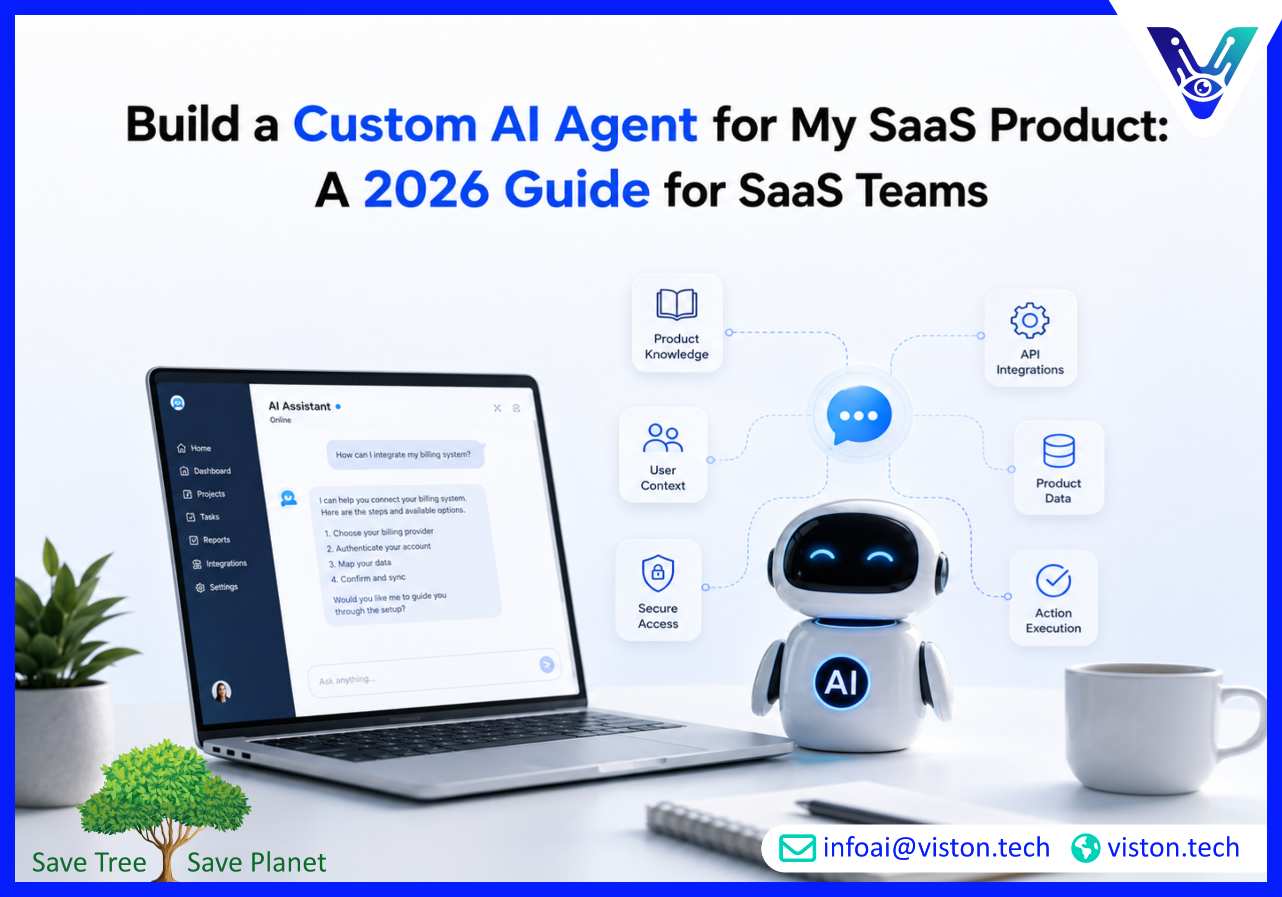
For SaaS companies, a custom AI agent is no longer just an experimental feature. It can become a practical product layer that improves onboarding, support, workflow automation, analytics, and customer success when it is designed around real user tasks, product data, and business outcomes.
To build a custom AI agent for a SaaS product means creating an intelligent software assistant that can understand user intent, access relevant product data, perform defined actions, and help users complete tasks inside or around the SaaS platform.
Unlike a basic chatbot, a custom AI agent is designed for a specific product environment. It can connect with APIs, knowledge bases, user permissions, CRM data, support systems, billing records, analytics dashboards, or internal workflows depending on the use case.
For example, a SaaS AI agent may help users:
The real value comes from building the agent around product-specific context. A SaaS agent should understand the product’s terminology, user roles, subscription logic, data structures, workflows, and customer pain points.
In 2026, SaaS buyers expect faster answers, more self-service, better personalization, and less friction across digital products. A custom AI agent can help SaaS businesses meet these expectations without simply adding more manual workload to support, sales, or customer success teams.
Many SaaS users leave because they do not understand how to reach value quickly. A custom AI agent can guide users through setup, explain features in context, and recommend workflows based on their goals.
Support teams often handle repeated questions about configuration, billing, integrations, permissions, or feature usage. An AI agent can resolve routine queries, collect context before escalation, and help human agents respond faster.
Instead of forcing users to search documentation, a SaaS AI agent can answer questions directly inside the product. This makes help more timely, contextual, and easier to act on.
For product-led SaaS companies, activation and retention depend on how quickly users discover value. A well-built AI agent can support onboarding, feature adoption, upsell signals, and usage-based engagement.
AI agents can assist internal teams by summarizing accounts, identifying churn signals, preparing customer notes, updating records, or routing tasks across tools.
A custom AI agent for a SaaS product should be built with clear boundaries, reliable integrations, and measurable business use cases. The goal is not to make the agent “do everything,” but to make it dependable for specific tasks.
The agent should understand product features, documentation, pricing rules, user roles, workflows, and common customer questions. This often requires structured knowledge management, retrieval-augmented generation, and regular content updates.
SaaS products often involve sensitive customer data. The agent must respect permissions, tenant boundaries, authentication rules, and privacy requirements. It should only access data the user is allowed to see.
A useful SaaS agent usually needs to connect with internal systems. This may include the product database, analytics tools, CRM, helpdesk, billing platform, email system, or workflow automation tools.
Beyond answering questions, an agent may perform actions such as creating tickets, updating records, generating reports, configuring settings, or triggering workflows. These actions should include validation, logging, and approval steps where needed.
Not every request should be automated. A strong agent experience includes smooth escalation to support, sales, customer success, or technical teams when confidence is low or the request is high-risk.
AI agents need ongoing evaluation. SaaS teams should track accuracy, task completion, escalation rate, response quality, user satisfaction, latency, failure patterns, and business impact.
The best custom AI agent solutions start with business clarity, not model selection. SaaS teams should define what the agent must achieve, who it serves, and which workflows matter most.
Start with one high-value use case. This could be onboarding assistance, support automation, product navigation, reporting, account intelligence, or workflow automation.
Identify what users ask, where they get stuck, and what actions they need to complete. This helps shape conversation flows, tool access, permission logic, and escalation rules.
The agent needs reliable information. SaaS teams should organize documentation, FAQs, API references, support articles, feature descriptions, and internal playbooks before deployment.
Connect the agent only to systems required for the use case. Each integration should include authentication, authorization, error handling, logging, and data protection controls.
For actions that affect customer data, billing, permissions, or account settings, the agent should confirm user intent and follow defined approval rules.
Testing should include common questions, edge cases, incomplete prompts, permission restrictions, integration failures, and escalation paths.
A phased rollout helps reduce risk. SaaS teams can start with internal users, then beta customers, then wider release after performance and safety checks.
Custom AI agents can create real value, but poor implementation can damage trust. SaaS companies should manage risk from the start.
A custom AI agent is an intelligent assistant built specifically for a SaaS platform. It can answer product questions, access approved data, use APIs, complete workflows, and support users based on product-specific context.
A chatbot mainly answers questions. An AI agent can understand goals, use tools, retrieve data, follow workflows, and perform actions within defined boundaries.
Yes. A custom AI agent can integrate with CRMs, helpdesks, billing systems, analytics platforms, databases, internal APIs, and workflow automation tools when secure access controls are designed properly.
The timeline depends on complexity, integrations, data readiness, security requirements, and the number of workflows. A focused first version is usually faster and safer than trying to automate every use case at once.
They should prepare product documentation, use cases, customer support data, API details, permission rules, success metrics, escalation paths, and security requirements.
To build a custom AI agent for your SaaS product in 2026, focus on real user problems, secure product integrations, reliable knowledge, measurable workflows, and continuous improvement. Custom AI Agent Solutions can help SaaS companies improve onboarding, support, automation, and customer engagement when the agent is designed for practical product outcomes rather than generic conversation. The strongest results come from starting with a clear use case, building safe action boundaries, and scaling only after the agent proves value.
