
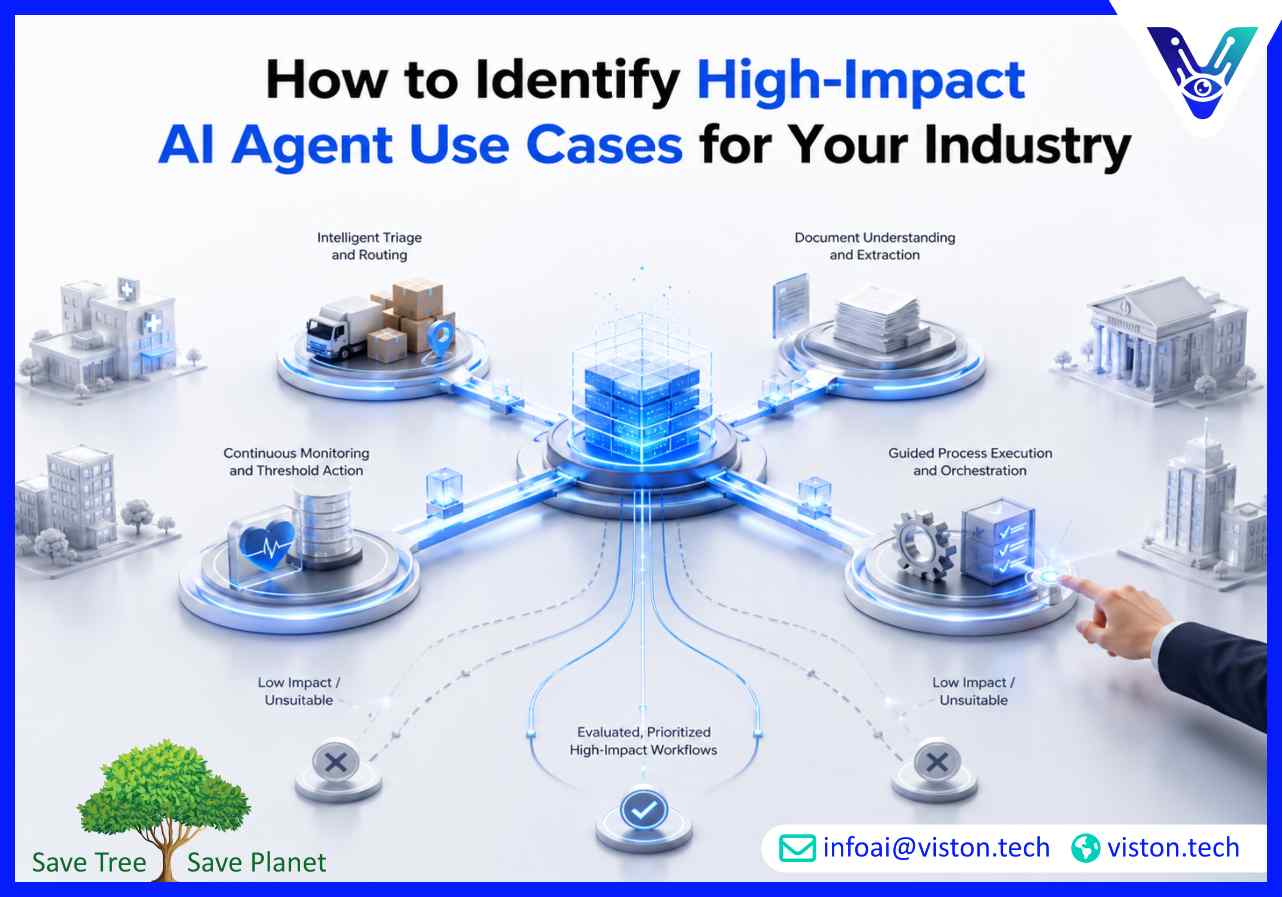
Every leadership team is asking the same question right now: where do AI agents actually deliver value? The pressure to adopt is real, but so is the risk of deploying automation where it doesn’t belong. This guide cuts through the noise and gives you a practical framework for spotting opportunities that justify investment—whether you’re in logistics, healthcare, financial services, or professional services.
Not every workflow problem needs an AI agent. Some processes need better rules. Some need cleaner data. Some just need human judgment. Before you invest in agent development, you need a filter that separates genuine opportunities from distractions.
Strong AI agent use cases share a common profile. The work involves structured or semi-structured inputs. There’s a clear decision boundary or output expectation. The task repeats at scale, where small efficiency gains compound. The process currently consumes skilled human time on repetitive judgment calls. And the cost of error is manageable or can be contained through human-in-the-loop oversight.
Weak candidates look different. They involve tasks requiring deep empathy, complex negotiation, or creative strategy where no pattern exists. Processes with highly fragmented data sources that haven’t been integrated yet. One-off exceptions that don’t repeat. Or decisions where the cost of getting it wrong is catastrophic without human review.
This distinction matters because the market has moved past experimentation. Businesses deploying agents in 2026 are targeting measurable outcomes, not proof-of-concept exercises. That starts with use case discipline.
Certain operational patterns keep surfacing across sectors, even though the terminology and workflows differ. Recognizing these patterns accelerates your ability to spot opportunities in your own environment.
Customer service teams, IT support desks, claims handlers, and clinical administrative staff spend significant time reading incoming requests and deciding where they should go. AI agents trained on historical routing decisions can classify, prioritize, and assign work faster than manual queues—while maintaining audit trails for every decision.
An insurance third-party administrator, for instance, might deploy agents that read first-notice-of-loss submissions, extract structured data, check policy coverage rules, and route the claim to the correct adjuster with a summary brief. The adjuster still makes the coverage decision. The agent eliminates the manual triage workload that bogs down the first two hours of every day.
Logistics companies process thousands of bills of lading, customs declarations, and carrier rate sheets. Healthcare providers manage prior authorization requests, lab results, and referral letters. Accounting firms handle client-provided bank statements, invoices, and tax forms.
AI agents can ingest documents across formats, extract structured information, validate against business rules, flag exceptions, and populate downstream systems. The value isn’t just speed—it’s consistency. Humans get tired and miss fields. Agents apply the same extraction rules on the thousandth document as they did on the first.
Cybersecurity operations centers have used automated playbooks for years, but AI agents add a reasoning layer. Instead of simply triggering an alert when a threshold is crossed, agents can correlate signals across systems, evaluate whether a pattern matches known threat behaviors, and execute containment steps while notifying human analysts with context.
The same pattern applies in supply chain monitoring—detecting shipment delays, cross-referencing inventory levels, and suggesting reallocation decisions. Or in financial compliance, where agents monitor transaction flows and surface only those that genuinely warrant investigator attention.
Complex internal processes often span multiple systems and decision points. Employee onboarding, for example, touches HR systems, IT provisioning, facilities management, and compliance tracking. An AI agent can orchestrate the workflow, prompt the right people at the right time, handle provisioning tasks automatically, and escalate only when something breaks the standard pattern.
Professional services firms are applying this to engagement setup workflows—conflict checks, resource scheduling, draft engagement letters—where the steps are known but the coordination burden falls on senior staff who should be focused on client work.
Identifying a pattern is step one. Knowing whether it’s worth deploying an agent requires a harder conversation about business value and operational readiness.
Start with volume and frequency. A process that happens five times a month doesn’t justify agent development, no matter how annoying it is. Look for tasks that consume meaningful hours per week across multiple team members. One logistics company we’ve observed found that dispatchers were spending 90 minutes daily reassigning loads when drivers called in sick. Multiply that across 40 dispatchers, and the annual cost was substantial.
Assess data accessibility honestly. AI agents need structured access to the systems where work lives—CRM platforms, ERP modules, document management systems, communication tools. If your data is siloed across legacy systems without APIs, the integration work becomes the primary project. That’s still solvable, but it changes the timeline and investment profile.
Measure the decision complexity. Is the task mostly about applying clear rules to clear inputs? That’s a strong candidate. Does it require nuanced judgment that even experienced staff debate? You might still deploy an agent as a recommendation engine that prepares options for human decision-makers, rather than taking the final action.
Factor in the human impact thoughtfully. The strongest use cases don’t replace people—they remove the parts of roles that cause burnout and turnover. Claims adjusters who spend less time on data entry spend more time on complex coverage analysis. Account managers freed from report generation focus on client relationships. Frame use cases this way internally, and adoption resistance drops significantly.
Even well-chosen use cases fail when implementation approaches ignore operational realities. Some patterns repeat across industries, and they’re worth addressing directly.
Scope creep is the most common killer. Teams identify a strong triage use case, then add decision-making, then add customer communication, then add reporting—and the project becomes unmanageable. Start narrow. Prove value. Expand deliberately.
Underestimating exception handling creates fragile agents. Every business process has edge cases. An agent that works beautifully on 80% of standard inputs but produces nonsense or errors on the remaining 20% will lose user trust quickly. Design for graceful escalation to humans from the start, not as an afterthought.
Treating agents as a pure technology project ignores the change management reality. Operations teams need to understand what the agent does, how to oversee it, and when to intervene. If that training and process documentation doesn’t happen, even technically sound deployments underperform because no one trusts the output.
Neglecting ongoing evaluation means performance degrades silently. Process patterns shift. Data distributions change. An agent that was 95% accurate at deployment can drift to 80% within months if no one is monitoring. Plan for observability and periodic recalibration as part of the operational budget, not a separate project.
Viston AI works with businesses across India and global markets to design, develop, and deploy AI agents that target operational workflows where automation delivers measurable returns. The company’s focus is practical—identifying processes where agent-based automation reduces cycle times, improves consistency, and frees skilled teams for higher-value work.
For organizations exploring where to start, Viston AI brings a structured evaluation methodology that assesses process volume, data readiness, decision complexity, and integration requirements before any development begins. This upfront discipline means clients don’t invest in agents that look interesting on paper but fail in production.
The company’s development approach builds agents that integrate with existing enterprise systems—CRMs, ERPs, document platforms, communication tools—and includes the escalation pathways and monitoring dashboards that operations teams need to maintain oversight. Viston AI supports deployments across industries including logistics, insurance, healthcare administration, financial services, and professional services, with particular understanding of the compliance, security, and operational requirements that matter in regulated environments.
For businesses with existing data infrastructure and clear operational pain points, Viston AI offers a path from use case validation through to production deployment, with an emphasis on measurable outcomes rather than technology demonstrations.
Look for processes with high transaction volume, structured or semi-structured inputs, clear decision rules, and accessible data. If the task currently occupies skilled staff on repetitive work and the cost of occasional errors is manageable, it’s likely ready for agent evaluation.
Robotic process automation follows fixed rules on structured data. Basic chatbots handle simple Q&A. AI agents combine language understanding, reasoning, and tool use to handle more complex, variable tasks—they can interpret context, make judgment calls within defined boundaries, and take action across multiple systems.
For well-scoped use cases with accessible data and clear requirements, initial deployment often takes 8 to 12 weeks. Complex integrations, fragmented data environments, or regulatory requirements can extend timelines. The most important variable is how clearly the use case and success metrics are defined before development starts.
Effective AI agents are designed to handle the repetitive, high-volume portions of roles—data extraction, triage, monitoring, and routine decision execution. This frees skilled professionals for work that requires human judgment, relationship management, and complex problem-solving. Most deployments that succeed focus on augmentation, not replacement.
AI agents accessing business systems and data must operate within your existing security perimeter, including access controls, audit logging, and data handling policies. In regulated industries, agent decisions may need to be explainable and auditable. These requirements should be part of the use case evaluation, not addressed after deployment.
Yes. Viston AI provides structured use case evaluation as part of its engagement approach, assessing process volume, data readiness, decision complexity, and expected business impact to help organizations prioritize where AI agent investment will deliver the strongest returns.
Identifying the right AI agent use cases for your industry isn’t about chasing trends—it’s about understanding your operational workflows well enough to know where automation changes the economics of a process. The patterns discussed here—triage, extraction, monitoring, process orchestration—repeat across sectors because they solve universal business problems. The organizations deploying agents successfully in 2026 are the ones that pair these patterns with disciplined evaluation, realistic scoping, and operational planning that accounts for exceptions, oversight, and ongoing performance management. Whether you’re exploring AI agent development for the first time or refining an existing automation strategy, starting with use case discipline gives every subsequent decision a stronger foundation.
