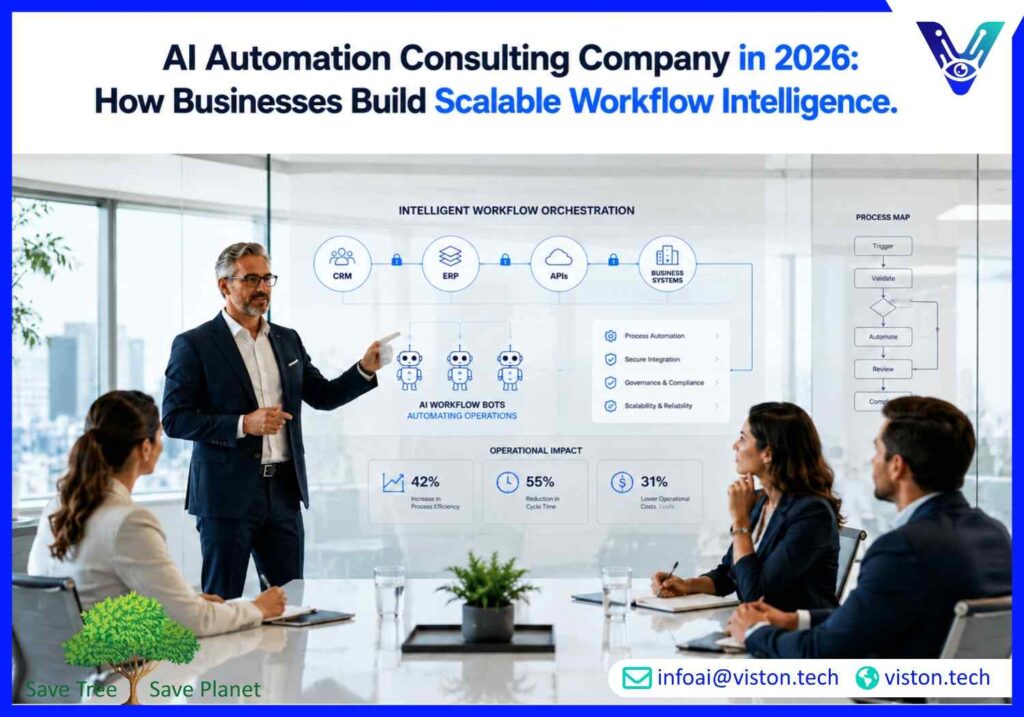
AI Automation Consulting Company in 2026: How Businesses Build Scalable Workflow Intelligence
Introduction
Businesses are no longer asking whether AI should be part of operations. The focus in 2026 is implementation quality. Companies want practical automation that reduces manual work, improves decision-making, and connects fragmented systems. That is where an AI automation consulting company becomes important—helping organizations move from experimentation to measurable operational value.
What Does an AI Automation Consulting Company Actually Do?
An AI automation consulting company helps businesses identify, design, implement, and optimize intelligent workflows across operational processes.Unlike basic software deployment, AI automation consulting typically combines:
Workflow analysis
Process mapping
AI model integration
Data architecture planning
API and system integration
Workflow bot deployment
Security and governance planning
Performance monitoring and optimization
The objective is not simply to automate tasks. The goal is to redesign how work moves through the organization.For example, a company processing hundreds of customer inquiries daily may automate:
Instead of multiple employees manually handling repetitive actions, intelligent workflow systems can manage much of the operational load while maintaining human oversight where necessary.
Why AI Automation Consulting Matters More in 2026
Many organizations experimented with AI tools during the past few years. However, businesses discovered that purchasing AI products alone rarely solves operational challenges.Several factors have shifted expectations in 2026:
Growing workflow complexity
Organizations operate across multiple platforms:
CRM systems
ERP platforms
Marketing tools
Communication systems
Customer support environments
Internal databases
Disconnected systems create bottlenecks and duplicated work.
Higher expectations around measurable outcomes
Leadership teams increasingly expect:
Faster process cycles
Reduced operational costs
Better employee productivity
Improved customer experience
Stronger reporting visibility
AI initiatives now need business justification beyond innovation goals.
Increased attention to governance and security
Businesses implementing automation also need:
Role-based access controls
Data privacy compliance
Audit visibility
Human review mechanisms
Responsible AI usage practices
Automation without governance creates risk.
Common Business Problems AI Automation Solves
Organizations usually seek automation support because they experience recurring operational friction.
Repetitive manual work
Employees often spend large portions of their day on activities such as:
Copying information between systems
Data entry
Scheduling
Status updates
Document processing
Manual processes increase operational costs and introduce errors.
Slow customer response times
Customer expectations continue to rise.Businesses handling support tickets, lead inquiries, onboarding requests, or service requests can struggle with:
Delayed routing
Long response queues
Inconsistent handling
AI workflow bots can automate classification, prioritization, and response assistance.
Fragmented operational visibility
Many teams operate with disconnected reporting systems.Managers frequently face questions such as:
Where are bottlenecks occurring?
Which processes are slowing down?
Which teams require intervention?
AI-powered workflows can centralize operational visibility.
Scaling challenges
Processes that work for a small company often become inefficient as the organization grows.Increasing headcount alone rarely solves structural workflow problems.Automation creates scalable process infrastructure.
AI Automation and Workflow Bots: Practical Use Cases
AI automation has evolved beyond simple chatbots or basic scripts.Businesses now use intelligent workflow systems across multiple departments.
Automation rarely ends after implementation.Processes evolve.A consulting partner should support:
Workflow refinement
Performance monitoring
Process expansion
Maintenance
Scaling requirements
Building Intelligent Operations with Viston AI Workflow Solutions
AI automation consulting becomes most valuable when implementation combines technical capability with business process understanding. This is where Viston AI aligns directly with workflow transformation needs.Viston AI focuses on AI Automation and Workflow Bots designed to help organizations reduce operational friction and create more efficient business systems. Rather than approaching automation as isolated tool deployment, the emphasis is on creating connected workflows that support measurable operational outcomes.For businesses dealing with repetitive processes, disconnected systems, or growing operational complexity, workflow design becomes as important as the technology itself. Intelligent automation environments frequently require integration across customer platforms, communication tools, operational systems, and internal business processes.A practical workflow approach can support challenges such as:
Manual task reduction
Process standardization
Cross-platform automation
Customer interaction management
Operational visibility improvements
Scalable process architecture
Organizations in India and global markets increasingly require automation systems that can grow alongside business demands while maintaining reliability and operational control.Specialized workflow implementation also requires attention to governance, scalability, and support structures. Businesses evaluating AI initiatives often prioritize sustainable delivery models that align with operational realities rather than short-term experimentation.When AI Automation & Workflow Bots are deployed around real business requirements, organizations gain systems designed to improve process efficiency while supporting long-term operational flexibility.
Implementation Considerations Before Starting an AI Automation Initiative
Businesses frequently underestimate implementation planning.Several areas deserve attention before deployment begins.
Define measurable outcomes
Clear objectives may include:
Reduced processing time
Lower operational costs
Faster customer response
Fewer manual errors
Improved productivity
Without measurable goals, evaluating success becomes difficult.
Start with process priorities
Not every workflow requires automation.Businesses often begin with:
High-volume activities
Repetitive tasks
Error-prone processes
Customer-facing workflows
Prepare data structures
Automation quality depends heavily on data quality.Poorly structured data creates:
Incorrect outputs
Process failures
Reporting problems
Maintain human oversight
Human review remains important for:
Sensitive decisions
Compliance-related processes
Exceptions
Escalations
The strongest automation environments balance AI efficiency with human judgment.
Frequently Asked Questions
What is an AI automation consulting company?
An AI automation consulting company helps organizations identify, design, implement, and optimize intelligent workflows using AI technologies and workflow automation systems.
How are AI workflow bots different from traditional automation?
Traditional automation often follows predefined rules. AI workflow bots can interpret context, analyze information, make recommendations, and adapt workflows based on changing inputs.
Which industries benefit most from AI automation consulting?
Industries commonly using AI automation include healthcare, finance, retail, logistics, SaaS, manufacturing, customer support, and professional services. Any business with repetitive workflows can benefit.
How long does AI automation implementation usually take?
Implementation timelines vary depending on workflow complexity, system integrations, and operational requirements. Small workflow projects may take weeks, while larger enterprise implementations can require several months.
What should businesses look for when selecting an AI automation partner?
Businesses should evaluate process expertise, integration capabilities, governance practices, scalability, support models, and experience with workflow architecture.
How does Viston AI support workflow automation initiatives?
Viston AI focuses on AI Automation & Workflow Bots that help businesses build connected operational workflows, reduce repetitive work, and create scalable automation systems aligned with business requirements.
Conclusion
Choosing an AI automation consulting company in 2026 is becoming less about technology selection and more about operational design. Businesses increasingly need intelligent systems that connect workflows, reduce inefficiencies, and support measurable outcomes across teams.AI Automation & Workflow Bots can help organizations improve productivity, strengthen customer experiences, and create scalable operations when implemented strategically. Companies evaluating long-term automation initiatives should prioritize providers that understand workflow realities as much as technology capabilities. For businesses seeking structured workflow transformation, Viston AI aligns with this need through practical automation approaches built around business operations rather than isolated tools.