
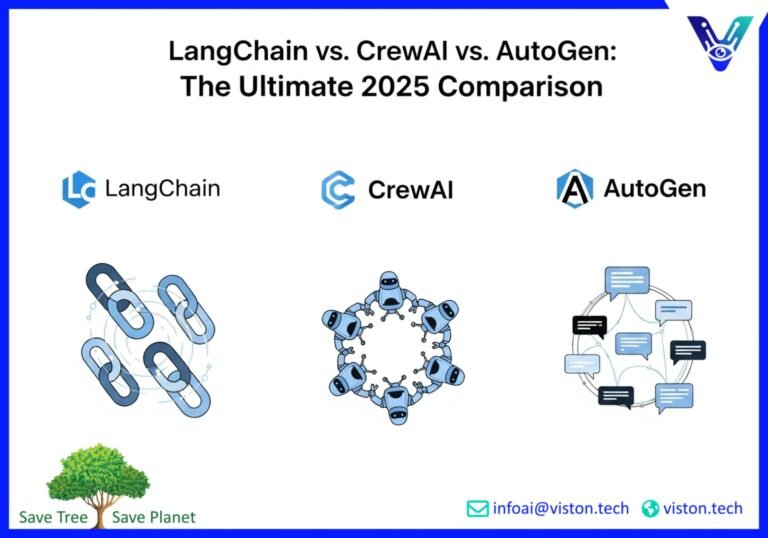
LangChain vs CrewAI vs AutoGen: Which AI Agent Framework for Your Business?
In the rapidly evolving landscape of artificial intelligence, AI agent frameworks are emerging as pivotal tools for businesses aiming to leverage the power of Large Language Models (LLMs). These frameworks provide the foundational architecture for building sophisticated AI-powered applications that can automate complex workflows, enhance decision-making, and create innovative products and services. With a myriad of options available, choosing the right framework is crucial for success. This deep dive into LangChain, CrewAI, and AutoGen will help you understand their unique strengths and determine the best fit for your business needs in 2025.
What are AI Agent Frameworks?
AI agent frameworks are software development kits (SDKs) that simplify the process of building applications powered by LLMs. They offer a structured approach to creating “agents” – autonomous programs that can understand tasks, make decisions, and use tools to achieve goals. Think of them as the scaffolding for constructing intelligent systems. These frameworks handle the complex “plumbing” of LLM orchestration, allowing developers to focus on the unique logic of their applications. Key functionalities include managing conversations, connecting to various data sources, and integrating with other software and APIs.
Framework Comparison at a Glance
| Feature | LangChain | CrewAI | AutoGen |
|---|---|---|---|
| Primary Strength | Vast integration ecosystem with over 100+ pre-built connectors. | Collaborative multi-agent workflows with a focus on role-playing and task delegation. Backed by a community of over 100K certified developers. | Powerful and flexible multi-agent conversation patterns, backed by the strength of the Microsoft ecosystem. |
| Architecture | Modular and chain-based, allowing for the linear sequencing of components. | Role-based and hierarchical, designed for agents to work together as a “crew”. | Conversation-driven and highly customizable, enabling complex and dynamic agent interactions. |
| Ease of Use | Steeper learning curve due to its extensive features and flexibility. | More intuitive for beginners, with a clear and structured approach to multi-agent systems. | Moderate to high complexity, offering significant control to developers. |
| Best For | Rapid prototyping and applications requiring a wide range of integrations. | Complex problem-solving that can be broken down into specialized roles and collaborative tasks. | Research, experimentation, and building highly customized multi-agent systems. |
Architectural Differences: A Deeper Look
LangChain: The Power of Chains and Integrations
LangChain’s architecture is built around the concept of “chains.” These are sequences of calls to LLMs, tools, or data sources. This modular approach allows for the construction of complex applications by linking together various components. For instance, a chain could first retrieve data from a document, then use an LLM to summarize it, and finally, pass the summary to another LLM for translation.
A key strength of LangChain lies in its extensive library of pre-built integrations. With support for over 100 tools, from databases and APIs to various LLM providers, LangChain provides a versatile toolkit for developers. This makes it an excellent choice for projects that require connecting to a diverse set of external resources. For more in-depth information, you can explore the official LangChain website.
CrewAI: Fostering Collaboration Among AI Agents
CrewAI’s architecture is designed to facilitate collaboration between multiple AI agents. It operates on a role-based system where each agent is assigned a specific role, goal, and backstory. These agents then work together as a “crew” to accomplish a larger objective. The framework manages the interaction and communication between agents, enabling them to delegate tasks and share information seamlessly.
This hierarchical and collaborative structure is particularly well-suited for complex problem-solving. Imagine a marketing campaign: one agent could be a “Market Researcher,” another a “Content Writer,” and a third a “Social Media Strategist.” CrewAI orchestrates their efforts to produce a cohesive and effective campaign. With a rapidly growing community of over 100,000 certified developers, CrewAI benefits from a wealth of shared knowledge and support.
AutoGen: Microsoft’s Vision for Flexible Multi-Agent Conversations
AutoGen, backed by Microsoft, offers a highly flexible framework for creating multi-agent conversational applications. Its architecture is centered around the concept of “conversable agents” that can communicate with each other to solve tasks. AutoGen allows for a high degree of customization in defining how agents interact, what their capabilities are, and how they are orchestrated.
The strength of AutoGen lies in its ability to support a wide range of conversation patterns, from simple two-agent dialogues to complex multi-agent collaborations. This makes it a powerful tool for research and development, as well as for building sophisticated applications that require dynamic and adaptive agent interactions. The backing of the Microsoft ecosystem also suggests a strong potential for future integrations and support.
Integration Ecosystem: Connecting to the World
The ability of an AI agent framework to connect with external tools and data sources is critical for building real-world applications. Here’s how our three contenders stack up:
- LangChain: As mentioned, LangChain is the undisputed leader in this area. Its extensive library of integrations is a major draw for developers who need to connect to a wide variety of services.
- CrewAI: While its native integration library is not as extensive as LangChain’s, CrewAI allows for the creation of custom tools, enabling developers to connect to any API or data source.
- AutoGen: AutoGen’s focus is more on the conversational aspect of multi-agent systems. However, it also supports the integration of custom tools and functions, providing flexibility for developers to extend its capabilities.
Best-Fit by Use Case: Which Framework for Which Job?
When to Choose LangChain:
- Rapid Prototyping: LangChain’s extensive integrations and modular design make it ideal for quickly building and testing new ideas.
- Data-Intensive Applications: If your application needs to connect to numerous databases, APIs, and other data sources, LangChain’s vast integration library is a significant advantage.
- Single-Agent Workflows: For tasks that can be accomplished by a single agent following a sequence of steps, LangChain’s chain-based architecture is highly effective.
When to Choose CrewAI:
- Complex Problem-Solving: When a task is too complex for a single agent, CrewAI’s collaborative approach allows you to break it down into manageable sub-tasks for a team of specialized agents.
- Creative and Strategic Tasks: The role-playing capabilities of CrewAI agents make them well-suited for tasks that require creativity, planning, and strategic thinking, such as marketing campaigns or business plan development.
- Human-in-the-Loop Workflows: CrewAI’s structured approach to task delegation and execution can make it easier to incorporate human oversight and feedback into the workflow.
When to Choose AutoGen:
- Research and Experimentation: AutoGen’s flexibility and customizable conversation patterns make it an excellent choice for researchers and developers exploring the frontiers of multi-agent systems.
- Highly Customized Applications: If you need to build a multi-agent system with unique and complex interaction patterns, AutoGen provides the low-level control necessary to do so.
- Applications Requiring Dynamic Agent Behavior: For scenarios where agent roles and interactions need to adapt and evolve in response to new information, AutoGen’s conversation-driven architecture is a powerful asset. For those interested in the latest advancements in AI, the OpenAI blog is a valuable resource.
Code Examples: A Glimpse into Development
To give you a practical sense of what it’s like to work with these frameworks, here are simplified code examples for each.
LangChain: Simple Q&A Chain
from langchain.chains import LLMChain
from langchain.llms import OpenAI
from langchain.prompts import PromptTemplate

llm = OpenAI(temperature=0.9)
prompt = PromptTemplate(
    input_variables=["product"],
    template="What is a good name for a company that makes {product}?",
)

chain = LLMChain(llm=llm, prompt=prompt)
print(chain.run("colorful socks"))
CrewAI: A Simple Research Crew
from crewai import Agent, Task, Crew

researcher = Agent(
  role='Senior Research Analyst',
  goal='Uncover cutting-edge developments in AI and data science',
  backstory="You are a renowned research analyst..."
)
writer = Agent(
  role='Tech Content Strategist',
  goal='Craft compelling content on tech advancements',
  backstory="You are a skilled content strategist..."
)

task1 = Task(description='Investigate the latest AI trends', agent=researcher)
task2 = Task(description='Write a blog post on the top 3 AI trends', agent=writer)

crew = Crew(
  agents=[researcher, writer],
  tasks=[task1, task2],
  verbose=2
)

result = crew.kickoff()
AutoGen: A Basic Two-Agent Conversation
import autogen

config_list = autogen.config_list_from_json("OAI_CONFIG_LIST")
assistant = autogen.AssistantAgent("assistant", llm_config={"config_list": config_list})
user_proxy = autogen.UserProxyAgent("user_proxy", code_execution_config={"work_dir": "coding"})

user_proxy.initiate_chat(assistant, message="Plot a chart of NVIDIA and Tesla stock prices for the last year.")
Conclusion: The Right Framework for Your AI-Powered Future
The choice between LangChain, CrewAI, and AutoGen ultimately depends on the specific needs of your business and the nature of the applications you intend to build. LangChain offers unparalleled flexibility and integration capabilities, making it a strong choice for a wide range of applications. CrewAI excels in orchestrating collaborative multi-agent workflows, ideal for tackling complex and multifaceted problems. AutoGen provides a powerful and customizable platform for creating sophisticated conversational agents, backed by the innovation of Microsoft.
As you embark on your AI journey, it’s essential to not only consider the technical features of these frameworks but also the skills of your team, your long-term goals, and the evolving landscape of AI. By carefully evaluating your options, you can select the framework that will best empower you to build the next generation of intelligent applications. For further reading on the business implications of AI, Harvard Business Review’s section on Artificial Intelligence offers a wealth of insights.
Ready to unlock the potential of AI for your business? Contact Viston AI today to explore how our expertise in AI-powered solutions can help you innovate, automate, and grow. Our team of experts can guide you in selecting and implementing the right AI agent framework to achieve your strategic objectives.
Frequently Asked Questions (FAQs)
1. What is the main difference between single-agent and multi-agent frameworks?
Single-agent frameworks, like the core concept of LangChain, focus on creating a sequence of tasks for one AI agent to perform. Multi-agent frameworks, such as CrewAI and AutoGen, are designed to orchestrate the collaboration of multiple agents, each with potentially specialized roles, to solve more complex problems.
2. Are these frameworks suitable for non-programmers?
While these frameworks are primarily designed for developers, the trend is towards creating more user-friendly interfaces. However, a foundational understanding of programming concepts is generally required to leverage their full potential.
3. Can I use different LLMs with these frameworks?
Yes, all three frameworks are designed to be model-agnostic, meaning you can integrate them with a variety of LLMs from different providers, such as OpenAI, Google, Anthropic, and more.
4. What are the costs associated with using these frameworks?
The frameworks themselves are open-source and free to use. The primary costs will be associated with the API calls to the LLMs you choose to use and the hosting of your applications.
5. How do I choose the right framework for my startup?
For a startup, the choice of framework often depends on the need for rapid prototyping and the specific problem you are trying to solve. LangChain can be excellent for quickly building an MVP. If your concept revolves around collaborative AI, CrewAI might be a better fit from the start.
6. What is the learning curve for each of these frameworks?
LangChain has a steeper learning curve due to its vast number of features. CrewAI is often considered more beginner-friendly because of its structured and intuitive approach. AutoGen’s learning curve can vary depending on the complexity of the conversational patterns you aim to create.
7. Can these frameworks be used to build customer-facing applications?
Absolutely. All three frameworks can be used to build a wide range of customer-facing applications, from intelligent chatbots and virtual assistants to sophisticated data analysis tools and personalized content generation platforms.
8. How important is the community around a framework?
A strong community is incredibly valuable. It provides a support system for developers, a source of shared knowledge and best practices, and a driver for the continued development and improvement of the framework. CrewAI, in particular, highlights its large and growing developer community as a key strength.
#AIAgentFrameworks #LLMOrchestration #ToolIntegration #LangChain #CrewAI #AutoGen #ArtificialIntelligence #BusinessAI #TechLeadership
