
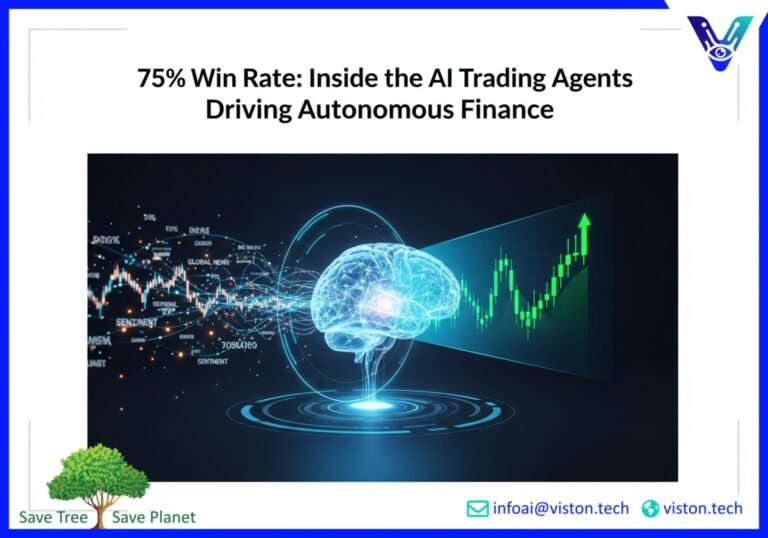
AI Trading Agents: Unlocking 75% Win Rates and the Future of Autonomous Finance
The financial markets never sleep. And now, neither does the trader. Imagine a world where your trading strategies operate 24/7 with relentless precision. They adapt to market shifts in microseconds. They make complex decisions free from human emotion. This isn’t science fiction. This is the new reality of autonomous finance, powered by sophisticated AI trading agents. In 2025, we are seeing these systems achieve incredible results. Some top-tier agents are reporting annualized returns that exceed 200%. They are hitting win rates between 65% and 75% on short-term trades. These figures are not just impressive; they are transformative. They show how agentic AI, when governed correctly, delivers tangible, high-risk-adjusted ROI. This is a pivotal moment for enterprise finance. Leaders who understand and adopt this technology will command an unparalleled competitive edge.
The New Financial Frontier: A Market Overview
We have moved far beyond traditional algorithmic trading. For years, algorithms have executed pre-programmed, rule-based instructions. If market condition ‘A’ happens, execute trade ‘B’. This was a major leap in efficiency. But these systems are rigid. They cannot learn or adapt to novel market conditions on their own. They are tools, not true decision-makers.
Enter the era of autonomous finance. AI trading agents represent a fundamental paradigm shift. These are not just executing orders. They are learning, strategizing, and making decisions. They function as autonomous entities with specific financial goals. This leap from automation to autonomy is reshaping the entire financial ecosystem.
- Unprecedented Speed: AI agents process vast datasets—from price action and order books to global news and social media sentiment—in real-time.
- Continuous Learning: They use machine learning, especially reinforcement learning, to improve their strategies with every trade. A losing trade is as valuable as a winning one, as it provides data for refinement.
- Eliminating Emotion: The two biggest barriers to successful trading—fear and greed—are removed from the equation. Decisions are based purely on data and probability.
The market for AI in finance is exploding. Enterprises are no longer asking *if* they should invest in AI, but *how* and *how quickly*. The pioneers in this space are not just seeing better returns. They are discovering new alpha, managing risk more effectively, and scaling their operations in ways previously unimaginable.
Inside the Machine: The Architecture of a Modern Trading Agent
So, how do these AI agents actually work? While the underlying technology is complex, the core architecture can be understood through four key layers. Think of it as a digital brain designed specifically for navigating the complexities of financial markets.
1. The Data Ingestion Layer
An AI agent is only as smart as the data it consumes. This foundational layer is a super-pipeline, feeding the agent a continuous stream of diverse information:
- Market Data: Real-time and historical price feeds, trading volume, and order book data from multiple exchanges.
- Alternative Data: News feeds, SEC filings, social media sentiment, satellite imagery, and even weather patterns that might impact commodity prices.
- Economic Data: Inflation rates, GDP figures, employment statistics, and central bank announcements.
The ability to process this massive, unstructured data is a key differentiator for modern agents.
2. The ‘Brain’ – The Core AI and Machine Learning Models
This is where the magic happens. The data is fed into a sophisticated suite of machine learning models. These are not static algorithms; they are dynamic systems that evolve.
- Reinforcement Learning (RL): This is often the star of the show. The agent learns through trial and error, much like a human. It is rewarded for profitable actions and penalized for losses, allowing it to develop highly nuanced strategies over millions of simulations.
- Deep Learning & Neural Networks: These models excel at identifying complex, non-linear patterns in large datasets that are invisible to human analysts.
- Natural Language Processing (NLP): NLP models analyze news articles and social media posts, gauging market sentiment and predicting how breaking news might impact asset prices.
3. The Decision-Making Engine
With insights from the core models, the decision-making engine formulates a strategy. It doesn’t just decide whether to buy or sell. It determines the optimal position size, sets entry and exit points, and calculates the potential risk-reward ratio for every potential trade. This engine synthesizes all the analysis into a single, actionable command.
4. The Execution Layer
Once a decision is made, it must be executed flawlessly. This layer connects directly to the market via APIs. It is responsible for placing orders with minimal latency and slippage. Speed and reliability are paramount here, as even a millisecond’s delay can impact profitability.
Safety First: The Critical Role of Risk and Guardrails
The idea of a fully autonomous system managing millions of dollars can be intimidating. That’s why robust risk management isn’t just a feature; it’s the foundation upon which autonomous trading is built. Autonomy without guardrails is recklessness. For enterprise-grade AI agents, safety is paramount.
Here are the essential guardrails that ensure AI trading agents operate safely and predictably:
- Position Sizing Limits: The agent is never allowed to risk more than a predefined percentage of the portfolio on a single trade or in a single day.
- Market-Wide Circuit Breakers: The agent is programmed to halt all trading activity if the broader market experiences extreme volatility, such as a flash crash. This prevents catastrophic losses during black swan events.
- Strategy-Specific Kill Switches: If a particular strategy starts underperforming or behaving erratically, a human supervisor can disable that specific strategy without shutting down the entire agent.
- Real-Time Monitoring and Alerts: A human oversight team monitors the agent’s performance through a live dashboard. They receive instant alerts for any unusual activity, allowing for immediate intervention if needed. The “human-in-the-loop” approach provides a crucial layer of oversight and control.
- Model Validation: Before an AI model is deployed with real capital, it undergoes rigorous backtesting and simulation on historical data to ensure its strategy is sound. Find out more about how regulators view these models at the U.S. Securities and Exchange Commission.
These guardrails ensure that while the agent has the autonomy to make decisions, it always operates within a safe and controlled environment defined by human experts.
Beyond Win Rates: True Performance Metrics
A 75% win rate sounds fantastic, but it’s only part of the story. A trader could win 9 out of 10 trades but lose everything on the tenth. Truly understanding an AI agent’s performance requires looking at risk-adjusted metrics. These metrics tell you not just how much money the agent made, but how much risk it took to make it. This is what separates professional-grade AI from gambling.
Key Metrics for Evaluating AI Agents:
- Sharpe Ratio: This is the industry standard. It measures the return of an investment compared to its risk. A higher Sharpe ratio indicates a better performance for the amount of risk taken.
- Sortino Ratio: A variation of the Sharpe ratio, the Sortino ratio only penalizes for downside volatility. It helps differentiate between harmless upward volatility and genuine downside risk.
- Maximum Drawdown: This metric measures the largest peak-to-trough decline a portfolio has experienced. It’s a crucial indicator of how much an investor could have lost, providing a worst-case scenario.
- Profit Factor: This is the gross profit divided by the gross loss. A profit factor above 2.0 is considered excellent, indicating that winning trades are significantly larger than losing ones.
Focusing on these metrics ensures you are evaluating the agent’s strategy, not just its luck. The goal of a world-class trading agent is to generate consistent, risk-adjusted returns over the long term, which is a core tenet for building robust financial systems, a concept further explored in reports on The future of risk management.
The Regulatory Lens on Autonomous Finance
With great power comes great responsibility—and greater scrutiny. Regulators across the globe are paying close attention to the rise of AI in finance. Their primary goals are to ensure market stability, prevent manipulation, and protect investors. As autonomous finance becomes more widespread, the regulatory landscape will continue to evolve.
Key Areas of Regulatory Focus:
- Model Explainability (XAI): Regulators want to ensure that trading firms can explain *why* their AI agents make certain decisions. “Black box” models with no transparency are a major concern. Firms must invest in Explainable AI to provide clarity and accountability.
- Data Governance: The quality and integrity of the data used to train AI models are under scrutiny. Regulators want to prevent the use of biased or manipulative data that could lead to unfair market outcomes.
- Systemic Risk: A major concern is the potential for “herd behavior” among AI agents. If multiple agents from different firms are trained on similar data and models, they might all react the same way during a crisis, amplifying a market downturn.
- Accountability: Who is responsible when an autonomous agent makes a mistake? Is it the developer, the firm that deployed it, or the supervisor on duty? Establishing clear lines of accountability is a top priority for regulatory bodies.
Proactive engagement with regulators is essential. The firms that lead in this new era will be those that build their AI systems on a foundation of transparency, ethics, and a commitment to market integrity.
The Actionable Takeaway for Leaders
The rise of AI trading agents is not a distant trend; it is a present-day reality creating a significant performance gap between adopters and laggards. For C-suite executives, product managers, and IT leaders, the time to act is now.
First, educate your organization. Foster a culture that understands both the immense potential and the inherent risks of autonomous finance. Second, start small. Begin with a pilot project to see how AI can augment a specific part of your trading or investment strategy. Third, prioritize governance. Build your AI initiatives with risk management and regulatory compliance at their core from day one.
The future of finance is autonomous. It’s intelligent, adaptive, and relentless. Embracing this technology responsibly is the key to unlocking the next level of performance and securing a lasting competitive advantage.
Ready to explore how autonomous finance can transform your enterprise? The team at Viston AI specializes in developing secure, transparent, and high-performing AI-powered solutions. We help you navigate the complexities of autonomous systems and unlock new levels of efficiency and profitability. Contact us today to start the conversation.
Frequently Asked Questions (FAQs)
1. Are AI trading agents just “black boxes”?
No, they don’t have to be. While some deep learning models can be complex, a field called Explainable AI (XAI) is dedicated to making their decisions understandable. Reputable solutions prioritize transparency, allowing human supervisors to understand the key factors driving an agent’s trading decisions, which is crucial for both risk management and regulatory compliance.
2. What happens if an AI trading agent starts losing money?
Professional-grade AI trading systems are built with multiple layers of risk management. These include automated “circuit breakers” that halt trading if losses exceed a predefined threshold. Furthermore, a human oversight team continuously monitors performance and can manually intervene or disable a strategy at any time if it is not performing as expected.
3. Do you need to be a data scientist to use an AI trading agent?
While data scientists are essential for building and refining the core models, the end-user interfaces are typically designed for financial professionals, not just engineers. A well-designed system provides intuitive dashboards and controls, allowing portfolio managers and traders to set parameters, monitor performance, and manage risk without needing to write code.
4. How is this different from the high-frequency trading (HFT) that already exists?
While both involve high speed, their core functions differ. HFT is primarily about execution speed, using pre-programmed algorithms to exploit tiny, fleeting price discrepancies. AI trading agents are about strategy and decision-making. They use learning models to develop complex strategies, adapt to new market information, and make autonomous choices, which is a significant evolution from rule-based HFT.
5. Can AI agents predict the market with 100% accuracy?
No, and any platform that claims this should be viewed with extreme skepticism. The goal of an AI trading agent is not to be a perfect oracle. Instead, its goal is to identify and exploit statistical edges and probabilities to achieve a positive return over a large number of trades. It is about playing the long game with a statistical advantage, not about being right every single time.
6. What are the biggest challenges in implementing an AI trading system?
The main challenges are threefold: 1) Data Quality – ensuring a clean, vast, and reliable stream of data to train the models. 2) Infrastructure – building the robust, low-latency computational infrastructure required to run the agent. 3) Talent – hiring and retaining the specialized talent, including AI/ML engineers and data scientists, who can build and manage these complex systems.
7. How does the AI agent handle unexpected “black swan” events?
No system can perfectly predict a true black swan event. However, AI agents can be trained on vast historical datasets that include past market shocks. This helps them identify precursors to volatility. More importantly, the risk management guardrails—such as market-wide circuit breakers and maximum drawdown limits—are specifically designed to protect capital during such extreme and unexpected events by automatically reducing or halting activity.
8. Is autonomous finance going to replace human traders?
It is more likely to augment them and change their role. AI agents can handle the high-speed data analysis and execution, freeing up human traders to focus on higher-level strategy, risk oversight, and managing client relationships. The future is likely a hybrid model where human expertise guides and governs powerful autonomous systems.
#AI #TradingAgents #AutonomousFinance #FinTech #MachineLearning #Investment #Finance #Technology #VistonAI
