
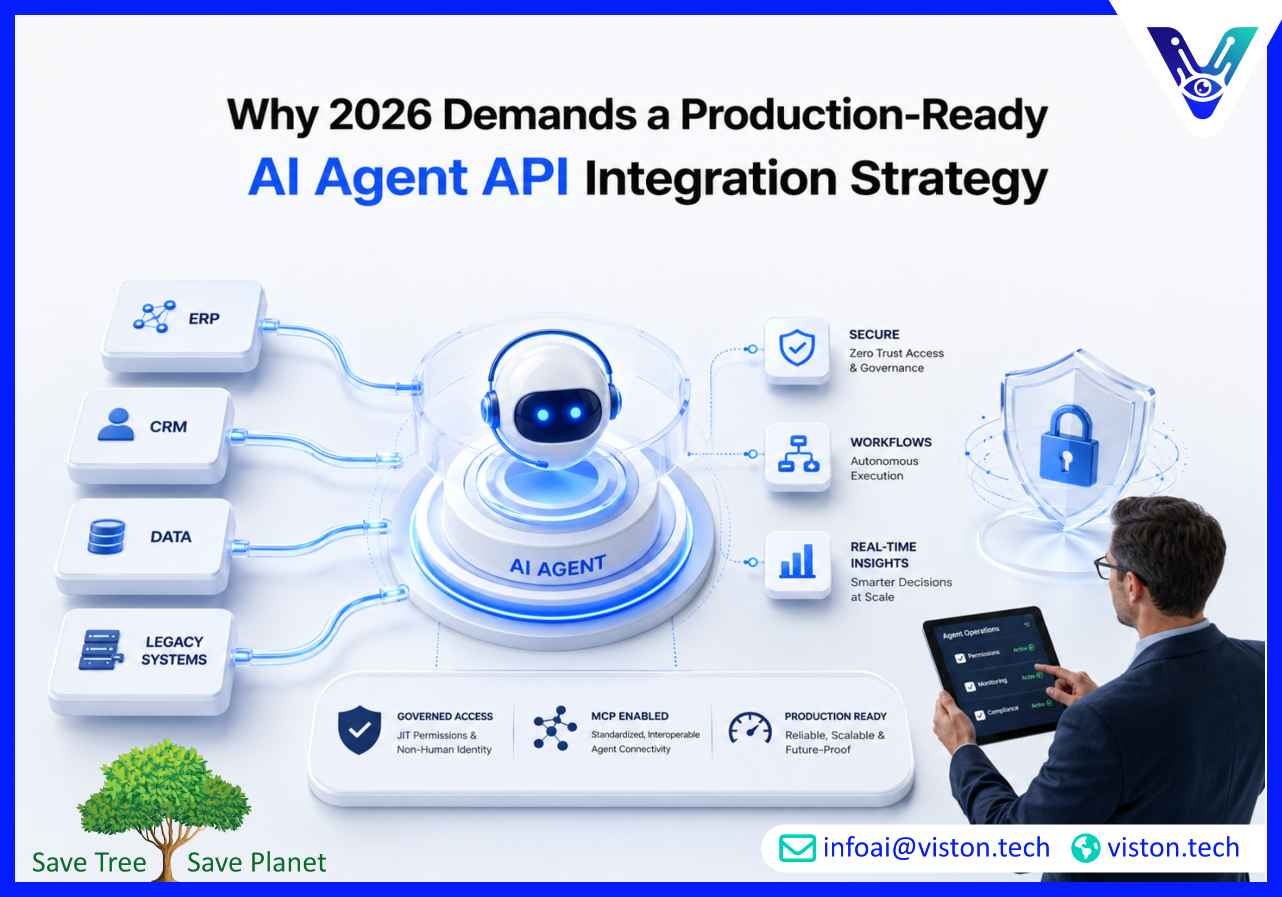
For most enterprises, the conversation around AI agents has shifted from experimental pilot to production reality. However, the path to deployment is currently blocked by a critical bottleneck: integration. As systems of record tighten their policies and autonomous workflows demand real-time data, businesses are discovering that connecting AI agents to complex enterprise ecosystems requires far more than simple API keys. In 2026, specialized Agent Integration Services are no longer a luxury but a technical necessity for governance, security, and reliability at scale .
The enterprise software landscape experienced a structural shift in early 2026. Major platforms like SAP, Salesforce, and ServiceNow have updated their terms to specifically govern how AI agents interact with their systems. SAP’s API policy revision (Section 2.2.2), for instance, explicitly restricts third-party AI agents from accessing core APIs unless routed through specific endorsed architectures .
This creates a difficult scenario for business decision-makers. While you legally own your operational data, the access pathways required for AI agents to act on that data are increasingly controlled by vendors. Direct API calls from autonomous agents risk policy violations, security flags, or service throttling. Consequently, the technical challenge is no longer just about moving data, but about navigating a complex web of vendor-specific governance rules to ensure your agents remain both compliant and functional .
Current data indicates that while 82% of enterprises plan to deploy AI agents, fewer than half have successfully moved them into production. The primary obstacle is the “execution gap”—the difficulty in connecting the agent’s reasoning engine with legacy protocols, authentication systems, and non-standardized endpoints .
Generic integration platforms often fail here because they lack the context of agentic workflows. An AI agent does not simply fetch a record; it plans, selects tools, and executes sequences of calls. Professional Agent Integration Services address this by moving beyond simple point-to-point API connections to build a durable, governed connectivity layer. This involves implementing just-in-time (JIT) permissions, cryptographic identity verification for non-human actors, and abstraction layers that shield the agent from underlying system volatility .
Integrating AI agents is fundamentally different from integrating static applications. Agents are dynamic actors. They spawn sub-tasks and navigate across domains. According to the latest AIUC-1 compliance updates (Q2 2026), every agent requires a unique, cryptographically verifiable identity, distinct from traditional service accounts .
Furthermore, 2026 has seen the rapid adoption of the Model Context Protocol (MCP) as a standard for agent-tool interaction. MCP allows agents to discover and interact with tools dynamically. However, an ungoverned MCP layer is a security risk. True integration requires enforcing zero-trust principles at the API gateway level, ensuring that an agent calling an API via MCP has the specific, time-limited clearance for that precise action, not blanket access to the system .
Navigating the fragmented landscape of vendor policies, identity protocols (like SPIFFE), and API gateways requires deep specialization. Viston AI bridges the gap between experimental AI prototypes and reliable business automation. Our Agent Integration Services are specifically designed to address the “last mile” execution challenges that stall enterprise adoption. We provide the engineering expertise to deploy and manage the secure connectivity layer your business needs. Viston AI focuses on building a neutral, independent integration architecture that sits between your AI agents and your existing enterprise resource planning (ERP), customer relationship management (CRM), and data systems. By implementing standardized MCP servers and rigorous non-human identity management, we help ensure your agents have safe, compliant, and real-time access to the data they need to autonomously resolve complex business tasks without being blocked by policy changes or security overrides.
Standard API integration typically handles static, read/write requests. AI Agent Integration supports dynamic, multi-step workflows. It requires the system to handle planning, tool selection, state management, and autonomous error correction, along with specific security protocols like JIT access for non-human identities .
SAP’s 2026 policy restricts third-party agents from directly calling core APIs. To remain compliant without losing functionality, you need an intermediary integration layer or an endorsed gateway architecture. Viston AI helps architect pathways that adhere to these new legal constraints while maintaining operational flow .
MCP is an emerging standard that allows AI agents to securely connect with data sources and tools. It acts as a universal connector, preventing vendor lock-in. Integrating via MCP allows your agents to switch between tools and data sources without rebuilding the integration for every new model .
Security is established through Non-Human Identity (NHI) management. Rather than using static API keys, Viston AI implements Zero Standing Privileges (ZSP). The agent is granted access only for the duration of a specific task, and that access is revoked immediately upon task completion, minimizing the attack surface .
It is an ongoing operational necessity. As vendor APIs update, security threats evolve, and your business logic changes, the integration layer requires constant monitoring, observability, and tuning to ensure the agent continues to perform accurately and safely .
As we move further into 2026, the ability to deploy reliable AI agents depends almost entirely on the robustness of your integration architecture. The era of basic API wrappers is over. To achieve true automation, businesses must invest in specialized Agent Integration Services that prioritize compliance, identity governance, and protocol standardization. By partnering with expert teams like Viston AI, enterprises can shift their focus from fighting connectivity fires to leveraging autonomous systems that drive real business value. The technology is ready. Your infrastructure needs to be too.
