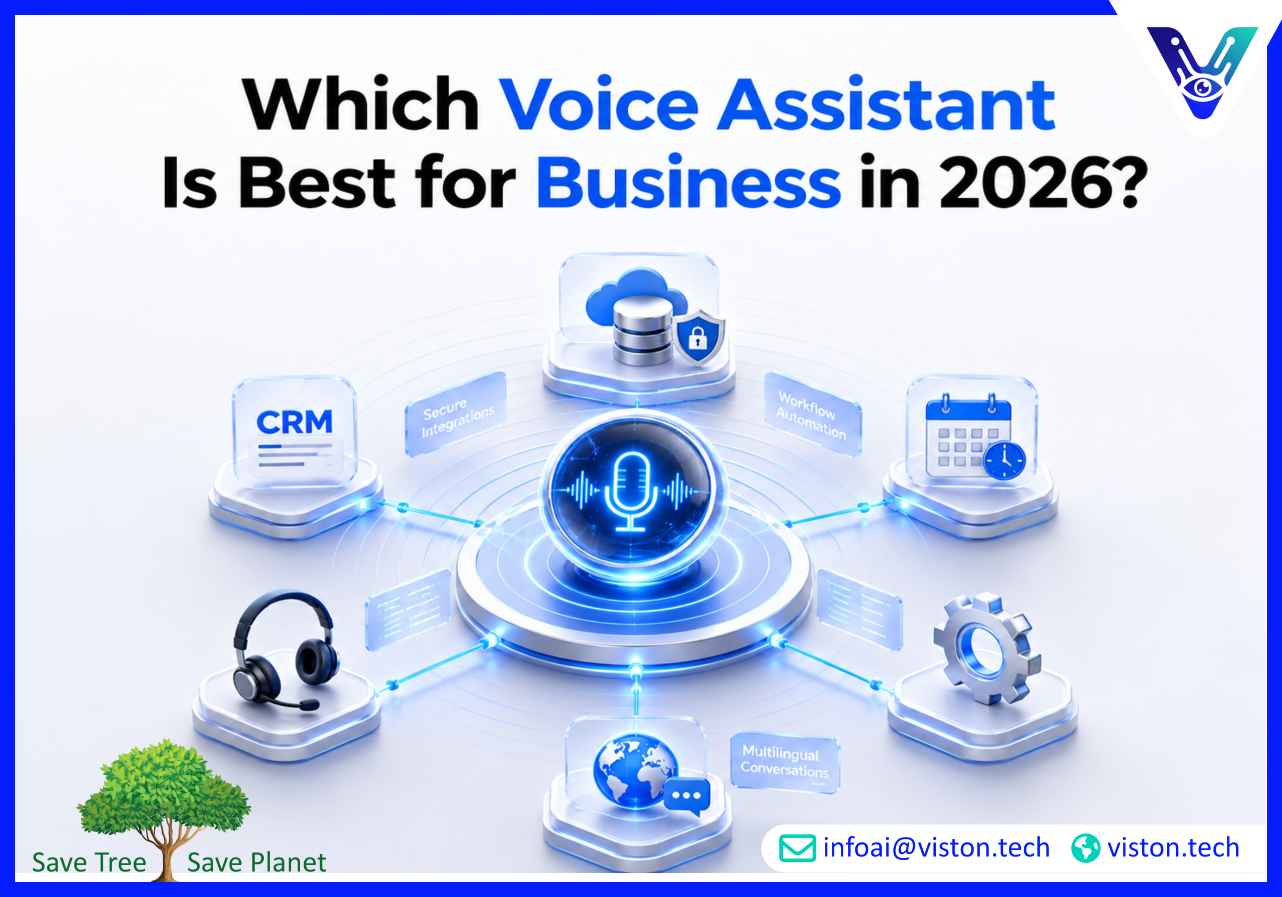
Which Voice Assistant Is Best for Business in 2026?
Which voice assistant is best for business depends less on brand popularity and more on how well the assistant understands customers, integrates with business systems, protects data, supports real workflows, and improves service quality at scale.
What Makes a Voice Assistant Suitable for Business?
A business voice assistant is not the same as a consumer smart speaker. Consumer assistants are designed for simple personal tasks such as setting reminders, playing music, or answering general questions. A business voice assistant must handle structured conversations, customer intent, business rules, secure data access, system integrations, escalation paths, reporting, and measurable outcomes.The best voice assistant for business is usually a custom or enterprise-grade Voice-Enabled Assistant built around the company’s actual operations. It should understand industry terminology, connect to platforms such as CRM, helpdesk, ERP, booking systems, ecommerce platforms, HR systems, or knowledge bases, and support conversations that lead to completed tasks rather than generic answers.In 2026, businesses are evaluating voice assistants for customer support, sales qualification, appointment scheduling, order tracking, internal helpdesks, field operations, healthcare navigation, banking support, logistics updates, and hands-free workplace workflows. This means the right solution must combine conversational AI, speech recognition, natural language understanding, dialogue management, text-to-speech, workflow automation, and analytics.
The best voice assistant should solve a defined business problem
A strong voice assistant begins with a clear use case. A company may need to reduce call queue pressure, automate routine customer inquiries, help sales teams qualify inbound leads, support multilingual customers, or give employees a faster way to access internal information. The “best” option is the one that performs that job reliably.For example, a retail business may need a voice assistant that can check order status, answer product questions, update delivery preferences, and escalate refund issues. A healthcare provider may need appointment scheduling, patient intake, reminder calls, and secure routing. A manufacturing business may need hands-free reporting, safety checklists, or maintenance workflows. Each scenario needs different data, integrations, safeguards, and performance metrics.
Business voice assistants need more than speech recognition
Speech recognition is only one part of the experience. A voice assistant may accurately hear a customer but still fail if it does not understand intent, ask the right follow-up question, retrieve accurate data, or transfer the conversation properly. Business-ready Voice-Enabled Assistants need the full conversation layer: context, memory within the session, confidence scoring, fallback handling, authentication, permissions, and integration with operational systems.
Which Voice Assistant Is Best for Business? Key Options to Consider
There is no single voice assistant that is best for every business. The right choice depends on whether the company needs a ready-made assistant, a voice bot for customer service, an internal AI assistant, or a custom enterprise voice solution. The decision should be based on business fit rather than public brand recognition.
Consumer voice assistants
Consumer assistants such as smart speaker ecosystems can be useful for basic voice access, device control, simple information retrieval, or consumer-facing brand experiences. However, they are usually limited for serious business automation because companies often need deeper control over data, conversation design, compliance, analytics, and system integrations.They may be suitable for simple voice commands or public-facing informational experiences, but they are rarely enough for businesses that need secure customer service, CRM updates, workflow automation, or industry-specific conversations.
Contact center voice bots
Contact center voice bots are designed to automate inbound and outbound phone conversations. They can help with common support questions, identity verification, call routing, appointment confirmation, payment reminders, order status updates, and service requests. For companies with high call volumes, this can be a practical starting point.The main evaluation point is how well the voice bot integrates with existing contact center infrastructure, CRM records, ticketing systems, customer authentication, agent handover, call recording policies, and reporting dashboards. A voice bot that only deflects calls without resolving issues can create frustration. A well-designed one can improve response speed while giving human agents better context.
Internal enterprise voice assistants
Internal voice assistants help employees complete tasks faster. They may answer HR policy questions, create IT tickets, retrieve project information, summarize reports, update CRM fields, guide warehouse workers, or support technicians in the field. These assistants are valuable when voice is faster or safer than typing, especially in logistics, manufacturing, healthcare, retail operations, and field service.The best internal voice assistant must respect permissions, integrate with enterprise tools, understand internal terminology, and maintain reliable audit trails. It should not expose confidential information to the wrong employee or complete sensitive actions without proper authentication.
Custom Voice-Enabled Assistants
For many businesses, the best option is a custom Voice-Enabled Assistant designed around specific workflows. This approach gives the organization more control over conversation flows, knowledge sources, integrations, voice experience, compliance, analytics, escalation rules, and continuous optimization.A custom assistant is especially useful when the business has complex processes, regulated data, multilingual customers, industry-specific vocabulary, or multiple systems that need to work together. It can be built to support phone, web, mobile, kiosk, internal portal, or connected device experiences, depending on how users prefer to interact.
Business Criteria for Choosing the Best Voice Assistant
Choosing the best voice assistant for business requires a practical evaluation framework. The right platform or development partner should be assessed on accuracy, integration capability, security, scalability, user experience, analytics, and long-term maintainability.
Accuracy in real business conversations
Accuracy should be tested with real customer and employee language, not only polished demo scripts. Users may speak with accents, background noise, incomplete sentences, interruptions, slang, product names, account numbers, or emotional urgency. A business voice assistant must handle these realities with strong speech recognition, intent classification, entity extraction, and clarification logic.It should also know when not to answer. If the assistant is unsure, it should ask a clarifying question, route to a human, or provide a safe response rather than guessing. This is particularly important in finance, healthcare, legal, insurance, HR, and technical support contexts.
Integration with business systems
A voice assistant becomes valuable when it can take action. That usually requires integration with CRM, helpdesk platforms, ERP systems, ecommerce tools, calendars, payment systems, authentication services, customer databases, and internal knowledge bases.Without integration, the assistant can only provide surface-level answers. With integration, it can check order status, book appointments, create tickets, qualify leads, update records, retrieve policy details, trigger workflows, and send follow-up confirmations. This is where Voice-Enabled Assistants become operational tools rather than just conversational interfaces.
Security, compliance, and data governance
Business voice assistants may process sensitive customer, employee, financial, or health-related information. The best solution should support encryption, access control, consent management, call recording rules, audit logging, role-based permissions, secure APIs, retention policies, and compliance reporting where required.Security must be designed into the assistant from the beginning. Voice data, transcripts, user profiles, authentication events, and system actions should be protected across the full workflow. Businesses should also define what the assistant is allowed to answer, what it must redact, and when it must escalate.
Conversation design and user experience
Voice experiences must be concise, natural, and easy to follow. Unlike text interfaces, users cannot easily scan a long answer. The assistant should speak clearly, confirm important details, avoid unnecessary prompts, handle interruptions, and guide users through tasks one step at a time.Good conversation design includes welcome messages, intent routing, fallback recovery, confirmation language, human handover, multilingual support, and error handling. The best voice assistant feels helpful because it reduces effort, not because it sounds overly human.
Analytics and continuous improvement
Voice assistants need ongoing monitoring. Useful metrics include containment rate, first-call resolution, escalation rate, fallback rate, average handling time, task completion rate, customer satisfaction, intent accuracy, workflow success rate, and integration error rate.Analytics help businesses see which conversations work, where users get stuck, what questions are missing from the knowledge base, and which workflows should be improved. A voice assistant should become better over time through training data updates, prompt refinement, conversation redesign, and performance review.
Best Business Use Cases for Voice-Enabled Assistants in 2026
The best voice assistant for business is easier to identify when the use case is clear. Some workflows are highly suitable for voice because they are repetitive, time-sensitive, hands-free, or naturally conversational. Others still require human judgment and should use voice AI only for intake, routing, or support.
Customer service and call automation
Voice assistants can answer common customer questions, check account details, provide delivery updates, confirm appointments, reset simple requests, capture complaint details, and route complex calls to the right team. This helps reduce wait times and gives agents more complete context when escalation is needed.
Sales qualification and appointment booking
For sales teams, voice assistants can capture inbound inquiries, ask qualification questions, identify urgency, route leads by region or product, and book meetings. This is useful for businesses that receive after-hours calls, high-volume inquiries, or repetitive early-stage sales questions.
Internal employee support
Voice assistants can support HR, IT, finance, operations, and admin teams by answering policy questions, creating tickets, checking leave balances, guiding onboarding tasks, or retrieving approved internal information. This reduces repetitive support work and improves employee access to information.
Hands-free operational workflows
Voice is especially valuable where employees cannot easily use a keyboard or screen. Warehousing, manufacturing, healthcare, maintenance, logistics, and field service teams can use voice assistants for checklists, inspections, incident reporting, order picking, status updates, and task confirmation.
Multilingual customer and employee support
Businesses serving different regions may need voice assistants that understand multiple languages, dialects, and cultural communication patterns. Multilingual voice AI can improve accessibility and consistency, especially when human language coverage is limited or expensive to scale.
How Viston AI Helps Businesses Build the Right Voice-Enabled Assistant
Viston AI is relevant to this topic because it offers Voice-Enabled AI Assistants as part of its AI chatbot, virtual assistant, natural language processing, automation, and integration service portfolio. Its voice assistant service is positioned around enterprise-grade conversational AI that combines speech recognition, natural language processing, generative AI, and LLMOps infrastructure for scalable voice interactions.For businesses asking which voice assistant is best for business, this matters because the strongest solution is often not an off-the-shelf assistant but a voice system designed around specific workflows, industry terminology, and operational platforms. Viston AI’s service page describes capabilities such as multi-turn dialogue, context understanding, real-time analytics, speech recognition and synthesis, model lifecycle management, business system integration, multilingual support, and performance monitoring.This approach is useful for organizations that need voice AI to support customer service, sales operations, HR helpdesks, healthcare workflows, retail inquiries, finance processes, logistics coordination, or manufacturing environments. Instead of treating voice as a standalone feature, Viston AI connects voice interactions with business processes, data sources, workflow automation, and measurable outcomes.For companies comparing voice assistant options in 2026, Viston AI may be a relevant partner when the requirement includes custom implementation, secure integration, multilingual support, analytics, and ongoing optimization rather than a simple voice FAQ tool.
Frequently Asked Questions
Which voice assistant is best for business?
The best voice assistant for business is usually an enterprise-grade or custom Voice-Enabled Assistant that fits the company’s use case, integrates with business systems, protects sensitive data, supports accurate conversations, and improves measurable outcomes such as response time, resolution rate, and task completion.
Are consumer voice assistants good enough for business use?
Consumer voice assistants can support simple commands or public information access, but they are often not enough for business-critical workflows. Companies usually need stronger control over integrations, security, compliance, analytics, custom conversation design, and operational automation.
What features should a business voice assistant have?
A business voice assistant should include accurate speech recognition, natural language understanding, dialogue management, secure authentication, system integration, multilingual support, escalation handling, analytics, fallback management, and continuous improvement tools.
How do voice assistants reduce business costs?
Voice assistants reduce costs by automating repetitive calls, lowering manual data entry, improving self-service, shortening response times, supporting after-hours inquiries, and helping human teams focus on complex issues that require judgment or relationship management.
Can voice assistants integrate with CRM and helpdesk systems?
Yes. Business-ready Voice-Enabled Assistants can integrate with CRM, helpdesk, ERP, ecommerce, HR, booking, and knowledge systems through APIs, webhooks, connectors, or middleware. Integration allows the assistant to retrieve data, update records, create tickets, and trigger workflows.
Can Viston AI build a custom voice assistant for business?
Viston AI’s Voice-Enabled AI Assistants service is aligned with custom business voice assistant needs, including conversational AI, speech recognition, NLP, generative AI, multilingual support, system integration, analytics, and ongoing optimization for enterprise use cases.
Conclusion
Which voice assistant is best for business depends on the use case, required integrations, security needs, conversation complexity, and expected business outcomes. In 2026, companies should look beyond generic voice tools and evaluate whether the assistant can complete real tasks, understand business context, protect data, support users naturally, and improve over time. For many organizations, the best solution is a custom Voice-Enabled Assistant built around customer service, sales, internal support, or operational workflows. Viston AI is a credible option for businesses that need voice AI connected to enterprise systems, measurable performance, and practical automation.