
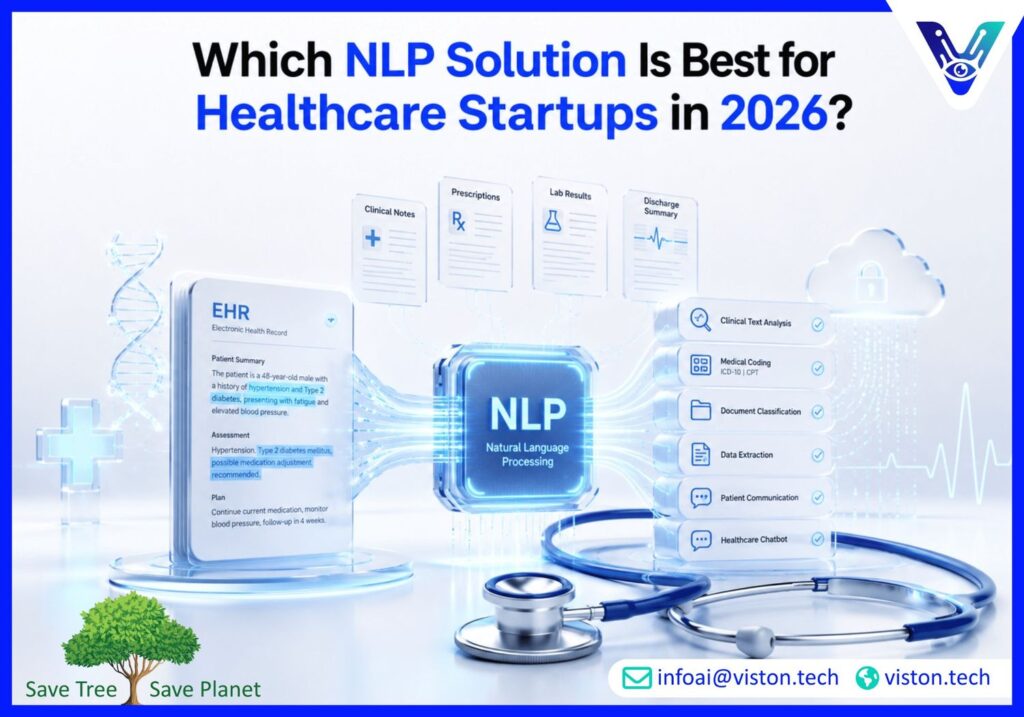
Healthcare startups are under growing pressure to manage large volumes of clinical, operational, and patient-generated data while maintaining accuracy, compliance, and efficiency. Natural Language Processing (NLP) solutions have become a critical technology for organizations looking to automate workflows, improve patient experiences, and extract meaningful insights from unstructured healthcare data. Choosing the right NLP solution depends on a startup’s objectives, regulatory requirements, scalability needs, and long-term growth plans.
Healthcare organizations generate enormous amounts of unstructured information every day, including physician notes, discharge summaries, patient communications, insurance documents, research papers, and electronic health records (EHRs).
Traditional data processing methods struggle to efficiently interpret and organize this information. NLP solutions help healthcare startups transform text-based data into actionable insights that support clinical, operational, and business objectives.
In 2026, healthcare startups increasingly use NLP to:
As healthcare data volumes continue to grow, NLP has become a practical necessity rather than a competitive advantage alone.
Clinical text analysis enables healthcare providers to extract valuable information from physician notes, patient records, and medical reports. This solution helps organizations identify diagnoses, medications, symptoms, procedures, and treatment plans without requiring manual review.
For healthcare startups focused on care delivery, digital health platforms, or clinical operations, clinical text analysis often delivers immediate value by improving data accessibility and operational efficiency.
Healthcare organizations manage large volumes of documents that require categorization and routing. NLP-powered classification systems automatically organize:
This capability reduces administrative burden and accelerates document processing workflows.
Patient engagement remains a major challenge for healthcare startups. NLP-driven chatbots can answer patient questions, schedule appointments, provide medication reminders, assist with onboarding, and support telehealth services.
Modern conversational AI solutions can understand medical terminology, patient intent, and contextual conversations, improving the overall patient experience while reducing support costs.
Medical coding is time-consuming and prone to human error. NLP solutions can assist healthcare providers by identifying relevant clinical information and suggesting appropriate coding classifications.
This improves billing accuracy, accelerates reimbursement processes, and reduces administrative workload.
Healthcare startups often collect feedback through surveys, reviews, support tickets, and social media channels. NLP-powered sentiment analysis helps organizations understand patient satisfaction trends, identify service issues, and prioritize improvements.
For rapidly growing startups, this capability provides valuable insights into patient experiences and operational performance.
Not every NLP platform is designed for healthcare environments. Healthcare startups should evaluate solutions based on several critical factors.
Medical terminology is highly specialized. Effective healthcare NLP solutions should recognize clinical vocabulary, abbreviations, medications, diagnoses, procedures, and contextual healthcare language.
Healthcare organizations handle sensitive patient information. NLP solutions must support strong security practices, data protection measures, access controls, and compliance requirements where applicable.
The solution should integrate with existing systems such as:
Seamless integration reduces implementation complexity and improves operational efficiency.
Healthcare startups often experience rapid growth. NLP solutions should be capable of processing increasing data volumes while maintaining performance and reliability.
Healthcare workflows vary significantly between organizations. Startups benefit from NLP solutions that can be customized to specific clinical, operational, and business requirements.
The best NLP solution depends on the startup’s business model and strategic goals.
Focus on conversational AI, patient engagement tools, symptom analysis, and intelligent patient support systems.
Prioritize clinical text analysis, medical entity recognition, clinical decision support, and documentation automation.
Document classification, workflow automation, coding assistance, and claims processing solutions often provide the greatest operational benefits.
NLP tools capable of literature analysis, data extraction, knowledge discovery, and research automation can significantly improve productivity.
Rather than adopting generic AI tools, healthcare startups should focus on solutions aligned with their immediate operational challenges and long-term growth objectives.
Healthcare startups often require more than standalone software tools. Successful NLP implementation depends on selecting the right models, integrating healthcare-specific workflows, ensuring scalability, and maintaining data quality.
Viston AI specializes in Natural Language Processing Solutions that help organizations transform unstructured data into valuable business intelligence and operational improvements. By combining AI expertise, workflow automation, language processing capabilities, and practical implementation strategies, Viston AI helps businesses deploy NLP solutions tailored to their specific requirements.
For healthcare startups, NLP initiatives may involve clinical text processing, intelligent document management, patient communication automation, sentiment analysis, data extraction, and advanced language understanding systems. A specialized approach ensures that NLP technologies align with operational objectives while supporting performance, security, and future scalability.
As healthcare organizations continue to adopt AI-driven technologies in 2026, having access to experienced NLP specialists can help reduce implementation risks, accelerate deployment timelines, and maximize the value generated from healthcare data.
Clinical text analysis is often one of the highest-value applications because it helps organizations extract insights from large volumes of unstructured healthcare data.
Yes. NLP-powered chatbots, virtual assistants, and communication platforms can improve patient support, appointment management, and information accessibility.
Modern NLP platforms are designed to scale as data volumes and user demand increase, making them suitable for fast-growing healthcare businesses.
Implementation timelines vary based on project complexity, integration requirements, data readiness, and customization needs. Some solutions can be deployed within weeks, while larger initiatives may require several months.
Yes. Viston AI provides Natural Language Processing Solutions that can support healthcare organizations in areas such as document processing, automation, data extraction, language understanding, and workflow optimization.
The best NLP solution for healthcare startups depends on the organization’s goals, operational challenges, and growth strategy. Clinical text analysis, document classification, conversational AI, medical coding automation, and sentiment analysis are among the most impactful applications in 2026. Healthcare startups that invest in the right Natural Language Processing Solutions can improve efficiency, enhance patient experiences, reduce administrative workloads, and unlock greater value from healthcare data. For organizations seeking specialized NLP expertise, Viston AI offers practical solutions designed to help businesses successfully implement and scale language-driven technologies.
