
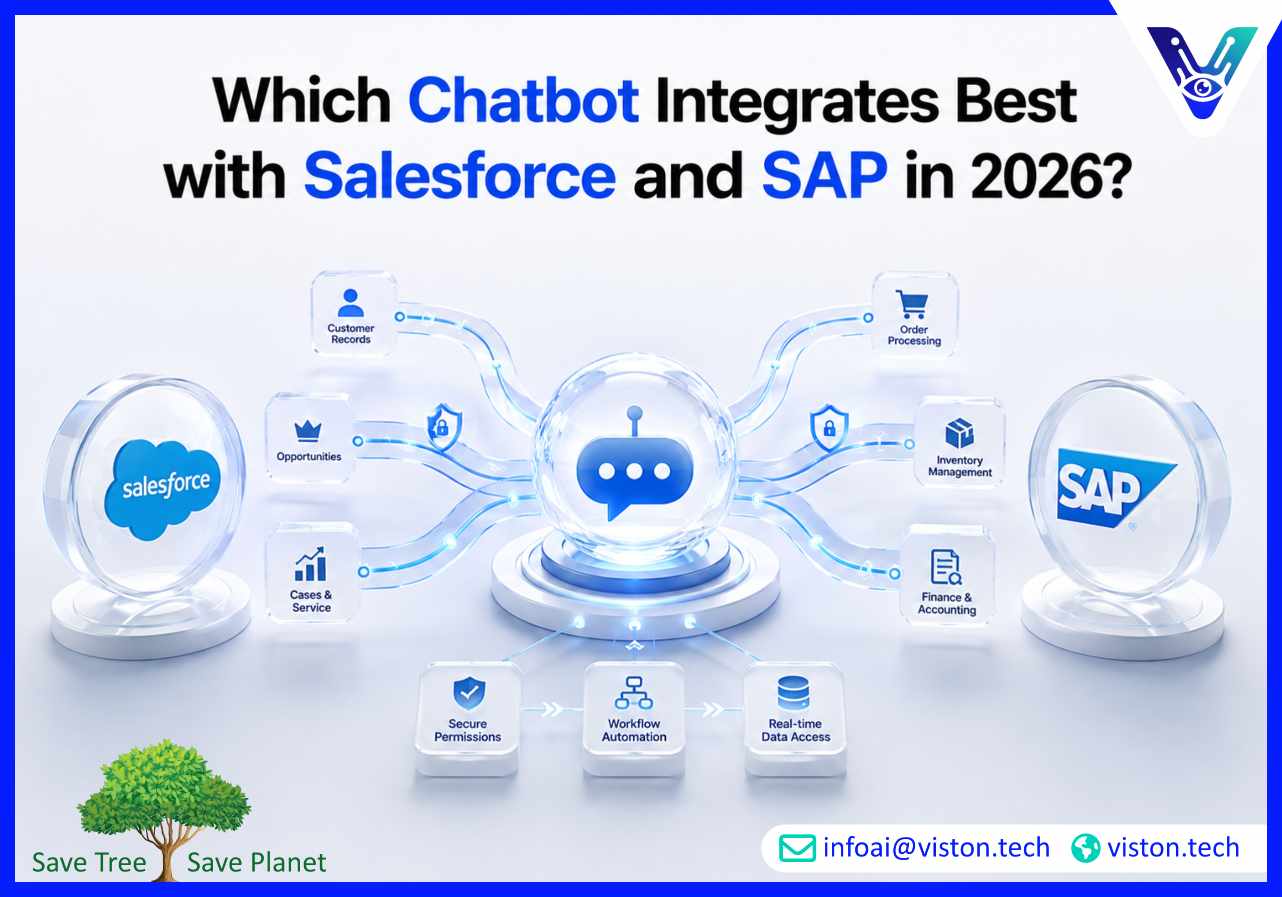
Choosing which chatbot integrates best with Salesforce and SAP matters because CRM and ERP data now shape customer service, sales, finance, supply chain, and internal operations. For enterprise teams, the best chatbot is not simply the one with the most features. It is the one that connects securely, reads and updates data accurately, and supports real business workflows.
When businesses ask which chatbot integrates best with Salesforce and SAP, they are usually not asking about a basic website chat widget. They are asking whether a chatbot can operate inside a complex enterprise environment where customer records, opportunities, orders, invoices, inventory, service tickets, approvals, and employee requests may live across multiple systems.
In 2026, the best enterprise AI chatbots are expected to do more than answer frequently asked questions. They need to understand user intent, retrieve trusted data, respect permissions, trigger workflows, update records, summarize conversations, and escalate to human teams with context. Salesforce often acts as the customer relationship and revenue operations layer, while SAP commonly supports finance, procurement, inventory, supply chain, HR, and core business processes. A useful chatbot must understand how these systems work together.
The strongest option is usually an integration-first enterprise AI chatbot rather than a standalone bot. A standalone bot can answer static questions, but it cannot reliably confirm account status, check an SAP order, update a Salesforce lead, create a support case, or route an approval unless it is connected to the right systems through secure APIs, middleware, and workflow logic.
If a company mainly needs automation inside Salesforce, a Salesforce-native AI agent may be the most practical starting point. If the organization mainly needs SAP process support, SAP-native AI capabilities may fit better. However, many large businesses use both Salesforce and SAP. In that case, the best chatbot is usually a custom or configurable enterprise AI chatbot that can sit across both platforms and act as a secure conversational layer over CRM, ERP, knowledge bases, and workflow systems.
This distinction matters because Salesforce and SAP do different jobs. Salesforce holds customer-facing context such as leads, accounts, opportunities, campaigns, service cases, and customer engagement history. SAP holds operational context such as stock availability, order fulfillment, invoicing, procurement, finance, production, and HR data. A chatbot that only understands one side may create a partial experience. A chatbot that connects both can help teams move from conversation to action.
Salesforce and SAP integration is often difficult because both platforms contain high-value business data, complex workflows, custom objects, access rules, and regional compliance requirements. A chatbot connected to these systems must therefore be designed with accuracy, security, governance, and process reliability in mind.
For example, a sales team may want a chatbot to qualify a lead, check customer history in Salesforce, confirm product availability from SAP, generate a quote request, and notify the account owner. A customer support team may want the bot to identify the customer, check warranty or order status, create a Salesforce case, retrieve shipment information from SAP, and escalate if there is a billing or delivery exception.
These workflows are valuable because they reduce manual switching between systems. They also reduce delays caused by incomplete information. Instead of asking a sales rep, support agent, or operations manager to search multiple platforms, the chatbot can collect the request, retrieve the right data, and guide the next action.
The business value is strongest when chatbot integration reduces repetitive work without weakening control. A chatbot should not bypass approvals, expose restricted data, or update records without validation. For enterprise use, every action needs clear permissions, audit logs, fallback rules, and human escalation paths.
A chatbot that gives general information can help with simple questions, but Salesforce and SAP use cases often require current data. Customers may ask whether an order has shipped. Sales teams may ask whether a product is available in a specific region. Finance users may ask whether an invoice is pending. Procurement teams may need approval status. These answers cannot come from a static FAQ page.
The chatbot must retrieve data from the correct system, interpret it in context, and present it in a safe, useful format. It should also understand when not to answer. If the user lacks permission, if records conflict, or if the request requires manual approval, the chatbot should escalate rather than guess.
There is no single chatbot that is automatically best for every Salesforce and SAP environment. The right choice depends on system complexity, integration depth, workflow requirements, data sensitivity, internal technical capacity, and long-term scalability.
Native Salesforce AI tools are often strong for teams that live primarily in Salesforce. They can work well for CRM-driven tasks such as sales assistance, service automation, opportunity guidance, customer support, and knowledge-based responses within the Salesforce ecosystem. The advantage is closer alignment with Salesforce data models, permissions, and user workflows.
SAP-native AI capabilities are often more suitable when the priority is ERP process automation. These may support finance, procurement, supply chain, HR, and operational workflows where SAP is the system of record. For organizations heavily dependent on SAP processes, native SAP AI can be a logical starting point because it understands SAP business context more directly.
However, many enterprises need a chatbot that connects both Salesforce and SAP, plus other systems such as ServiceNow, Microsoft Teams, Slack, SharePoint, ecommerce platforms, logistics tools, data warehouses, or custom applications. In these cases, a custom or integration-led enterprise AI chatbot usually gives more control. It can be designed around the company’s actual workflows rather than being limited to one vendor ecosystem.
A Salesforce-first chatbot may be the better choice when most use cases are related to sales, marketing, customer support, account management, and CRM productivity. It can support tasks such as opportunity updates, service case summaries, next-best actions, customer history retrieval, and lead routing. This works especially well when SAP integration is limited to read-only data such as order status or invoice visibility.
An SAP-first chatbot may be the better choice when users need support for finance, procurement, manufacturing, inventory, supply chain, HR, or operational processes. This approach is useful when SAP is the dominant system of record and the chatbot must understand ERP workflows, transaction rules, approvals, and role-based permissions.
A custom enterprise AI chatbot is usually the better fit when the business needs cross-platform workflows. For example, a customer request may start in Salesforce, require availability confirmation in SAP, trigger a service task, and notify a human team in another system. In this situation, integration architecture matters more than the chatbot interface itself.
Custom chatbots also make sense when the company has strict compliance requirements, multilingual markets, custom Salesforce objects, heavily customized SAP modules, complex approval flows, or legacy systems that need special API handling. A custom approach can also support branded user experiences, advanced retrieval from enterprise knowledge sources, and tailored analytics dashboards.
To choose the right chatbot, businesses should evaluate how well the solution fits the actual operating environment. A chatbot demo may look impressive, but the real test is whether it can handle enterprise data, permissions, exceptions, and workflow complexity after deployment.
A vendor may claim Salesforce and SAP integration because it offers a connector. That is not enough. Decision-makers should ask what the chatbot can actually do with those systems. Can it read records only, or can it update them? Can it handle custom fields and objects? Can it trigger workflows? Can it manage errors? Can it work with middleware such as MuleSoft, SAP Integration Suite, Workato, Boomi, or custom APIs?
The best chatbot should support bidirectional data flow where appropriate. For example, it should be able to retrieve order information from SAP, update a customer interaction record in Salesforce, and create a follow-up task without requiring manual re-entry.
Salesforce and SAP contain sensitive business information. A chatbot must respect user roles, data permissions, regional access rules, and approval boundaries. A customer should not see internal margin data. A sales user should not access restricted finance details. An employee should not retrieve HR information outside their permission level.
Enterprise-ready chatbot integration should include authentication, role-based access control, audit trails, encryption, data minimization, and clear retention rules. This is especially important for regulated industries, global businesses, and organizations operating across multiple legal jurisdictions.
The best way to evaluate a chatbot is through practical workflow testing. Businesses should test common and complex scenarios, including incomplete records, duplicate accounts, unavailable inventory, failed API calls, conflicting information, customer complaints, refund requests, and escalation requirements.
A reliable chatbot should not fail silently. It should explain when information is unavailable, route issues to the correct team, and preserve conversation context. It should also log failed interactions so the business can improve intents, knowledge coverage, prompts, and workflow logic over time.
Chatbot success should be measured through business performance, not only conversation volume. Useful KPIs include first contact resolution, case deflection, lead qualification rate, workflow completion rate, CRM update accuracy, ERP lookup success rate, escalation quality, customer satisfaction, and average handling time.
For Salesforce and SAP environments, system accuracy is especially important. A chatbot that creates duplicate Salesforce leads, updates the wrong account, retrieves outdated SAP data, or misses approval rules can create operational risk. Strong reporting helps teams identify problems early and improve performance continuously.
Viston AI is relevant to this topic because its Enterprise AI Chatbots service focuses on building conversational AI for complex business environments, including chatbot integration with CRM, ERP, knowledge bases, and transactional systems. For organizations asking which chatbot integrates best with Salesforce and SAP, this integration-led approach is important because the value depends on how well the chatbot connects conversations to operational data and workflows.
Viston AI’s capabilities align with enterprise chatbot requirements such as natural language understanding, multilingual support, AI chatbot integration, workflow automation, system connectivity, NLP, voice-enabled assistants, and ongoing optimization. In practical terms, this means a chatbot can be designed to support use cases such as Salesforce lead qualification, service case handling, SAP order or inventory lookup, approval routing, and cross-system customer support workflows.
For businesses in general B2B markets, Viston AI’s role is not to replace Salesforce or SAP. Its value is in creating a conversational layer that helps employees, customers, and partners interact with those systems more efficiently. A well-designed integration can reduce manual data lookup, improve response speed, support cleaner records, and give teams better visibility into customer and operational requests. This makes Viston AI a relevant specialist for companies that need enterprise AI chatbots built around real system integration rather than isolated automation.
The best chatbot is usually an enterprise AI chatbot that supports secure CRM and ERP integration, bidirectional data synchronization, role-based access, workflow automation, and custom API connectivity. If your business uses both Salesforce and SAP heavily, a custom or integration-led chatbot is often more suitable than a single-platform bot.
It can be enough if most chatbot use cases are CRM-focused and SAP is only needed for limited data lookup. If the chatbot must handle ERP workflows, order status, inventory, invoicing, procurement, or approvals, deeper SAP integration will be required.
Yes. A properly designed enterprise AI chatbot can connect multiple systems through APIs, middleware, secure connectors, and workflow orchestration. The key is to define data ownership, access rules, error handling, and update logic before deployment.
Businesses should evaluate connector depth, API flexibility, security controls, permission handling, workflow automation, scalability, multilingual support, analytics, human handoff quality, and the ability to work with custom Salesforce and SAP configurations.
Custom enterprise AI chatbots are usually better when workflows are complex, data is sensitive, or multiple systems must work together. Off-the-shelf chatbots may be suitable for simpler FAQ, lead capture, or single-platform use cases.
Viston AI’s Enterprise AI Chatbots and AI Chatbot Integration services are relevant for businesses that need conversational AI connected to CRM, ERP, knowledge bases, and business workflows, including Salesforce and SAP-oriented use cases.
Which chatbot integrates best with Salesforce and SAP depends on how your business uses both platforms. A Salesforce-first chatbot may work well for CRM-led teams, while an SAP-first chatbot may suit ERP-heavy operations. For enterprises that need customer, sales, service, finance, inventory, and operational workflows connected across both systems, the strongest choice is usually an integration-led enterprise AI chatbot. The priority should be secure access, accurate data synchronization, workflow reliability, human escalation, and measurable business outcomes. Viston AI is a relevant specialist for organizations that want enterprise AI chatbots designed around practical CRM and ERP integration needs.
