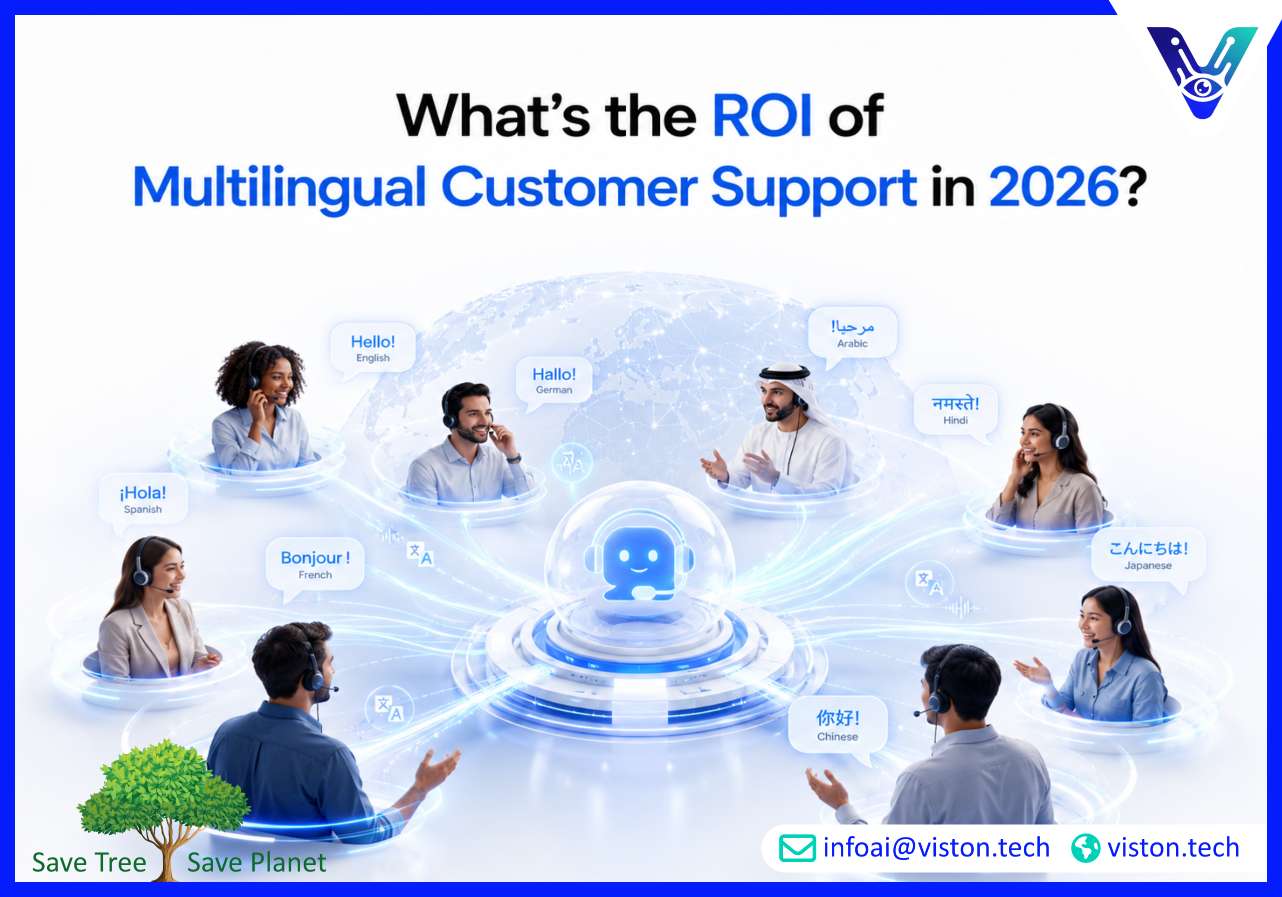
What’s the ROI of Multilingual Customer Support in 2026?
Multilingual customer support ROI comes from more than reducing translation costs. It can improve customer retention, increase conversions in international markets, expand support capacity, shorten resolution times, and help businesses enter new regions without building a separate service team for every language.
What Multilingual Customer Support ROI Means for a Business
The return on multilingual customer support is the measurable business value created by serving customers in their preferred languages compared with the total cost of delivering that support.Traditional ROI analysis often focuses on one question: does multilingual support reduce the cost of handling customer enquiries? Cost efficiency is important, but it represents only part of the value.A complete calculation should examine four areas:
Revenue generated or protected in multilingual markets
Customer retention and lifetime value
Support productivity and operating costs
Market expansion and service scalability
Revenue growth from reduced language friction
Customers are more likely to complete purchases, renew subscriptions, resolve payment problems, or continue using a service when they can understand the information provided. Language barriers can create uncertainty around product features, delivery terms, billing, returns, onboarding, and account management.One widely cited CSA Research finding, reported by Translated, indicates that customers are more likely to buy when support is available in their native language. This supports the commercial case for treating language coverage as part of the customer journey rather than only as a support expense.For an ecommerce company, the return may appear through higher checkout completion and fewer abandoned international orders. A SaaS company may see better onboarding completion, feature adoption, and subscription renewal. A travel business may reduce booking errors, while a marketplace may improve successful transactions between buyers and sellers.
Retention and customer lifetime value
Customers who cannot explain a problem clearly are more likely to become frustrated, contact support repeatedly, request refunds, or leave the business. Multilingual customer support reduces this friction by making policies, instructions, and resolutions easier to understand.The financial value may appear as:
Lower customer churn
More repeat purchases
Higher subscription renewal rates
Fewer preventable refunds or cancellations
Better recovery of dissatisfied customers
Customer-service satisfaction should not be treated as an isolated experience metric. Research examining contact-centre interactions has shown the importance of connecting service satisfaction with downstream business outcomes rather than assuming that correlation automatically proves financial value.
Operational capacity without proportional hiring
Serving another language traditionally required recruiting fluent agents, outsourcing conversations, or relying on bilingual employees. These approaches remain appropriate for complex and sensitive cases, but they can become expensive when every language requires separate staffing, training, scheduling, and quality assurance.In 2026, businesses increasingly use a hybrid model. AI handles repetitive, well-documented enquiries, while people manage complaints, negotiations, high-risk decisions, and unusual cases. Current industry analysis identifies AI, outsourced teams, and in-house multilingual agents as the main delivery models, each with different cost, control, and scalability characteristics.The ROI therefore depends on assigning each conversation to the most suitable resource, rather than attempting to automate everything or hire native-speaking teams for every interaction.
How to Calculate the ROI of Multilingual Customer Support
A practical multilingual customer support ROI calculation compares the financial benefits created during a defined period with the full cost of implementation and operation.ROI (%) = [(Total multilingual support benefits − Total multilingual support costs) ÷ Total multilingual support costs] × 100The calculation is straightforward, but accurately identifying benefits and costs requires reliable data from support, CRM, ecommerce, subscription, finance, and customer analytics systems.
Identify the complete cost base
Businesses should avoid comparing the cost of a multilingual platform only with agent salaries. The investment may include technology, implementation, content localization, integration, quality assurance, training, and ongoing optimization.Relevant costs can include:
Multilingual chatbot or translation platform fees
Implementation and workflow design
CRM, helpdesk, ecommerce, or knowledge-base integration
Localization of support articles and approved responses
Human linguists or native-language quality reviewers
Agent training and change management
Security, privacy, and compliance review
Monitoring, maintenance, and continuous improvement
Existing costs should also be documented. These may include bilingual recruitment premiums, outsourced support fees, overtime, manual translation, repeated customer contacts, delayed ticket resolution, and the cost of preventable churn.
Measure direct cost savings
Direct savings are usually the easiest part of ROI to calculate. They can come from reducing manual translation, automating repetitive enquiries, lowering average handling time, and enabling existing teams to support more conversations.For example, suppose a company handles 20,000 non-English enquiries annually. Before automation, each conversation requires an average of 12 minutes of agent time. After introducing multilingual self-service and translated agent assistance, the average human effort falls to seven minutes.The time saved is 100,000 minutes, or approximately 1,667 working hours. The financial value can then be estimated using the company’s fully loaded support cost per hour.This does not automatically mean the business should reduce headcount. The return may instead come from absorbing growth, extending service hours, reducing backlogs, or allowing agents to handle higher-value cases.
Calculate revenue and retention value
Revenue-related benefits require stronger attribution. A business should compare supported language groups before and after implementation while controlling, where possible, for pricing changes, promotions, seasonality, and market growth.Useful calculations include:
Additional revenue from non-English customer segments
Increase in conversion rate after multilingual support is introduced
Reduction in language-related checkout or onboarding abandonment
Renewal revenue protected through improved support
Refunds or cancellations prevented after successful resolution
Expansion revenue from customers entering new plans or services
For subscription businesses, customer lifetime value may be more meaningful than immediate sales. A small reduction in churn across a valuable international customer segment can produce a larger return than short-term ticket savings.
Include avoided market-entry costs
Multilingual support can also create value by reducing the cost and time required to enter a new region. A company may be able to test demand in a new language before establishing a local office or hiring a full regional support team.This value can be measured through reduced recruitment costs, faster launch, lower outsourcing commitments, and the ability to serve early customers using existing systems and centralized knowledge.
Which Metrics Prove Multilingual Customer Support ROI?
No single metric proves ROI. Businesses need a balanced dashboard that connects customer experience, operational performance, and commercial outcomes.
Operational efficiency metrics
Cost per resolved conversation by language
Average handling time
First-response time
Self-service resolution rate
Ticket deflection rate
Human escalation rate
Translation review or correction rate
Agent capacity per working hour
These metrics reveal whether multilingual support is reducing workload and improving service capacity. However, a lower cost per conversation is not valuable when customers receive incomplete or inaccurate answers.
Customer experience metrics
Customer satisfaction by language
First-contact resolution
Repeat-contact rate
Complaint and refund rate
Customer effort score
Handover quality
Language-specific fallback rate
Performance should always be reviewed separately for each language. Strong English results do not prove that Spanish, German, Arabic, Hindi, French, or another supported language is delivering the same level of accuracy and customer experience.
Commercial metrics
Conversion rate by customer language
Average order value
Trial-to-paid conversion
Onboarding completion
Subscription renewal rate
Customer churn by language group
Revenue per supported market
Customer lifetime value
These measures help leadership understand whether language support is influencing growth. CRM and transaction data should be connected to support records so the company can see what happened after the conversation.
Integration and quality metrics
Multilingual automation depends on access to reliable business information. A chatbot may provide fluent answers but still fail commercially if it retrieves an outdated return policy, creates duplicate CRM records, or cannot access order status.Businesses should therefore track knowledge retrieval accuracy, workflow completion, CRM update success, routing accuracy, API failures, escalation context, and policy compliance. These measures reveal whether the system is producing dependable operational outcomes.
How to Improve Multilingual Customer Support ROI
The strongest returns usually come from focused deployment rather than immediate support for every language and channel.
Prioritize languages using commercial evidence
Review customer locations, browser languages, ticket volumes, sales enquiries, refund reasons, failed searches, and market-level revenue. Support the languages associated with meaningful demand or growth potential.A language with modest ticket volume may still deserve priority when it represents high-value customers. Conversely, a high-volume language may generate limited ROI if most questions can already be answered effectively through localized self-service content.
Automate high-volume, low-risk enquiries first
Order tracking, account access, appointment confirmation, subscription guidance, delivery information, opening hours, and basic troubleshooting are often suitable for automation.Complaints, payment disputes, regulated advice, legal requests, cancellation negotiations, safety concerns, and emotionally sensitive conversations should have clear human escalation paths.
Localize the knowledge base
Multilingual support performs poorly when it is built on outdated or inconsistent source content. Businesses should first establish approved policies, product terminology, troubleshooting steps, and escalation guidance.Localization should consider more than literal translation. Dates, currencies, measurements, formality, product names, regional processes, and cultural expectations can all affect whether an answer is useful.
Use a controlled human-and-AI model
AI can provide speed, availability, and scale. Human specialists provide judgment, empathy, cultural understanding, and accountability. Combining them helps businesses control costs without lowering service quality.Human reviewers should examine failed conversations, low-confidence answers, negative feedback, terminology errors, and performance differences between languages. The resulting improvements should feed back into the knowledge base, prompts, routing rules, and automated workflows.
Run a measured pilot
A pilot should begin with a small number of languages, channels, and enquiry types. Establish baseline metrics before launch, then compare performance over a meaningful period.The pilot should answer practical questions:
Did resolution speed improve?
Did customers need fewer repeat contacts?
Did support capacity increase?
Did conversion or retention improve?
Were answers accurate in each language?
Did CRM and helpdesk workflows complete correctly?
Only after these outcomes are validated should the business expand to more languages or complex use cases.
How Viston AI Supports Measurable Multilingual Customer Support ROI
Viston AI provides Multilingual AI Chatbot Support for businesses that need to manage customer conversations across languages, channels, and operational systems. Its published capabilities include multilingual intent recognition, localization, omnichannel deployment, intelligent routing, performance analytics, and integration with CRM platforms, knowledge bases, transaction systems, and other business applications.These capabilities are relevant to ROI because multilingual support must connect with real customer outcomes. Automated conversations need reliable knowledge, customer context, language-aware escalation, and the ability to complete tasks such as retrieving account information, creating tickets, updating records, or triggering workflows.Viston AI describes a delivery methodology covering discovery, data preparation, model selection, testing, integration, deployment, monitoring, and continuous improvement. Its analytics capabilities are designed to track language-specific performance, conversation success, customer satisfaction, cost savings, and model quality.For ecommerce, SaaS, financial services, healthcare, travel, manufacturing, marketplaces, and other globally active organizations, this structured approach can help establish clear baselines and measurable success criteria. The practical value lies in building multilingual support around business workflows rather than treating translation as an isolated feature.
Frequently Asked Questions
Is multilingual customer support profitable?
It can be profitable when language demand is connected to meaningful revenue, retention, or support volume. The return depends on choosing the right languages, automating suitable enquiries, maintaining answer quality, and measuring commercial outcomes.
How long does it take to see ROI from multilingual support?
Operational savings may appear within the first few months, particularly when repetitive enquiries are automated. Revenue and retention benefits usually require a longer measurement period because businesses need enough data to evaluate conversion, renewal, churn, and customer lifetime value.
What is the biggest source of multilingual support ROI?
The largest value source varies by business. High-volume support teams may benefit most from lower handling costs, while ecommerce and SaaS companies may gain more through conversion, onboarding, retention, and international expansion.
Should multilingual support ROI include customer retention?
Yes. Retention should be included when the business can connect support interactions with renewal, repeat purchase, cancellation, or churn data. Retention value may exceed the direct savings created by ticket automation.
Can AI improve multilingual customer support ROI?
AI can improve ROI by automating routine conversations, translating agent responses, extending availability, and supporting more languages without proportional hiring. Human review remains important for accuracy, cultural nuance, sensitive cases, and quality control.
How can Viston AI help measure multilingual support ROI?
Viston AI’s multilingual chatbot, analytics, routing, integration, and optimization capabilities can help businesses connect language-specific support performance with cost, customer satisfaction, workflow, and operational metrics.
Conclusion
The ROI of multilingual customer support depends on how effectively a business converts language access into better service, stronger retention, greater operational capacity, and international revenue. A reliable business case should include direct cost savings, protected customer value, conversion improvements, market-entry benefits, and the full cost of implementation. Companies should begin with priority languages, measurable use cases, approved knowledge, and clear human escalation. When Multilingual Support is integrated with customer data and business workflows, it becomes a scalable growth capability rather than a standalone translation expense. Viston AI offers relevant multilingual automation and integration expertise for organizations seeking measurable, controlled service expansion.