
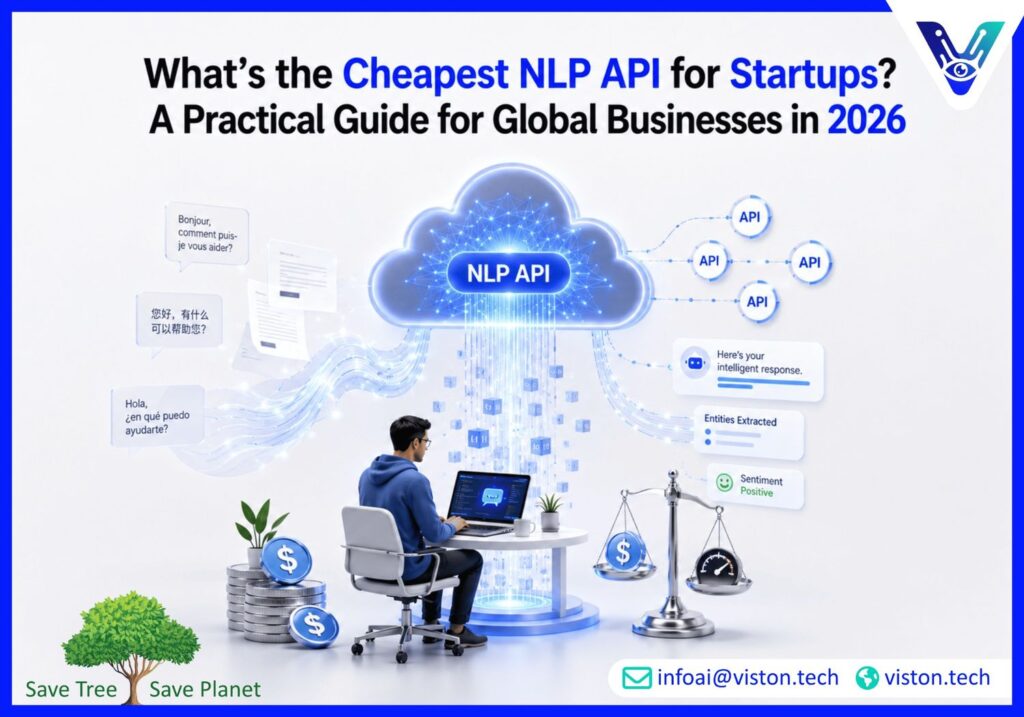
For startups building AI-powered products, choosing the right Natural Language Processing (NLP) API is often a balance between capability, scalability, and cost. While advanced language models have become more accessible, many early-stage companies still struggle to identify which NLP solution offers the best value without compromising performance. Understanding the true cost of NLP APIs in 2026 can help startups make smarter technology investments and accelerate product development.
Natural Language Processing APIs allow applications to understand, analyze, generate, classify, summarize, and process human language without requiring businesses to build complex machine learning infrastructure from scratch.
Startups commonly use NLP APIs for:
By leveraging API-based NLP services, startups can significantly reduce development time, infrastructure costs, model training requirements, and operational complexity.
The cheapest NLP API is not necessarily the one with the lowest advertised price. Businesses must evaluate total value, scalability, and long-term operational costs.
Most NLP providers charge based on token consumption, requests, characters processed, API calls, or model usage. Low entry-level pricing can become expensive when applications scale.
Simple use cases such as sentiment analysis or keyword extraction may not require large language models. More complex tasks like reasoning, content generation, and conversational AI typically require advanced NLP capabilities that impact costs.
Using a managed NLP API often eliminates expenses related to:
These indirect savings can significantly outweigh API usage fees.
Startups operating internationally must consider multilingual support, latency, regional compliance requirements, and integration flexibility when evaluating API costs.
Rather than focusing exclusively on price, startups should assess whether an NLP platform can support growth over the next several years.
Lower-cost APIs may produce inconsistent outputs that require additional human review. Poor accuracy can increase operational costs and negatively impact customer experience.
A startup-friendly NLP API should integrate easily with:
Many startups eventually require domain-specific language understanding. APIs that support fine-tuning, custom workflows, or specialized models often provide greater long-term value.
As AI adoption increases globally, businesses must evaluate data protection, privacy controls, access management, and regulatory compliance requirements before selecting a provider.
The most cost-effective NLP solutions offer predictable pricing structures without hidden infrastructure or implementation costs.
Many startups initially prioritize budget constraints, but selecting an NLP API solely based on price can create challenges later.
Potential risks include:
For customer-facing AI products, reliability often has a greater impact on business outcomes than marginal cost savings.
A practical approach is to calculate cost per business outcome rather than cost per API call. An NLP API that improves automation accuracy, reduces support workload, and enhances user experience can deliver a stronger return on investment even if its unit pricing appears higher.
In 2026, startups evaluating NLP platforms should look beyond basic language processing capabilities.
Modern applications increasingly require contextual understanding, intent recognition, entity extraction, semantic search, and conversational intelligence.
Many businesses now combine traditional NLP functions with generative AI features such as content creation, summarization, intelligent assistants, and workflow automation.
Global startups benefit from NLP platforms capable of supporting multiple languages and regional variations without requiring separate systems.
Applications involving customer engagement, support automation, and conversational AI often require low-latency responses.
As startup usage grows, the chosen NLP solution should handle increasing workloads efficiently without major platform migrations.
Strong documentation, SDK support, API reliability, testing environments, and onboarding resources can significantly reduce development costs.
Organizations evaluating affordable and scalable Natural Language Processing Solutions often require more than simple API access. They need practical implementation expertise, integration support, AI strategy alignment, and solutions that can evolve alongside business growth.
Viston AI focuses on helping businesses leverage modern NLP technologies to automate processes, improve customer interactions, extract actionable insights from data, and build intelligent AI-driven applications. Rather than treating NLP as a standalone technology component, the emphasis is placed on aligning language processing capabilities with measurable business objectives.
For startups and growing organizations operating in global markets, Natural Language Processing Solutions may involve conversational AI, intelligent document processing, semantic search systems, customer support automation, content workflows, knowledge management platforms, and AI-powered decision support tools. Successfully implementing these systems requires attention to data quality, integration architecture, security considerations, scalability planning, and ongoing optimization.
By combining NLP expertise with practical business requirements, Viston AI can help organizations evaluate appropriate language technologies, reduce implementation complexity, and develop solutions that support long-term growth. This approach is particularly valuable for companies seeking cost-effective AI adoption without sacrificing performance, reliability, or future scalability.
The answer depends on usage volume, required features, model quality, and scalability needs. The lowest-cost API may not always provide the best overall value when considering accuracy and operational efficiency.
For most startups, NLP APIs provide faster deployment, lower upfront costs, and reduced infrastructure management compared to building and maintaining custom models.
Costs vary significantly based on application complexity and user volume. Startups should estimate expected API consumption and evaluate pricing models before committing to a provider.
Many modern NLP platforms offer multilingual capabilities, allowing businesses to support international users through a single language processing framework.
Healthcare, finance, SaaS, ecommerce, education, legal services, telecommunications, manufacturing, logistics, and customer service industries commonly leverage NLP technologies.
Viston AI helps organizations evaluate, implement, integrate, and optimize Natural Language Processing Solutions that align with business objectives, operational requirements, and growth plans.
The question of “What’s the cheapest NLP API for startups?” cannot be answered through pricing alone. The most effective choice balances affordability, accuracy, scalability, security, and long-term business value. As AI adoption continues to expand globally in 2026, startups should evaluate NLP platforms based on both technical capabilities and measurable business outcomes. Organizations seeking reliable Natural Language Processing Solutions should focus on providers and implementation partners that can support sustainable growth, efficient automation, and evolving AI requirements. For businesses exploring these opportunities, Viston AI offers expertise that can help transform NLP investments into practical business results.
