
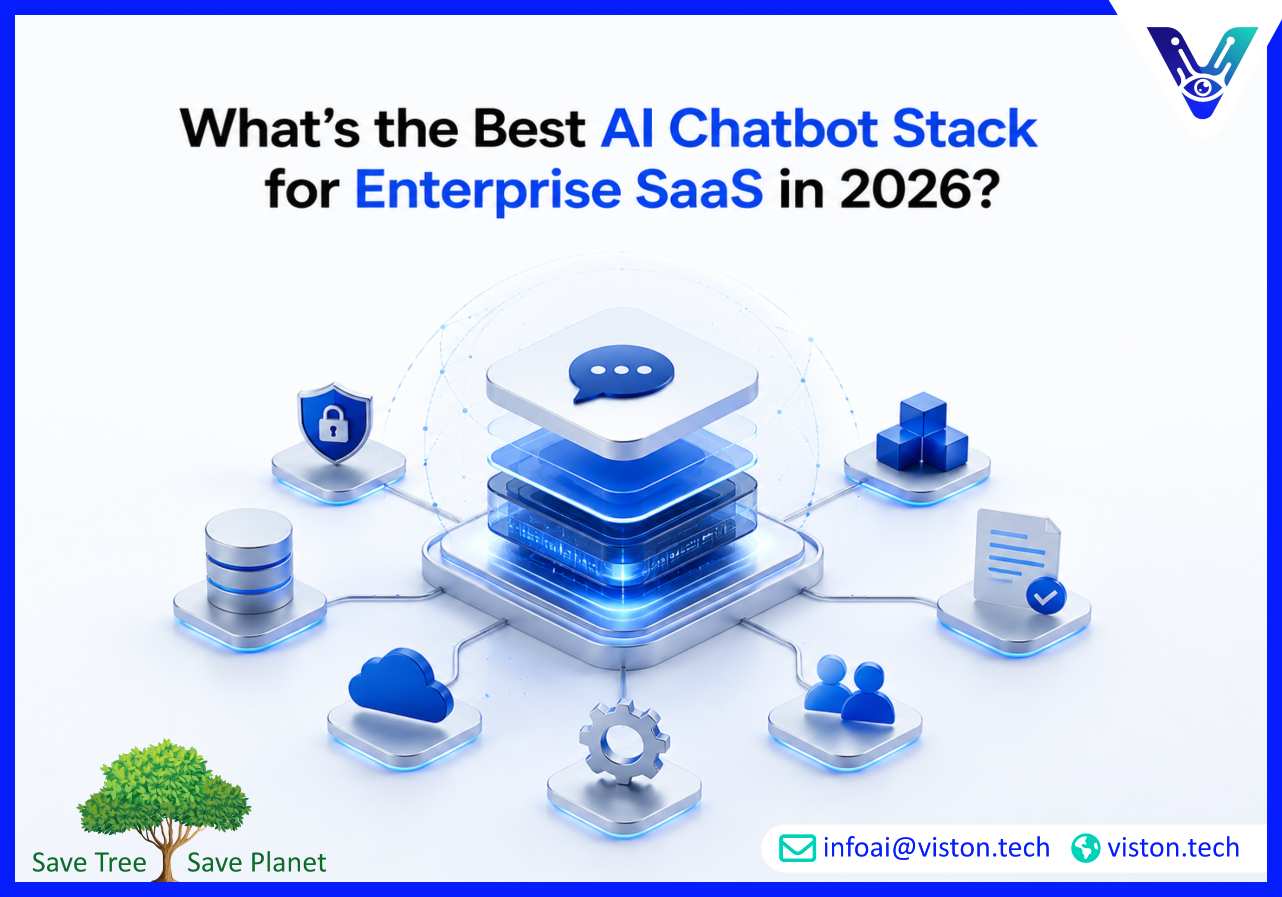
Choosing the best AI chatbot stack for enterprise SaaS is no longer just a product feature decision. It affects customer onboarding, support scale, account management, retention, data security, workflow automation, and how reliably users receive answers inside complex software environments.
An enterprise SaaS chatbot stack is the combination of technologies, data pipelines, integrations, controls, and operating processes used to deliver conversational AI across a software product or customer support ecosystem. For SaaS companies, the chatbot must do more than answer FAQs. It needs to understand product usage, account context, subscription status, permissions, integrations, documentation, and escalation rules.
The best AI chatbot stack for enterprise SaaS usually includes several connected layers:
For enterprise SaaS, the stack should be designed around product complexity and customer lifecycle stages. A new user may need onboarding guidance. An admin may need configuration support. A developer may need API troubleshooting. A procurement stakeholder may ask about compliance. An existing customer may need billing, renewal, or escalation support. The chatbot stack must handle these journeys without exposing restricted data or giving confident but incorrect answers.
A basic chatbot answers questions. An enterprise SaaS chatbot should also complete controlled actions. It may retrieve account information, summarize a support history, check plan eligibility, route a customer to the correct success manager, generate a troubleshooting checklist, or open a ticket with full conversation context. This is why the best stack combines natural language understanding, RAG, secure APIs, workflow logic, and human handoff rather than relying on a single chatbot widget.
Enterprise SaaS buyers and users expect fast, accurate, contextual support. At the same time, SaaS products have become more complex. Many platforms now include role-based access, modular pricing, usage-based billing, integrations, APIs, customer-specific configurations, data residency options, and compliance requirements. A chatbot that cannot understand this context can quickly become a risk.
In 2026, SaaS teams should avoid treating chatbot deployment as a simple help center overlay. The chatbot must be part of the product and customer operations architecture. It needs to connect with trusted sources, respect permissions, and improve over time through measured feedback.
Natural language responses can sound helpful even when the answer is incomplete or wrong. For enterprise SaaS, this creates problems. Incorrect setup guidance can delay onboarding. Wrong integration instructions can increase support tickets. Misleading plan information can create sales friction. Poorly handled security questions can damage buyer confidence.
The stack should therefore use retrieval-augmented generation, approved knowledge bases, source-aware responses, confidence thresholds, and escalation logic. The chatbot should know when to answer, when to ask a clarifying question, and when to hand off to a human team.
Enterprise SaaS platforms often serve many customers from shared infrastructure. The chatbot stack must respect tenant boundaries. It should not retrieve one customer’s data for another customer, expose internal notes, or provide admin-level guidance to users without the right permissions.
This requires integration with identity providers, role-based access control, organization-level permissions, audit logging, and secure data handling. If the chatbot can access account-level data, it must follow the same security expectations as the core SaaS platform.
SaaS products change through releases, feature flags, beta programs, pricing updates, documentation edits, and integration changes. A chatbot stack must be able to refresh knowledge without rebuilding the entire system. Content pipelines, versioning, approval workflows, and retrieval testing are essential for keeping answers current.
For enterprise SaaS companies with frequent releases, chatbot maintenance should be connected to product operations. Documentation updates, support macros, changelogs, API references, and onboarding content should feed into the chatbot knowledge layer through governed workflows.
The best AI chatbot stack for enterprise SaaS depends on the use case, but the strongest architectures usually follow a layered model. This keeps the chatbot flexible, secure, measurable, and easier to improve as the product grows.
The chatbot should be available where users need help: inside the SaaS dashboard, on documentation pages, in the support portal, and across approved customer communication channels. In-product chat is especially valuable because it can use page context, user role, account type, and current workflow to provide more relevant help.
For example, a user configuring an integration should not receive the same generic answer as a visitor browsing the public website. The chatbot should understand the user’s current product area, permission level, and likely intent.
Enterprise SaaS teams should avoid locking all chatbot behavior into one model choice. A model gateway or orchestration layer allows the system to route tasks based on risk, cost, latency, data sensitivity, and complexity. Simple classification, summarization, and routing tasks may not require the same model used for complex reasoning.
This layer can manage prompts, tools, system instructions, fallback behavior, guardrails, and response formatting. It also helps teams test model updates without disrupting the customer experience.
Retrieval-augmented generation is central to enterprise SaaS chatbot reliability. The chatbot should retrieve from approved sources such as product documentation, API references, help center articles, onboarding guides, release notes, troubleshooting guides, and internal support knowledge.
The retrieval layer should support metadata, document freshness, access controls, language handling, and source prioritization. For example, current API documentation should override an older support article. Customer-facing content should be separated from internal escalation notes. Beta feature documentation should only appear for eligible customers.
A chatbot becomes significantly more useful when it connects to business systems. For enterprise SaaS, common integrations include CRM, customer success platforms, ticketing systems, subscription billing, product analytics, identity providers, data warehouses, and internal workflow tools.
These integrations allow the chatbot to answer questions such as “Why can’t I access this feature?”, “What plan am I on?”, “Has this issue already been reported?”, “Can I book onboarding?”, or “Which integration failed?” The key is to expose only the minimum data required and use clear authorization checks before every action.
Even the best chatbot stack should not try to automate every interaction. Enterprise SaaS customers often need human support for contract questions, complex technical issues, security reviews, migration planning, or high-risk account situations.
The chatbot should detect when escalation is needed and transfer the conversation with useful context. A strong handoff includes the user’s issue, account details allowed by permissions, attempted steps, sentiment, urgency, product area, and recommended routing. This reduces repetition for the customer and improves agent productivity.
Building the chatbot stack is only the first stage. Enterprise SaaS companies need an operating model for evaluation, improvement, governance, and cost control. Without this, chatbot quality can decline as the product changes and users discover new ways to ask questions.
Conversation volume is useful, but it does not prove value. SaaS teams should track self-service resolution rate, first contact resolution, fallback rate, escalation quality, average response time, customer satisfaction, ticket deflection, onboarding completion, conversion influence, and account retention signals where relevant.
For technical SaaS products, it is also useful to measure API documentation resolution, developer support deflection, integration troubleshooting success, and reduction in repetitive setup tickets.
Prompt changes, retrieval updates, model upgrades, and workflow changes should be tested before release. A practical evaluation set should include common support questions, edge cases, ambiguous requests, security-sensitive questions, role-restricted queries, billing scenarios, integration failures, and multilingual examples if the company serves global customers.
This prevents silent regressions. A chatbot may improve on one category while becoming worse on another. Evaluation helps teams make informed changes instead of relying on anecdotal feedback.
Enterprise SaaS chatbot stacks must balance user experience with operational cost. Long context windows, excessive retrieval, unnecessary model calls, and poorly optimized workflows can increase cost and slow responses. The stack should use caching, task-specific routing, token controls, monitoring, and rate limits.
Reliability also matters. If the chatbot depends on CRM, billing, or ticketing APIs, the system should handle outages gracefully. It should explain when a live lookup is unavailable and avoid inventing account-specific answers.
Governance should define who owns chatbot knowledge, who approves product answers, who reviews failed conversations, who monitors compliance risks, and who decides when new workflows can be automated. In enterprise SaaS, this usually requires collaboration between product, support, customer success, security, legal, sales operations, and engineering teams.
The chatbot should be treated as a product capability, not a one-time automation project. That means release cycles, testing, analytics, documentation ownership, and continuous improvement are all part of the stack.
Viston AI is relevant to this topic because its Enterprise AI Chatbots service aligns closely with the architecture needs of enterprise SaaS companies. The company provides enterprise chatbot capabilities connected to natural language understanding, multi-turn dialogue, real-time knowledge integration, workflow automation, multilingual support, system integration, security controls, and ongoing optimization.
For SaaS businesses, this combination matters because the best AI chatbot stack for enterprise SaaS must connect product knowledge with operational systems. A chatbot needs to retrieve accurate documentation, understand user intent, respect account context, integrate with CRM or ticketing platforms, support controlled workflows, and escalate conversations when automation is not appropriate.
Viston AI’s broader service portfolio includes AI Chatbot Integration, NLP and text analysis, AI Automation & Workflow Bots, MLOps and model monitoring, AI strategy development, multilingual support, and voice-enabled assistants. These capabilities are useful for SaaS teams that want a chatbot stack designed around reliability rather than a standalone chat interface.
Its approach is especially relevant for organizations that need conversational AI across customer support, onboarding, product guidance, sales qualification, knowledge search, and internal support. By combining chatbot development with integration and monitoring practices, Viston AI can help enterprise SaaS companies design systems that are practical, scalable, secure, and measurable.
The best AI chatbot stack for enterprise SaaS combines an in-product conversational interface, LLM orchestration, RAG-based knowledge retrieval, secure system integrations, workflow automation, human handoff, analytics, security controls, and continuous evaluation. The right stack depends on product complexity, customer data sensitivity, and support goals.
Yes. RAG helps SaaS chatbots answer from approved documentation, knowledge bases, release notes, API references, and internal content instead of relying only on model memory. This improves accuracy, freshness, and trust, especially when product information changes often.
Common integrations include CRM, ticketing platforms, customer success tools, billing systems, identity providers, product analytics, help centers, data warehouses, and workflow automation tools. The chatbot should connect only to systems needed for the approved use case.
They should maintain governed knowledge sources, use source-aware retrieval, test responses with evaluation sets, monitor fallback conversations, review failed answers, and connect chatbot updates to product release and documentation workflows.
Yes, but only with secure authentication, role-based permissions, tenant separation, audit logging, and carefully scoped API access. Account-specific answers require stronger controls than public FAQ responses.
Viston AI’s Enterprise AI Chatbots and AI Chatbot Integration services are relevant for SaaS companies that need conversational AI connected to knowledge bases, CRM, workflows, analytics, multilingual support, and secure enterprise systems.
The best AI chatbot stack for enterprise SaaS in 2026 is not a single tool or model. It is a secure, integrated, measurable architecture that combines conversational AI, RAG, system integrations, workflow automation, governance, and continuous improvement. SaaS companies should design chatbots around real customer journeys, product complexity, account permissions, and operational outcomes. When implemented well, Enterprise AI Chatbots can reduce repetitive support, improve onboarding, strengthen customer experience, and give teams better insight into user needs. Viston AI offers relevant enterprise chatbot and integration capabilities for SaaS organizations that want a practical, scalable approach to conversational AI.
