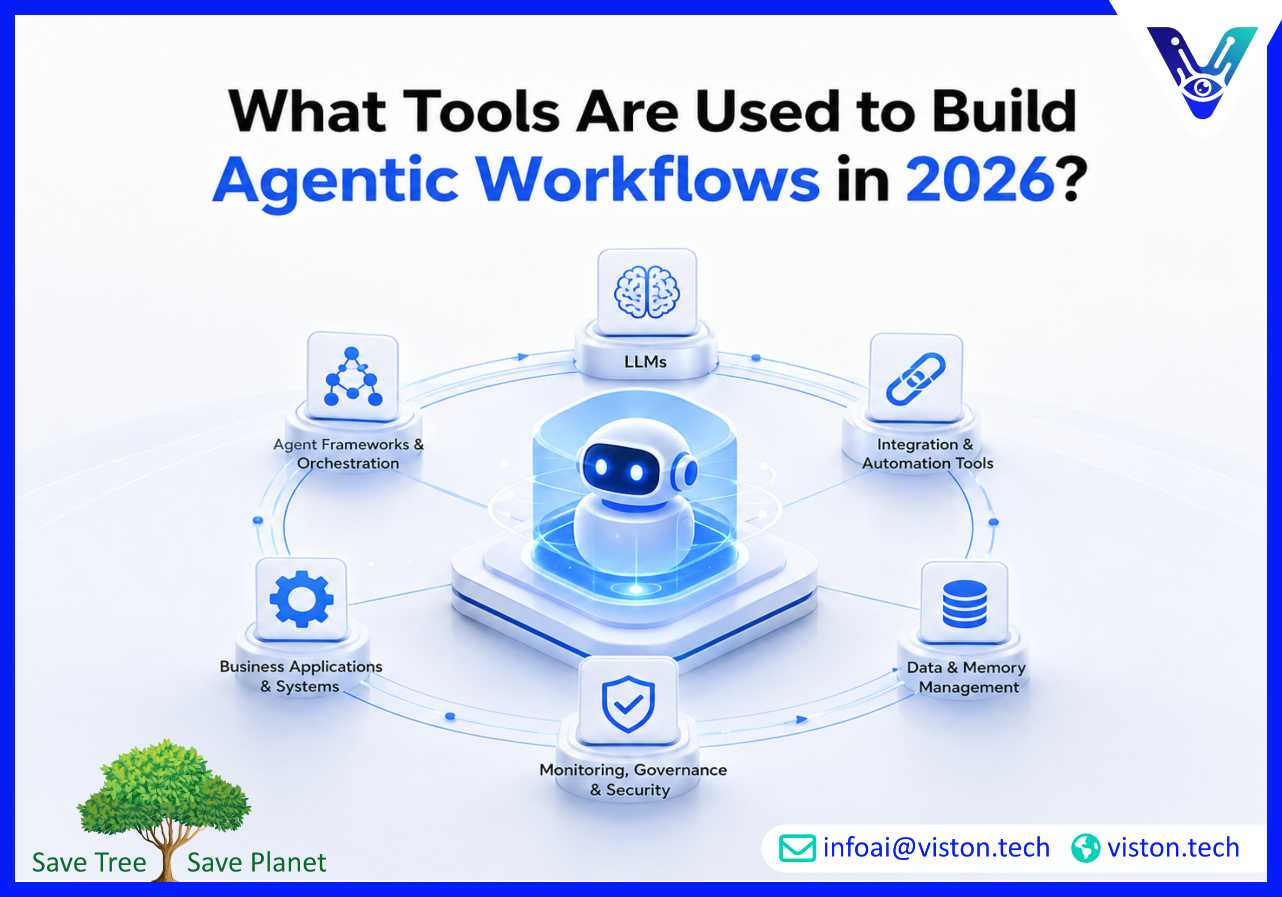
What Tools Are Used to Build Agentic Workflows in 2026?
As businesses move beyond basic automation, agentic workflows are becoming a practical way to orchestrate AI-driven decision-making, task execution, and process automation across departments. Understanding the tools used to build agentic workflows is essential for organizations looking to implement scalable AI systems that can reason, act, collaborate, and continuously improve business operations.
Understanding Agentic Workflow Technology
An agentic workflow combines AI agents, orchestration systems, business applications, data sources, and automation platforms into a coordinated process. Unlike traditional automation, agentic workflows can make contextual decisions, interact with multiple systems, retrieve information, execute actions, and escalate tasks when human input is required.Building these workflows requires several categories of tools working together. Each tool serves a specific role within the overall architecture.
Large Language Models (LLMs) as the Intelligence Layer
At the core of most agentic workflows are large language models that provide reasoning, planning, analysis, and communication capabilities.
Common LLM Platforms
OpenAI GPT models
Anthropic Claude models
Google Gemini models
Mistral AI models
Meta Llama models
Enterprise-hosted open-source models
These models enable agents to understand instructions, interpret business data, generate responses, evaluate outcomes, and support decision-making throughout workflows.In most enterprise environments, LLMs are not deployed independently. They are integrated into broader orchestration frameworks that manage workflow execution.
Agent Frameworks and Orchestration Platforms
Agent frameworks provide the structure needed for multiple AI agents to collaborate effectively. They define agent roles, task routing, memory management, communication patterns, and workflow execution logic.
Popular Agent Development Frameworks
LangGraph
LangChain
AutoGen
CrewAI
LlamaIndex
Semantic Kernel
OpenAI Agents SDK
These frameworks help developers create specialized agents such as research agents, customer service agents, compliance agents, planning agents, validation agents, and execution agents.
Why Orchestration Matters
Agent orchestration ensures workflows remain predictable and auditable. Without orchestration, multiple agents may operate independently without producing reliable business outcomes.Orchestration platforms manage:
Task sequencing
Agent collaboration
Workflow routing
Error handling
Approval processes
Performance monitoring
Escalation rules
Workflow Automation and Integration Tools
Agentic workflows become valuable when agents can interact with business systems. Integration platforms connect AI agents with operational tools used throughout the organization.
Popular Automation Platforms
Zapier
Make
n8n
Microsoft Power Automate
Workato
Tray.io
UiPath
These platforms allow agents to trigger workflows, update records, send notifications, move data between systems, and automate repetitive business processes.
Typical Integrations
CRM platforms
ERP systems
Helpdesk software
Email platforms
Project management tools
Knowledge bases
Databases
Analytics systems
Document management platforms
Integration capabilities often determine the real-world usefulness of an agentic workflow.
Data and Memory Management Tools
Agentic workflows require access to accurate business information. Memory and retrieval systems help agents maintain context and access relevant knowledge.
Vector Databases
Pinecone
Weaviate
Chroma
Milvus
Qdrant
Vector databases support Retrieval-Augmented Generation (RAG), allowing agents to retrieve company knowledge, policies, documentation, and operational data during workflow execution.
Knowledge Management Systems
Confluence
Notion
SharePoint
Google Drive
Custom document repositories
Combining knowledge repositories with retrieval systems enables agents to provide more accurate and context-aware outputs.
Monitoring, Governance, and Security Tools
Production-grade agentic workflows require governance, security, and observability capabilities.
Monitoring Solutions
LangSmith
Helicone
Arize AI
Weights & Biases
Datadog integrations
These tools help organizations track workflow performance, identify errors, evaluate outputs, and optimize agent behavior.
Governance Requirements in 2026
Access controls
Audit logging
Prompt management
Role-based permissions
Compliance monitoring
Data protection controls
Human approval workflows
As agentic systems become more autonomous, governance capabilities are becoming essential rather than optional.
How Viston AI Helps Businesses Build Agentic AI Workflows
For organizations exploring Agentic AI Workflows, Viston AI focuses on helping businesses move from isolated automation projects to integrated AI-driven operational systems. Building successful agentic workflows requires more than selecting tools. It involves workflow analysis, agent design, orchestration planning, integration architecture, governance controls, testing, and ongoing optimization.Viston AI helps businesses identify where agentic workflows can deliver measurable value, whether in sales operations, customer support, internal processes, data workflows, knowledge management, or enterprise automation. By combining AI agents, orchestration frameworks, business integrations, and workflow automation strategies, organizations can create systems that improve efficiency while maintaining control and visibility.The focus is not simply on deploying AI models but on creating practical workflows that align with real business objectives and operational requirements.
Frequently Asked Questions
What is the most important tool for building agentic workflows?
There is no single tool. Successful agentic workflows typically combine AI models, orchestration frameworks, integration platforms, memory systems, and monitoring tools.
Do agentic workflows require coding?
Some workflows can be built using low-code or no-code platforms, but complex enterprise implementations often require custom development and integration work.
What role do vector databases play in agentic workflows?
Vector databases store embeddings and enable AI agents to retrieve relevant information from company knowledge bases, improving context and accuracy.
Can agentic workflows connect with existing business software?
Yes. Modern agentic workflows commonly integrate with CRM systems, ERP platforms, databases, communication tools, analytics platforms, and document repositories.
How does Viston AI support agentic workflow development?
Viston AI helps organizations design, integrate, deploy, and optimize agentic AI workflows that align with operational goals and business processes.
Conclusion
The tools used to build agentic workflows extend far beyond AI models alone. Successful implementations combine large language models, orchestration frameworks, workflow automation platforms, vector databases, integration tools, monitoring systems, and governance controls. As businesses increasingly adopt Agentic AI Workflows in 2026, selecting the right combination of technologies becomes critical for scalability, reliability, and business value. Organizations that focus on workflow design, system integration, and operational outcomes will be best positioned to benefit from the next generation of AI-powered automation.