
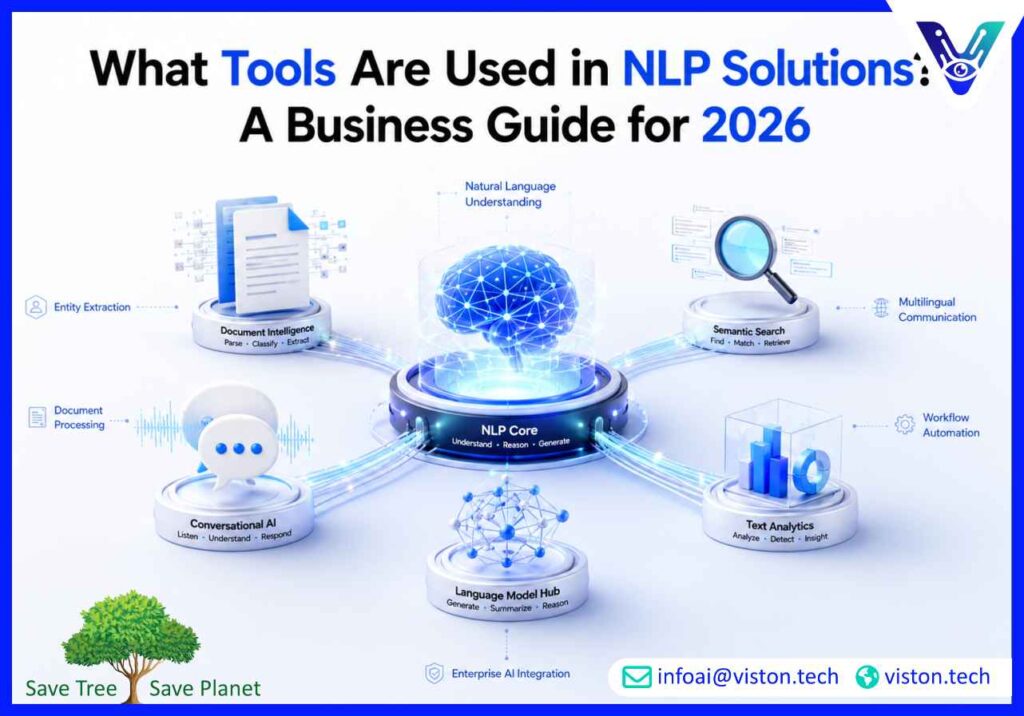
Natural Language Processing (NLP) has become a core technology for businesses seeking to automate communication, analyze text data, improve customer experiences, and unlock insights from unstructured information. As NLP adoption continues to grow in 2026, many organizations evaluating Natural Language Processing Solutions want to understand the tools that power modern NLP systems and how these technologies support real business outcomes.
NLP tools provide the foundation for applications that enable computers to understand, interpret, process, and generate human language. These tools help organizations automate language-intensive tasks that would otherwise require significant manual effort.
Businesses use NLP tools for a wide range of purposes, including:
The right combination of NLP tools can significantly improve operational efficiency, customer engagement, and decision-making capabilities.
Natural Language Understanding tools help machines interpret the meaning behind user inputs. These platforms identify user intent, extract key information, and determine context within conversations or documents.
Common capabilities include:
NLU tools are essential for customer service bots, virtual assistants, and intelligent search systems.
Modern NLP solutions increasingly rely on Large Language Models to generate human-like responses, summarize content, answer questions, and support conversational experiences.
These models can assist with:
Many businesses integrate LLMs into broader NLP architectures rather than using them as standalone solutions.
Text analytics platforms transform large volumes of unstructured text into actionable business intelligence.
Organizations commonly use these tools to analyze:
These tools help identify trends, customer sentiment, recurring issues, and business opportunities.
Traditional keyword search often struggles to understand user intent. Semantic search tools use NLP to deliver more relevant results based on meaning rather than exact keyword matches.
Businesses implement semantic search in:
This improves information discovery and reduces the time users spend searching for answers.
spaCy remains one of the most widely used NLP frameworks for production-grade applications. It provides capabilities such as tokenization, named entity recognition, part-of-speech tagging, and text classification.
Businesses often use spaCy for custom NLP development projects that require scalability and performance.
NLTK is a popular NLP library commonly used for research, experimentation, and educational purposes. It offers a broad collection of language processing resources and algorithms.
Organizations may use NLTK during early-stage NLP development and testing.
Hugging Face provides access to thousands of pre-trained NLP models and tools for implementing modern AI-driven language applications.
It supports:
Many enterprise NLP projects incorporate Hugging Face technologies to accelerate development.
Apache OpenNLP offers machine learning-based tools for text processing, including sentence detection, tokenization, parsing, and entity extraction.
It is commonly used in enterprise environments where open-source solutions are preferred.
NLP tools enable intelligent chatbots and virtual assistants that can answer questions, route requests, and provide 24/7 support.
Benefits include:
Businesses often manage large volumes of contracts, invoices, reports, and compliance documents. NLP tools can automatically extract key information and categorize content.
This reduces manual review requirements while improving accuracy and processing speed.
Organizations use sentiment analysis tools to understand customer opinions and market perception.
Applications include:
NLP solutions can automatically classify incoming emails, prioritize requests, and route communications to the appropriate teams.
This improves workflow efficiency and reduces response delays.
Businesses should evaluate NLP tools based on practical implementation requirements rather than feature lists alone.
Important considerations include:
The best NLP toolset depends on business objectives, technical infrastructure, and long-term automation goals.
Understanding NLP tools is only one part of building successful language-driven automation. Organizations also need expertise in selecting the right technologies, integrating them with existing systems, and aligning implementations with business objectives.
Viston AI provides Natural Language Processing Solutions that help businesses leverage technologies such as conversational AI, intelligent document processing, semantic search, text analytics, and workflow automation. Rather than focusing solely on individual tools, the company emphasizes practical implementation strategies that connect NLP capabilities with operational workflows and customer engagement processes.
Businesses often require a combination of NLP frameworks, AI models, integrations, and optimization strategies to achieve meaningful outcomes. Viston AI supports organizations in developing scalable NLP solutions that improve efficiency, automate language-intensive tasks, and support long-term digital transformation initiatives.
Popular NLP tools include spaCy, Hugging Face, NLTK, Apache OpenNLP, and various Large Language Model platforms. The best choice depends on the specific business use case.
Yes. Most enterprise NLP solutions combine several tools, frameworks, models, and integrations to support different functions such as language understanding, analytics, search, and automation.
Modern NLP tools can typically integrate with CRM platforms, ERP systems, helpdesk software, knowledge bases, databases, and workflow automation platforms through APIs and connectors.
Yes. Many NLP technologies are now accessible to businesses of all sizes, enabling automation, customer support improvements, and operational efficiencies without requiring large internal AI teams.
Yes. Viston AI provides Natural Language Processing Solutions that help organizations evaluate, implement, integrate, and optimize NLP technologies based on specific business goals and operational requirements.
The tools used in NLP solutions range from language understanding platforms and Large Language Models to text analytics frameworks and semantic search technologies. Each plays a distinct role in helping businesses automate communication, process information, improve customer experiences, and gain insights from unstructured data. As NLP adoption continues to expand in 2026, organizations that select the right combination of technologies and implementation expertise will be better positioned to achieve measurable business outcomes. For businesses exploring Natural Language Processing Solutions, working with experienced specialists such as Viston AI can help ensure technology choices align with operational goals and long-term growth strategies.
