
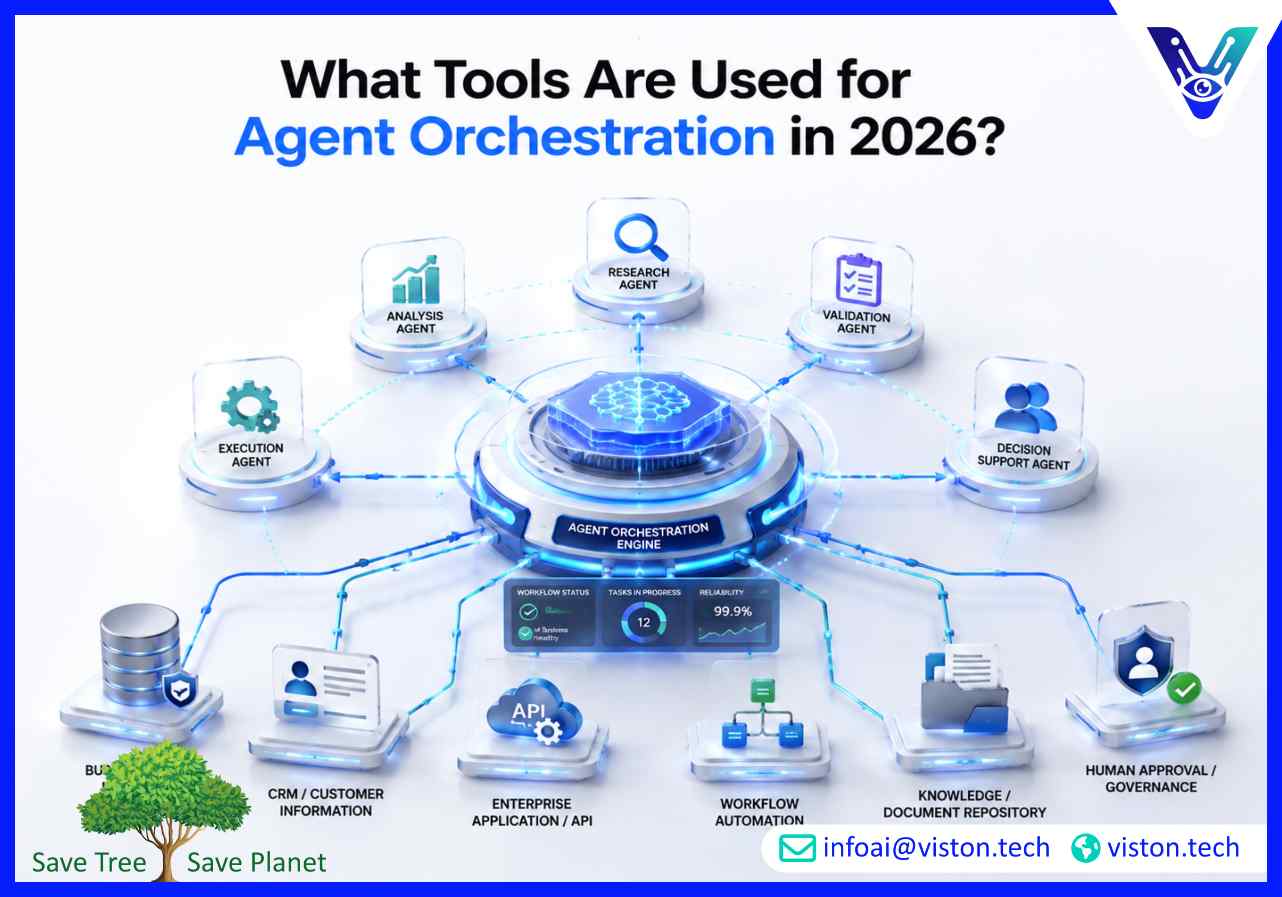
As businesses adopt AI agents to automate workflows, answer customer requests, process data, and support decision-making, the challenge is no longer building a single agent. The real challenge is coordinating multiple agents, tools, and systems efficiently. This is where agent orchestration becomes essential. Understanding what tools are used for agent orchestration helps organizations build scalable, reliable, and production-ready AI systems that deliver measurable business value.
Agent orchestration is the process of coordinating multiple AI agents, tools, data sources, workflows, and business systems so they can work together toward a common objective. Instead of operating independently, orchestrated agents communicate, share context, delegate tasks, and follow structured workflows.
For example, a customer service workflow may involve one agent retrieving customer data, another analyzing previous interactions, a third drafting a response, and a validation agent reviewing the output before sending it. Orchestration ensures every step happens in the correct sequence while maintaining accuracy and governance.
As organizations move toward more complex AI implementations in 2026, orchestration platforms have become a critical layer between AI models and business operations.
Modern enterprises increasingly rely on multiple AI models, APIs, databases, SaaS platforms, and automation tools. Without orchestration, managing these components becomes difficult and often creates operational risks.
Agent orchestration tools help businesses:
The best orchestration tools provide both flexibility for developers and control mechanisms required by enterprise teams.
LangGraph has become one of the most widely adopted frameworks for building stateful multi-agent workflows. It allows developers to define agent interactions as graph-based workflows where agents can branch, loop, collaborate, and share memory.
Organizations often use LangGraph when building sophisticated workflows that require decision-making, iterative reasoning, and multi-step task execution.
Key strengths include:
CrewAI focuses specifically on role-based agent collaboration. Businesses can define specialized agents such as researchers, analysts, writers, reviewers, or planners and assign tasks according to responsibilities.
This approach simplifies the creation of collaborative AI teams that mirror human organizational structures.
CrewAI is commonly used for:
Microsoft AutoGen enables conversational multi-agent systems where agents communicate with each other to solve problems. It supports agent-to-agent communication, human participation, and tool usage.
Many enterprises leverage AutoGen for internal assistants, collaborative problem-solving workflows, and software development automation.
Benefits include:
Organizations operating within AWS environments increasingly use Amazon Bedrock Agents to orchestrate AI workflows connected to enterprise data and applications.
These agents can retrieve information, perform actions, and automate tasks while leveraging AWS security and infrastructure capabilities.
Typical use cases include:
Google’s Vertex AI Agent Builder helps organizations create and orchestrate AI agents that interact with enterprise data, search systems, APIs, and business applications.
Businesses already invested in Google Cloud often use Vertex AI to deploy scalable agent ecosystems with centralized management and monitoring.
Semantic Kernel, developed by Microsoft, provides orchestration capabilities for integrating AI models with traditional software systems. It supports workflow automation, planning, memory management, and tool execution.
It is frequently used by enterprises building AI-powered business applications that require tight integration with existing technology stacks.
Choosing an orchestration platform requires more than comparing features. Organizations should evaluate how well a platform aligns with operational requirements and long-term scalability goals.
The platform should support structured workflows, branching logic, task sequencing, retries, exception handling, and escalation paths.
Multi-agent communication capabilities become increasingly important as workflows grow more sophisticated.
Agents must maintain access to relevant information throughout workflow execution. Strong context management reduces inconsistencies and improves output quality.
Most business workflows require integrations with CRMs, ERPs, databases, communication platforms, analytics systems, and external APIs.
Organizations should prioritize access controls, audit trails, monitoring, permissions management, and compliance capabilities.
Visibility into agent performance, workflow execution, failures, and business outcomes is essential for production deployments.
Organizations exploring agent orchestration often discover that selecting a framework is only one part of a successful implementation. Building production-ready AI systems requires workflow design, agent architecture, integrations, testing, monitoring, governance, and continuous optimization.
As a specialist in AI Agent Development & Deployment, Viston AI helps businesses move from experimentation to practical implementation. This includes designing agent ecosystems, selecting appropriate orchestration frameworks, integrating business systems, establishing governance controls, and deploying scalable AI solutions aligned with operational objectives.
Whether organizations are implementing customer support agents, internal knowledge assistants, workflow automation systems, or multi-agent business processes, the orchestration layer plays a critical role in long-term reliability and performance. Viston AI helps organizations evaluate the right technologies while focusing on business outcomes rather than simply adopting new tools.
LangGraph is widely regarded as one of the leading frameworks for multi-agent orchestration due to its support for stateful workflows, branching logic, and agent collaboration.
Yes. Many organizations combine orchestration frameworks with cloud AI services, workflow automation platforms, and enterprise integration tools to meet specific requirements.
Workflow automation follows predefined rules, while agent orchestration coordinates intelligent agents that can reason, collaborate, adapt, and make task-level decisions within defined boundaries.
Many advanced platforms require development expertise, although some vendors increasingly offer low-code and no-code orchestration capabilities for business users.
Viston AI supports AI Agent Development & Deployment by helping organizations design agent architectures, select orchestration frameworks, integrate business systems, and deploy scalable AI solutions.
Understanding what tools are used for agent orchestration is increasingly important as organizations expand their use of AI agents in 2026. Platforms such as LangGraph, CrewAI, Microsoft AutoGen, Amazon Bedrock Agents, Google Vertex AI Agent Builder, and Semantic Kernel provide the orchestration capabilities needed to manage complex AI workflows. However, successful implementation depends on more than technology selection. Businesses must focus on workflow design, governance, integrations, scalability, and operational outcomes. For organizations pursuing AI Agent Development & Deployment initiatives, choosing the right orchestration approach can significantly influence long-term success and business value.
