
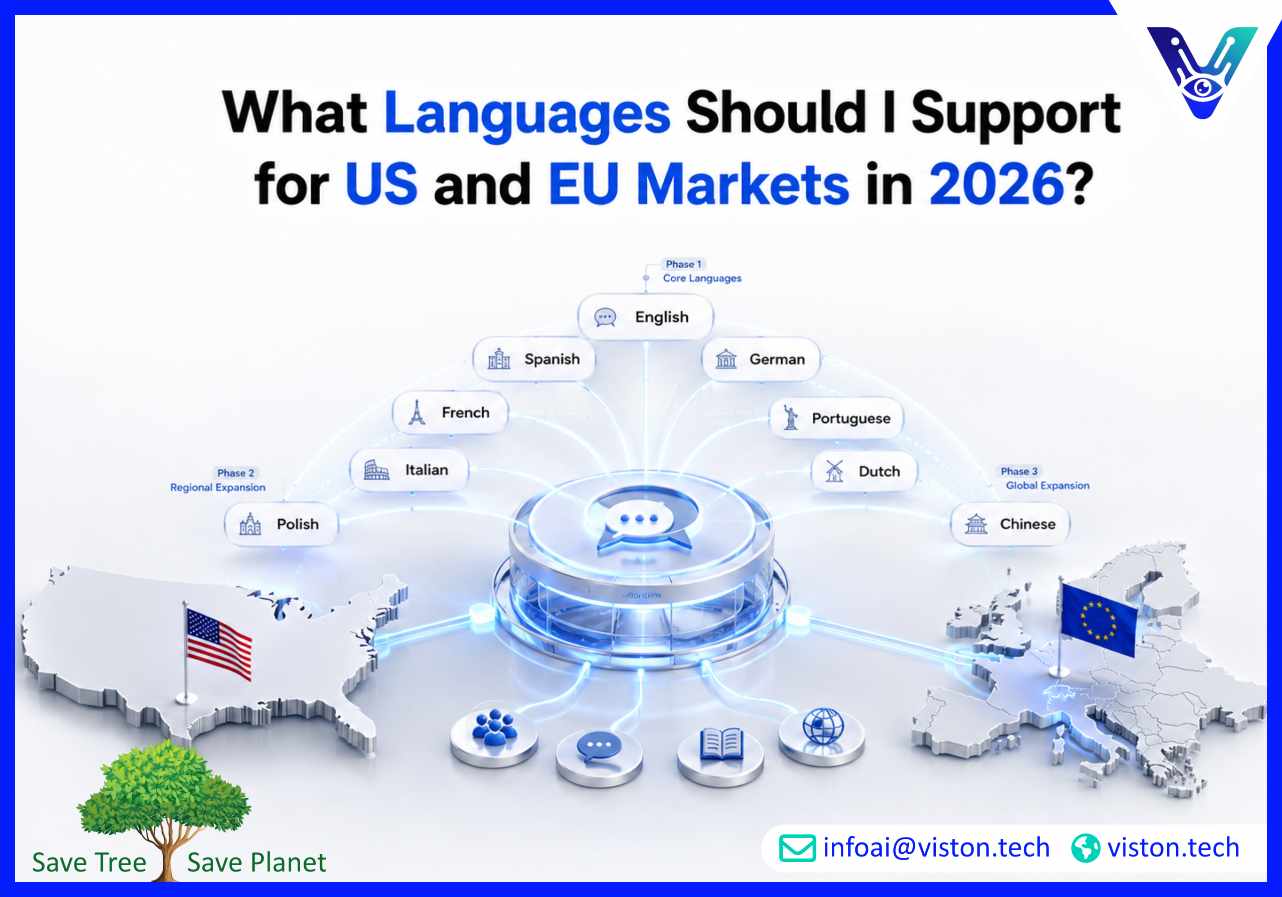
Choosing what languages to support for US and EU markets requires more than ranking languages by population. Businesses must consider customer demand, target countries, revenue potential, support complexity, regulatory expectations, and the quality they can maintain across every customer-facing channel.
For most businesses entering both regions, the strongest starting point is not to launch every possible language. A phased multilingual support strategy normally produces better service quality, cleaner analytics, and lower operational risk.
A practical initial language stack is:
This list should be treated as a planning framework rather than a universal requirement. A business selling primarily in France and Belgium may need French and Dutch before Spanish. A US healthcare provider in Southern California may prioritize Spanish, Vietnamese, and Chinese. A SaaS company targeting Germany, France, and Poland should support those languages even when English is commonly used by its professional audience.
The right language mix depends on where support demand and commercial value intersect. Useful evidence includes website sessions by country and browser language, sales pipeline by region, support tickets, abandoned conversations, customer satisfaction, product usage, refund requests, and the language preferences recorded in CRM systems.
Businesses should also distinguish between website translation and operational language support. Publishing a translated landing page creates an expectation that onboarding, billing, technical guidance, returns, complaints, and human escalation can also be handled appropriately. A language should therefore be considered fully supported only when the business can deliver an end-to-end customer experience in it.
English remains the default language for most US commercial communication, but an English-only service model can overlook substantial customer groups. US Census data shows that Spanish is by far the most widely spoken non-English language at home, followed by Chinese and Tagalog or Filipino among the largest reported groups.
For businesses serving customers nationally, English and Spanish are the most defensible starting pair. Spanish support is particularly relevant for ecommerce, financial services, insurance, healthcare, telecommunications, travel, education, utilities, public services, local marketplaces, and consumer subscription businesses.
Supporting Spanish should extend beyond translating frequently asked questions. Customers may need assistance with account access, payments, order changes, returns, identity verification, appointment scheduling, technical troubleshooting, and complaints. The business should use consistent terminology and provide agents with complete conversation context when automated support cannot resolve the issue.
Chinese-language support can be valuable for organizations serving major metropolitan markets, international students, cross-border buyers, travel customers, property clients, healthcare patients, or specific business communities.
Implementation requires more detail than selecting “Chinese” in a software menu. Written content may need Simplified Chinese, Traditional Chinese, or both. Spoken support may involve Mandarin, Cantonese, or another variety. Businesses should confirm the formats their actual customers use rather than assuming one version covers every audience.
Filipino or Tagalog and Vietnamese can be commercially important in particular states and metropolitan areas. Arabic may be relevant for healthcare, finance, education, travel, government-adjacent services, and businesses serving specific local communities.
Other languages may become higher priorities depending on location:
National statistics provide a useful starting point, but local demand should guide the final decision. A language representing a smaller national population may be operationally critical in a particular service area.
Commercial businesses in the United States do not all face the same language requirements. Organizations receiving federal financial assistance, government bodies, healthcare providers, financial institutions, insurers, and other regulated or public-facing services may have stronger language-access responsibilities than an ordinary private retailer.
Legal and compliance teams should assess applicable federal, state, sector, contract, and accessibility requirements. Multilingual customer support should not be treated as a substitute for qualified interpretation where medical, legal, financial, or safety-critical information requires specialist handling.
The EU is not a single-language market. It has 24 official languages, and multilingualism is embedded in how EU institutions communicate with citizens. For businesses, however, this does not mean every company must immediately operate customer support in all 24 languages.
The practical requirement is to identify the Member States being served, the languages customers expect in those countries, and any product-specific or national rules that apply.
English remains highly valuable for cross-border business, technology, B2B sales, travel, and international support operations. European Commission survey findings published in 2024 reported that 47% of Europeans could speak English as a foreign language. The same research found French, German, and Spanish were the next most frequently spoken foreign languages.
That reach makes English an efficient shared language, particularly for professional audiences. It does not remove the need for local-language service. Customers may browse in English but prefer their native language when discussing payment problems, refunds, contracts, product safety, complaints, or technical failures.
For a business entering several major EU economies, German, French, Spanish, and Italian are common priorities alongside English.
These languages can provide a strong initial footprint, but the correct choice still depends on the countries in the commercial plan. A company should not add Italian merely because it is widely spoken if Italy is not part of its target market.
Polish is a strong priority for businesses entering Poland, one of the EU’s significant consumer and business markets. Dutch is relevant for the Netherlands and Dutch-speaking Belgium, while Portuguese is necessary for a genuinely localized experience in Portugal.
These languages are often added in the second phase after core-market demand has been established. However, they should move into the first phase when those countries are central to acquisition, distribution, hiring, or customer growth.
Companies entering Nordic markets may require Swedish, Danish, and Finnish. Central and Eastern European growth may create demand for Czech, Romanian, Hungarian, Slovak, Bulgarian, Croatian, Slovenian, or Baltic languages. Greek should be prioritized for Greece and Cyprus when those countries are commercially relevant.
Regional language considerations may also apply within individual countries. Businesses should review local customer expectations and legal requirements rather than assuming that the country’s largest language is sufficient for every audience.
EU and national rules may require certain labels, warnings, instructions, contractual information, or customer communications to be presented in a language consumers can understand. Food information, for example, must appear in a language easily understood by consumers in the Member State where the food is marketed. Other regulated products may have their own national language provisions.
This makes language planning partly a compliance exercise. Businesses should identify mandatory content separately from optional marketing localization and customer-service coverage.
The best language portfolio is one the organization can operate reliably. Launching ten languages with weak knowledge coverage and poor escalation is less useful than supporting four languages well.
Create a prioritization score using factors such as:
This process separates commercially necessary languages from those that are merely attractive additions.
Good starting workflows include order tracking, account access, product information, booking confirmation, subscription guidance, opening hours, appointment scheduling, and basic troubleshooting.
Complaints, cancellations, payment disputes, medical questions, contractual interpretation, fraud concerns, and safety incidents require tighter controls. These conversations should have appropriate confidence thresholds, approved wording, and rapid access to qualified human support.
AI translation cannot compensate for outdated or contradictory source material. Product terminology, refund rules, billing instructions, troubleshooting procedures, and escalation messages should first be standardized in the source language.
Each supported language should have a terminology glossary, content owner, review schedule, and quality-assurance process. Native-language testing should include natural customer phrasing, spelling errors, abbreviations, code-switching, and local expressions.
Aggregate chatbot or helpdesk results can hide serious gaps. Businesses should track intent recognition, resolution rate, fallback rate, escalation rate, response time, repeat contact, customer satisfaction, and translation corrections by language and channel.
A language should be expanded only after the existing experience is stable. Usage data can then guide the next market rather than forcing the company to maintain an unnecessarily broad language portfolio.
Viston AI provides Multilingual AI Chatbot Support for organizations managing customer conversations across languages, channels, and business systems. Its published capabilities include language-aware intent recognition, real-time translation and localization, omnichannel deployment, intelligent routing, language-specific analytics, and integration with CRM platforms, knowledge bases, transaction systems, and support tools.
These capabilities are relevant when a business needs to serve US and EU customers without creating a separate manual workflow for every language. A deployment can begin with English and Spanish for the United States and selected European languages based on target countries, then expand after performance and demand have been validated.
Viston AI’s approach also supports web chat, mobile applications, WhatsApp, SMS, voice, and social channels through centralized knowledge and conversation management. Language-specific reporting can help teams identify where customers abandon conversations, which intents require human assistance, and which localized answers need improvement.
The practical value lies in connecting language support with real operations. Multilingual conversations can use relevant customer context, update CRM records, create support tickets, and trigger workflows rather than functioning as isolated translated messages. This gives companies a more scalable way to maintain consistency while adapting service delivery to different US communities and EU markets.
Most nationally focused US businesses should begin with English and Spanish. Additional languages should be selected using customer location, ticket volume, website behavior, sector requirements, and local market demand.
English, German, French, Spanish, and Italian provide a practical starting tier for businesses targeting several large EU markets. The final selection should match the specific countries included in the company’s sales and service plan.
Most businesses do not need to launch customer support in all 24 languages. They should support the languages required by their target markets, customers, products, contracts, and applicable national or EU regulations.
The correct format depends on the customer audience. Simplified Chinese and Traditional Chinese serve different user groups, and spoken support may also need to distinguish between Mandarin and Cantonese. Customer data should guide the choice.
A focused launch of two to five well-supported languages is usually more manageable than broad simultaneous coverage. Businesses should expand after validating knowledge quality, automation accuracy, escalation, compliance, and customer satisfaction.
Viston AI’s multilingual chatbot, integration, routing, analytics, and optimization capabilities can support a phased language strategy based on customer demand, use cases, channels, and operational requirements.
Deciding what languages to support for US and EU markets should begin with evidence, not an arbitrary language count. English and Spanish form a practical US baseline, while English, German, French, Spanish, and Italian provide broad initial EU coverage. Additional languages should follow customer demand, target countries, regulatory needs, and service performance. Effective Multilingual Support requires localized knowledge, reliable automation, contextual human handover, and measurement by language. Viston AI offers relevant capabilities for businesses seeking to manage this process across customer channels and operational systems.
