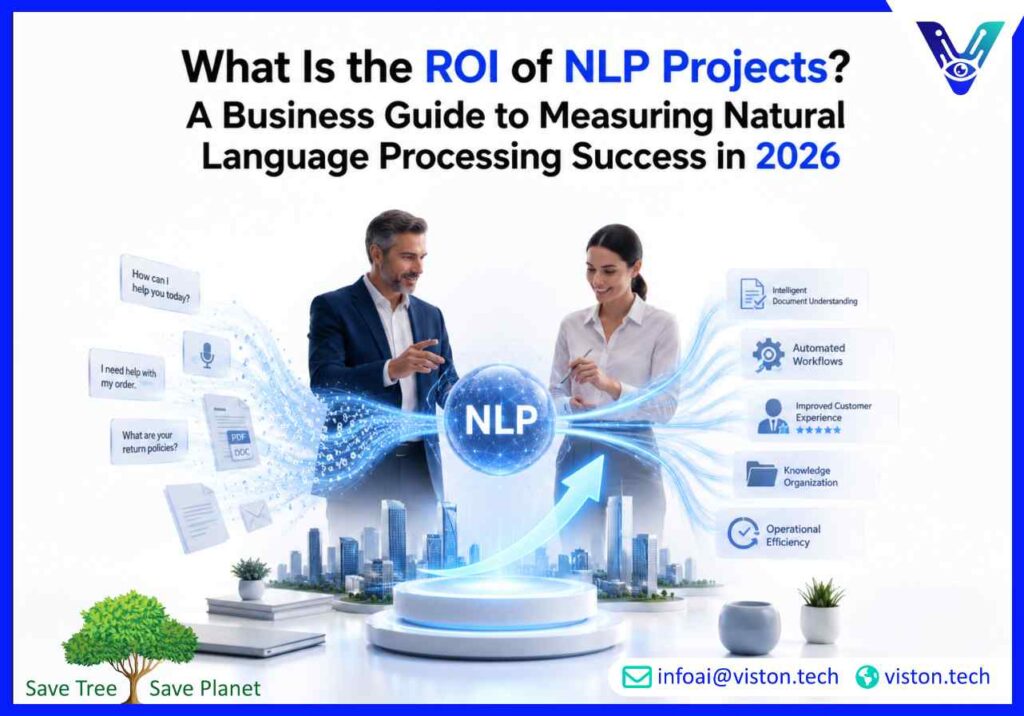
What Is the ROI of NLP Projects? A Business Guide to Measuring Natural Language Processing Success in 2026
As organizations continue investing in artificial intelligence, many decision-makers ask the same question before approving budgets: what is the ROI of NLP projects? Natural Language Processing (NLP) has evolved from an experimental technology into a practical business tool that helps companies automate workflows, improve customer experiences, and extract value from large volumes of unstructured data. Understanding how to measure return on investment is essential for evaluating the long-term business impact of NLP initiatives.
Understanding ROI in Natural Language Processing Projects
ROI, or Return on Investment, measures the value generated from an NLP implementation compared to its total cost. Unlike traditional software projects, NLP solutions often create both direct financial benefits and indirect operational improvements.A successful NLP project typically delivers value through:
Reduced operational costs
Improved employee productivity
Faster customer response times
Higher customer satisfaction
Increased revenue opportunities
Better business intelligence
Enhanced decision-making capabilities
The overall ROI depends on how effectively NLP technologies are aligned with business objectives and operational requirements.
Key Areas Where NLP Projects Generate ROI
Customer Service Automation
One of the most common applications of Natural Language Processing Solutions is customer support automation. NLP-powered chatbots and virtual assistants can handle repetitive inquiries, reducing the workload on support teams.Businesses often achieve ROI through:
Lower support staffing costs
24/7 customer assistance
Reduced ticket volumes
Shorter resolution times
Improved customer experience
When routine requests are automated, human agents can focus on higher-value and more complex customer interactions.
Document Processing and Data Extraction
Many organizations spend significant time manually reviewing contracts, invoices, reports, forms, and compliance documents. NLP can automate information extraction and classification processes.ROI benefits include:
Reduced manual labor
Faster document processing
Lower error rates
Improved compliance workflows
Higher operational efficiency
For businesses processing thousands of documents monthly, these gains can create substantial cost savings.
Knowledge Management Optimization
Employees often waste valuable time searching for information scattered across multiple systems. NLP-powered semantic search and intelligent knowledge bases improve information accessibility.Organizations benefit from:
Reduced search time
Faster onboarding
Improved employee productivity
Better internal collaboration
More consistent decision-making
Even small productivity improvements across large teams can generate meaningful returns over time.
Customer Insights and Sentiment Analysis
NLP technologies help businesses analyze customer feedback, reviews, support conversations, and survey responses at scale.This can lead to:
Improved products and services
Higher customer retention
More effective marketing strategies
Better customer experience management
Earlier identification of business risks
While these benefits may be less direct than automation savings, they often contribute significantly to long-term revenue growth.
Factors That Influence NLP Project ROI
Quality of Business Use Case Selection
The highest-return NLP projects solve specific business problems rather than implementing AI for its own sake. Organizations that clearly define objectives before development typically achieve stronger results.Examples of high-value use cases include:
Support ticket automation
Invoice processing
Contract analysis
Knowledge retrieval systems
Customer service chatbots
Lead qualification automation
Data Quality and Availability
NLP systems rely heavily on data. Clean, structured, and relevant datasets improve model performance and increase the likelihood of achieving expected outcomes.Poor-quality data often leads to lower accuracy, reduced user adoption, and weaker ROI.
Integration with Existing Systems
NLP solutions generate the most value when integrated into existing workflows and business applications.Common integrations include:
CRM platforms
ERP systems
Helpdesk software
Knowledge management systems
Business intelligence platforms
Communication tools
Well-integrated solutions enable automation and decision-making without disrupting existing operations.
User Adoption and Change Management
Even highly accurate NLP systems can fail to deliver ROI if employees or customers do not use them effectively. Training, communication, and workflow alignment play a critical role in maximizing adoption rates.
Common Costs Associated with NLP Projects
To accurately calculate ROI, businesses must understand total implementation costs.Typical investment areas include:
NLP software and platform licensing
Custom development and configuration
System integration
Data preparation and training
Security and compliance implementation
Testing and deployment
Ongoing maintenance and optimization
Employee training
Organizations should evaluate both upfront expenses and long-term operational costs when building business cases for NLP adoption.
How Businesses Measure NLP ROI in 2026
Modern organizations use a combination of financial and operational metrics to assess NLP project performance.
Cost Reduction Metrics
Lower support costs
Reduced manual processing expenses
Decreased outsourcing requirements
Operational efficiency gains
Productivity Metrics
Employee time savings
Faster task completion
Reduced workflow bottlenecks
Increased process throughput
Customer Experience Metrics
Customer satisfaction scores
First-contact resolution rates
Response time improvements
Customer retention rates
Revenue Impact Metrics
Lead conversion improvements
Cross-selling opportunities
Higher customer lifetime value
Increased sales productivity
The most successful organizations establish baseline measurements before implementation and track performance continuously after deployment.
How Viston AI Helps Businesses Maximize NLP Project ROI
Achieving strong ROI from Natural Language Processing Solutions requires more than deploying AI technology. Viston AI focuses on helping businesses align NLP initiatives with measurable operational goals, customer experience improvements, and automation opportunities.Its approach emphasizes practical business applications such as conversational AI, intelligent document processing, semantic search, workflow automation, and language-driven analytics. By integrating NLP capabilities into existing business systems and processes, organizations can reduce implementation risks while improving adoption and long-term value.For companies evaluating NLP investments, factors such as scalability, security, integration readiness, reporting, and ongoing optimization often play a major role in determining ROI. Viston AI supports businesses in building solutions that are designed to deliver sustainable business outcomes rather than isolated technology deployments.
Frequently Asked Questions
What is considered a good ROI for an NLP project?
A good ROI depends on the business objective, project scope, and implementation costs. Successful NLP projects typically demonstrate measurable improvements in efficiency, customer service, cost reduction, or revenue generation.
How long does it take to see ROI from NLP solutions?
Many organizations begin seeing operational benefits within a few months of deployment, while larger enterprise implementations may require longer periods to achieve full ROI.
Which NLP use cases typically deliver the highest ROI?
Customer support automation, document processing, semantic search, knowledge management, and workflow automation are often among the highest-return NLP applications.
What factors reduce NLP project ROI?
Poor data quality, unclear business objectives, weak system integration, low user adoption, and insufficient optimization can negatively impact project returns.
Can Viston AI help businesses evaluate NLP project ROI?
Yes. Viston AI supports organizations implementing Natural Language Processing Solutions by aligning NLP initiatives with business goals, operational requirements, and measurable performance outcomes.
Conclusion
The ROI of NLP projects depends on how effectively Natural Language Processing Solutions are applied to real business challenges. When implemented strategically, NLP can reduce costs, improve productivity, enhance customer experiences, and create valuable operational insights. Businesses that focus on clear objectives, strong integration, quality data, and ongoing optimization are more likely to achieve meaningful returns from their AI investments. As NLP adoption continues to accelerate in 2026, organizations that treat NLP as a business transformation tool rather than a standalone technology project will be better positioned to realize sustainable value. For companies seeking expert guidance, Viston AI provides practical Natural Language Processing Solutions designed to support measurable business outcomes.