What Is the ROI of NLP in Customer Service? A Business Guide for 2026
Customer expectations continue to rise, while support teams face increasing pressure to deliver faster, more personalized, and cost-effective service. As organizations handle larger volumes of customer interactions across multiple channels, Natural Language Processing (NLP) has become a practical solution for improving efficiency and customer experience. Understanding the ROI of NLP in customer service helps businesses make informed investment decisions and identify where automation can deliver measurable value.
Understanding NLP in Customer Service
Natural Language Processing is a branch of artificial intelligence that enables systems to understand, interpret, and respond to human language. In customer service environments, NLP powers tools that help organizations manage customer conversations more effectively across chat, email, messaging platforms, voice interactions, and self-service channels.Common NLP applications in customer service include:
AI-powered chatbots and virtual assistants
Automated ticket classification and routing
Sentiment analysis
Knowledge base search and recommendations
Voice-of-customer analytics
Multilingual customer support
Email response automation
Conversation summarization
Rather than replacing human agents, modern NLP solutions are designed to help support teams work more efficiently while improving service quality and response consistency.
Why ROI Matters When Evaluating NLP Investments
Organizations increasingly evaluate technology investments based on measurable business outcomes rather than feature lists alone. Customer service leaders need clear evidence that NLP initiatives contribute to operational efficiency, customer satisfaction, revenue retention, or cost reduction.The ROI of NLP in customer service typically comes from several areas:
Reduced support costs
Improved agent productivity
Faster response times
Higher customer satisfaction scores
Increased customer retention
Better scalability during demand spikes
Reduced manual workload
Improved service consistency
When properly implemented, NLP can create both direct financial benefits and long-term strategic advantages.
Key Areas Where NLP Generates ROI in Customer Service
Lower Operational Costs
One of the most visible returns comes from reducing the volume of routine inquiries handled by human agents. Many customer interactions involve repetitive questions regarding order status, account information, billing inquiries, password resets, and product information.NLP-powered self-service tools can automate a significant portion of these interactions, allowing support teams to focus on more complex customer needs.Benefits include:
Reduced staffing pressure
Lower cost per interaction
Fewer support escalations
More efficient resource allocation
Organizations handling thousands of customer inquiries daily often experience meaningful operational savings through intelligent automation.
Improved Agent Productivity
NLP solutions help agents resolve issues faster by providing contextual information, recommended responses, conversation summaries, and automated ticket categorization.Instead of manually reviewing lengthy customer histories, agents can access relevant information instantly.This leads to:
Reduced average handling time
Faster issue resolution
Higher first-contact resolution rates
Improved employee productivity
Productivity gains often become one of the strongest contributors to overall ROI because they impact every customer interaction.
Enhanced Customer Satisfaction
Customers increasingly expect immediate responses and seamless experiences across channels. NLP enables organizations to provide 24/7 assistance while maintaining consistency in communication.Customers benefit from:
Shorter wait times
Instant access to information
Faster problem resolution
More personalized support experiences
Higher customer satisfaction often translates into stronger retention rates, positive brand perception, and increased customer lifetime value.
Reduced Customer Churn
Customer service quality has a direct impact on retention. Poor service experiences frequently lead customers to consider alternative providers.NLP tools can identify customer frustration, dissatisfaction, or escalation risks through sentiment analysis and conversation monitoring. This allows organizations to intervene before issues become retention problems.Reducing churn by even a small percentage can generate substantial financial returns, particularly in subscription-based or recurring-revenue business models.
How Businesses Measure NLP ROI in Customer Service
Calculating ROI requires a structured approach that considers both implementation costs and measurable business outcomes.
Key Performance Indicators
Organizations typically monitor:
Cost per support ticket
Average handling time (AHT)
First-contact resolution rate
Customer Satisfaction Score (CSAT)
Net Promoter Score (NPS)
Customer retention rate
Agent productivity metrics
Self-service adoption rates
Support volume deflection
ROI Formula
A simplified approach involves comparing total benefits generated by NLP against total implementation and operational costs.Benefits may include:
Labor savings
Productivity improvements
Reduced churn-related losses
Revenue preservation
Improved service capacity
Costs may include:
Software licensing
Implementation services
Training and onboarding
System integrations
Maintenance and optimization
Organizations that establish baseline metrics before deployment generally achieve more accurate ROI assessments.
Factors That Influence NLP ROI in 2026
Not every implementation delivers the same results. Several factors influence how quickly businesses realize returns from NLP investments.
Quality of Training Data
Effective NLP systems depend on accurate, relevant, and well-structured data. Poor-quality training data can negatively affect performance, accuracy, and customer experience.
Integration with Existing Systems
NLP solutions provide greater value when connected to CRM platforms, helpdesk systems, knowledge bases, order management tools, and customer data platforms.Integrated workflows reduce manual effort and improve automation effectiveness.
Use Case Selection
Organizations that begin with high-volume, repetitive customer interactions often achieve faster ROI compared to businesses attempting overly complex automation projects from the start.
Continuous Optimization
Customer language evolves over time. NLP systems require ongoing monitoring, testing, and refinement to maintain accuracy and performance.Businesses that treat NLP as an ongoing capability rather than a one-time implementation generally achieve stronger long-term results.
How Viston AI Helps Organizations Maximize NLP ROI
For organizations exploring Natural Language Processing solutions, successful ROI depends on more than deploying AI technology. It requires aligning automation initiatives with real business objectives, customer expectations, operational workflows, and measurable outcomes.Viston AI specializes in Natural Language Processing solutions designed to help businesses transform customer interactions into scalable, data-driven service experiences. By leveraging advanced language understanding, conversational AI, intelligent automation, sentiment analysis, and workflow integration capabilities, organizations can improve support efficiency while maintaining service quality.Modern customer service environments often require seamless integration between communication channels, CRM systems, analytics platforms, and operational processes. Viston AI focuses on helping businesses implement NLP-driven solutions that support automation, customer engagement, operational visibility, and continuous improvement.Whether organizations are seeking to automate routine inquiries, improve ticket management, enhance self-service experiences, or gain deeper insights from customer conversations, specialized NLP expertise can help reduce implementation risks and accelerate business value.As customer expectations continue to evolve in 2026, businesses increasingly require NLP solutions that are scalable, adaptable, and aligned with long-term customer experience goals. A strategic implementation approach helps maximize both operational efficiency and return on investment.
Frequently Asked Questions
What is the average ROI of NLP in customer service?
ROI varies by organization, industry, support volume, and implementation scope. Businesses often see returns through cost savings, productivity improvements, customer retention, and operational scalability.
How quickly can businesses see results from NLP implementation?
Many organizations begin seeing measurable improvements within a few months, particularly when NLP is applied to high-volume customer service processes such as chatbot automation and ticket routing.
Can NLP replace customer service agents?
NLP is typically used to augment human agents rather than replace them. It automates repetitive tasks while allowing agents to focus on complex customer interactions that require empathy and problem-solving.
Which customer service processes benefit most from NLP?
Common areas include chat support, email automation, ticket classification, sentiment analysis, self-service portals, multilingual support, and customer feedback analysis.
What challenges can affect NLP ROI?
Poor data quality, weak integrations, unclear objectives, insufficient training, and lack of ongoing optimization can reduce the effectiveness and return of NLP initiatives.
How can Viston AI support NLP-driven customer service initiatives?
Viston AI provides Natural Language Processing solutions that help organizations automate customer interactions, improve service efficiency, enhance customer experiences, and build scalable support operations aligned with business goals.
Conclusion
The ROI of NLP in customer service extends far beyond simple automation. When implemented strategically, Natural Language Processing solutions can reduce operational costs, improve agent productivity, enhance customer satisfaction, and strengthen customer retention. As organizations continue to prioritize efficiency and experience in 2026, NLP has become an increasingly important capability for modern customer service operations. Businesses that invest in well-designed NLP initiatives and align them with measurable objectives are better positioned to achieve sustainable service improvements and long-term business value. For organizations seeking specialized support, Viston AI offers expertise in Natural Language Processing solutions that can help translate AI capabilities into meaningful operational outcomes.

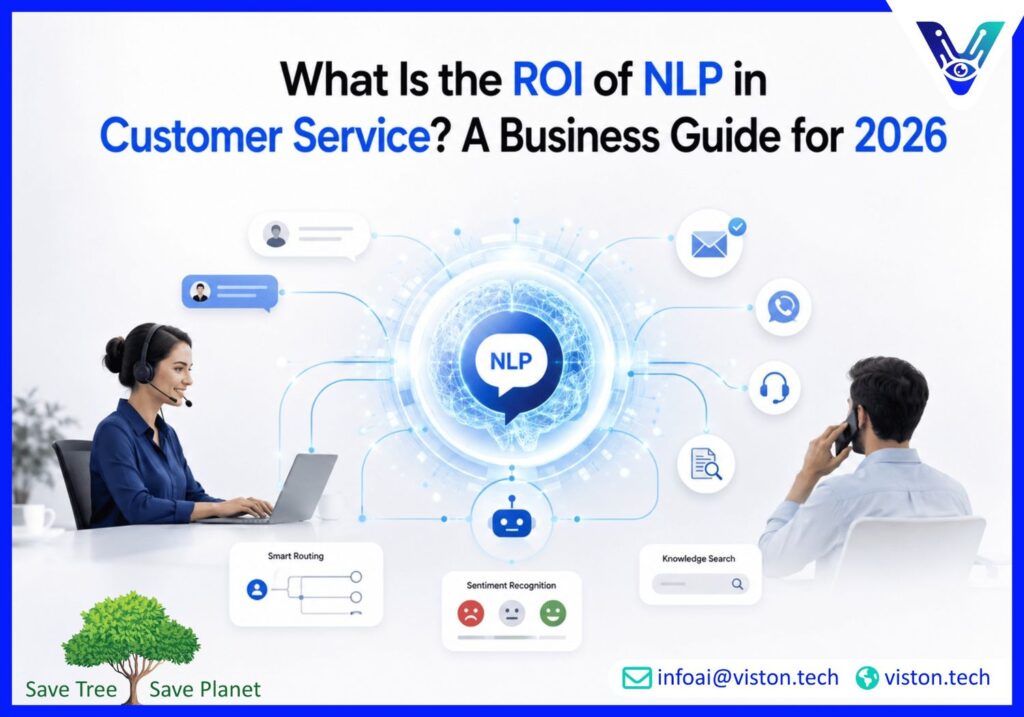 Customer expectations continue to rise, while support teams face increasing pressure to deliver faster, more personalized, and cost-effective service. As organizations handle larger volumes of customer interactions across multiple channels, Natural Language Processing (NLP) has become a practical solution for improving efficiency and customer experience. Understanding the ROI of NLP in customer service helps businesses make informed investment decisions and identify where automation can deliver measurable value.