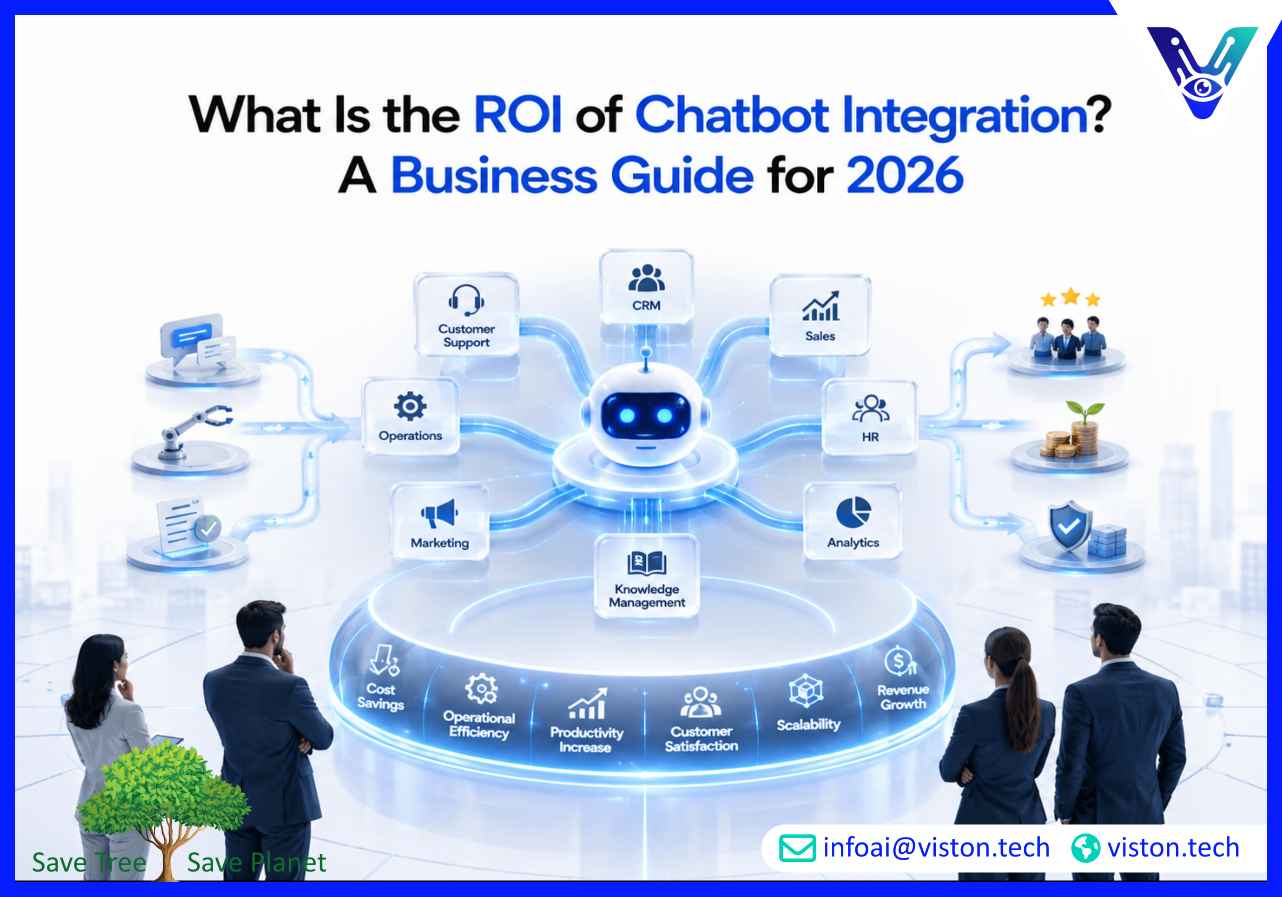
What Is the ROI of Chatbot Integration? A Business Guide for 2026
As organizations continue investing in automation and digital customer experiences, one question consistently arises before implementation: what is the ROI of chatbot integration? Understanding chatbot return on investment helps businesses evaluate whether AI-powered customer interactions can generate measurable financial and operational value. In 2026, chatbot integration is increasingly viewed as a strategic business initiative rather than simply a customer support tool.
Understanding the ROI of Chatbot Integration
ROI, or Return on Investment, measures the value generated from a business investment compared to its cost. In the context of AI chatbot integration, ROI reflects how effectively a chatbot improves efficiency, reduces expenses, increases revenue, or enhances customer experiences relative to implementation and operational costs.Unlike traditional software investments, chatbot ROI often comes from multiple areas simultaneously, including:
Reduced customer support costs
Higher lead conversion rates
Faster response times
Improved customer satisfaction
Increased operational efficiency
24/7 service availability
Reduced workload for human teams
Scalable customer engagement
Because chatbots can impact multiple departments, businesses should evaluate ROI across both financial and operational performance metrics.
Key Factors That Influence Chatbot Integration ROI
Customer Support Cost Reduction
One of the most common sources of chatbot ROI comes from automating repetitive customer inquiries. Questions related to account information, order tracking, FAQs, appointment scheduling, and basic troubleshooting can often be resolved without human intervention.This reduces the volume of support tickets handled by customer service teams, allowing organizations to operate more efficiently while maintaining service quality.
Improved Lead Generation and Qualification
AI chatbots can engage website visitors immediately, collect customer information, answer product questions, and qualify prospects before transferring them to sales teams.By responding instantly and guiding users through the buying journey, chatbots can help increase conversion opportunities and reduce lead leakage.
Higher Employee Productivity
Internal chatbot integrations can support employees by providing quick access to information, automating routine requests, and reducing administrative workloads.Teams spend less time searching for answers and more time focusing on strategic activities that directly contribute to business growth.
Scalable Customer Engagement
Unlike human support teams, chatbots can handle thousands of conversations simultaneously. This scalability allows businesses to manage increased customer demand without proportionally increasing staffing costs.For growing organizations, this can create significant long-term operational savings.
How Businesses Calculate Chatbot ROI
Calculating chatbot ROI requires evaluating both costs and measurable business outcomes.
Common Chatbot Costs
Platform licensing fees
Integration and implementation costs
Customization and development expenses
Maintenance and optimization costs
Training and support requirements
Common ROI Metrics
Support ticket reduction percentage
Cost savings per automated interaction
Lead conversion improvements
Customer satisfaction scores
Average response time reduction
Employee productivity gains
Revenue influenced by chatbot interactions
A simplified ROI formula is:ROI = (Total Benefits − Total Costs) ÷ Total Costs × 100However, organizations should also consider strategic benefits that may not immediately appear in financial calculations, such as customer experience improvements and competitive differentiation.
Business Benefits That Contribute to Long-Term ROI
Faster Customer Response Times
Modern consumers expect immediate responses. Delayed support often results in lost opportunities and customer dissatisfaction.AI chatbots provide instant engagement, helping businesses improve responsiveness while maintaining consistency across customer interactions.
Enhanced Customer Experience
When integrated correctly, chatbots deliver accurate information, personalized interactions, and seamless handoffs to human agents when necessary.Improved customer experiences often contribute to stronger retention rates and increased customer lifetime value.
Better Data Collection and Insights
Chatbots capture valuable customer interaction data that can help businesses understand user behavior, identify service gaps, and optimize operational processes.These insights support more informed decision-making across sales, marketing, support, and product teams.
Consistent Service Delivery
Human performance can vary due to workload, staffing levels, and operational pressures. Chatbots provide consistent responses based on predefined business rules and AI capabilities.This consistency helps organizations maintain service quality standards at scale.
Common Challenges That Can Reduce Chatbot ROI
While chatbot integration offers significant opportunities, poor implementation can limit returns.Common challenges include:
Unclear business objectives
Poor integration with existing systems
Limited access to business data
Weak conversation design
Insufficient testing
Lack of performance monitoring
Inadequate user experience planning
Failure to optimize after deployment
Organizations that treat chatbot integration as a long-term business initiative rather than a one-time technology deployment generally achieve stronger ROI outcomes.
How Viston AI Helps Businesses Maximize Chatbot Integration ROI
Achieving strong chatbot ROI requires more than deploying conversational AI. Businesses need effective integration between chatbots and the systems that drive customer engagement, sales, support, and operational workflows.Viston AI specializes in AI chatbot integration solutions that help organizations connect chatbots with CRM platforms, support systems, knowledge bases, communication channels, and other business-critical technologies.By focusing on integration architecture, workflow automation, user experience design, scalability, and performance optimization, Viston AI helps businesses build chatbot ecosystems that support measurable outcomes. Effective chatbot integration allows organizations to automate repetitive tasks, improve customer experiences, increase operational efficiency, and generate actionable business insights.As businesses increasingly adopt AI-driven customer engagement strategies in 2026, a well-integrated chatbot solution can play a meaningful role in reducing costs, improving service delivery, and supporting sustainable growth.
Frequently Asked Questions
What is considered a good ROI for chatbot integration?
A good ROI varies by industry and business objectives. Many organizations evaluate success through cost savings, support automation rates, conversion improvements, customer satisfaction, and operational efficiency gains.
How long does it take to see chatbot ROI?
Some businesses begin seeing measurable benefits within a few months, particularly through support automation and faster customer response times. Larger enterprise deployments may require additional time to realize full value.
Can small businesses achieve positive chatbot ROI?
Yes. Small businesses often benefit from improved customer engagement, lead capture, and reduced support workloads without needing to significantly expand staffing resources.
Which departments benefit most from chatbot integration?
Customer service, sales, marketing, operations, HR, and IT departments commonly achieve value through chatbot automation and workflow optimization.
How can Viston AI help improve chatbot ROI?
Viston AI helps businesses integrate chatbots with operational systems, automate workflows, improve customer experiences, and optimize performance to support stronger business outcomes and long-term ROI.
Conclusion
Understanding the ROI of chatbot integration is essential for businesses evaluating AI investments in 2026. While financial savings remain important, the true value of chatbot integration extends beyond cost reduction to include improved customer experiences, operational efficiency, scalability, and data-driven decision-making. Organizations that align chatbot initiatives with clear business objectives and implement robust integration strategies are more likely to achieve sustainable returns. For businesses seeking to maximize the value of AI chatbot integration, working with experienced specialists such as Viston AI can help create a foundation for measurable and long-term success.
Source context verified from uploaded project instructions. :contentReference[oaicite:0]{index=0} :contentReference[oaicite:1]{index=1}