
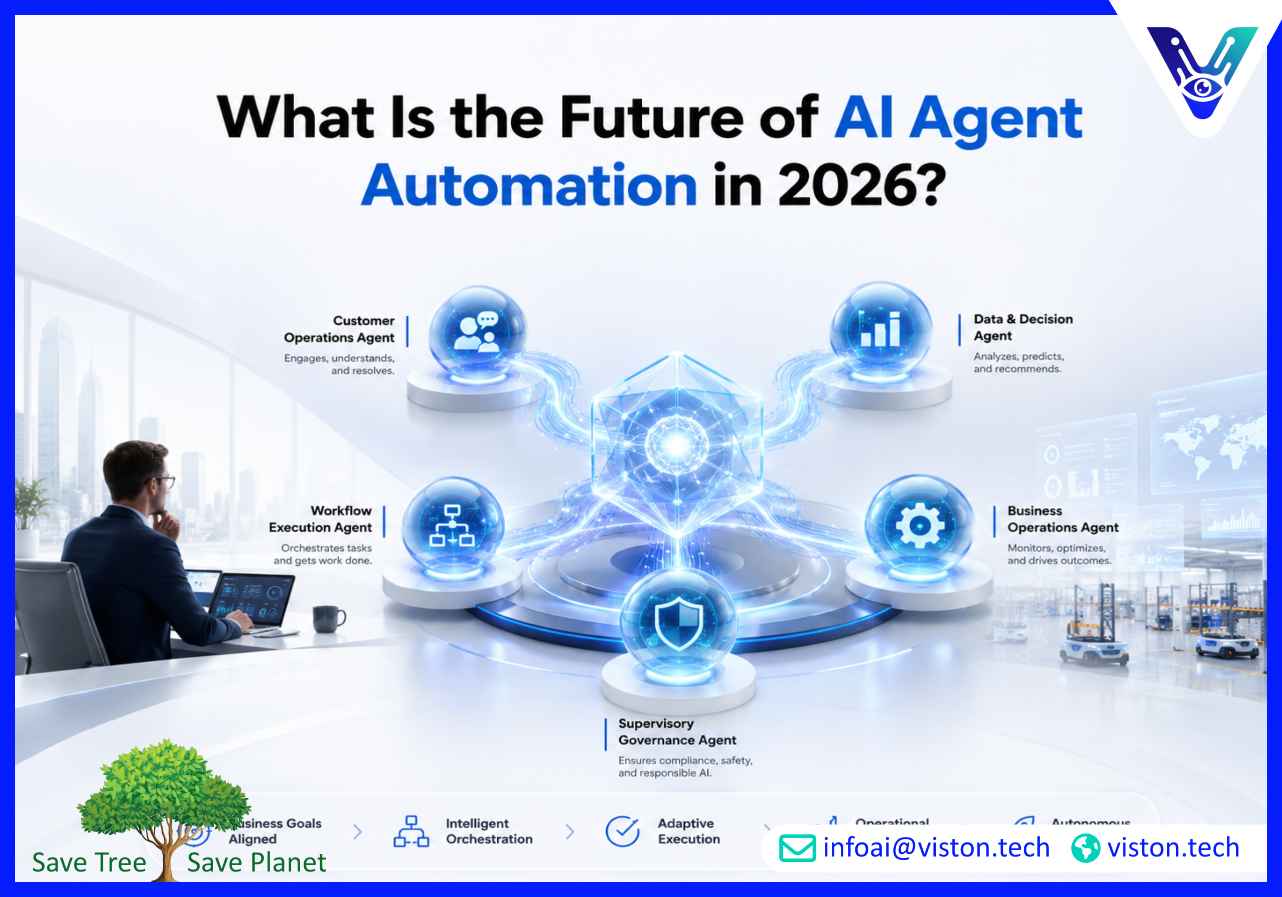
AI agent automation is moving beyond simple task execution into intelligent, adaptive business operations. In 2026, organizations are increasingly adopting AI-driven workflow systems to improve efficiency, reduce operational bottlenecks, and enable faster decision-making. Businesses exploring scalable automation strategies are now looking at AI agents as long-term operational assets rather than isolated productivity tools.
AI agent automation refers to intelligent software systems capable of autonomously performing tasks, making decisions, interacting with applications, and coordinating workflows with minimal human intervention.
Unlike traditional automation tools that follow rigid rule-based instructions, AI agents can:
Modern AI agents combine technologies such as:
As businesses generate more operational data and rely on increasingly complex digital ecosystems, AI agents are becoming essential for scalable workflow automation.
Businesses are under constant pressure to improve operational speed while controlling costs and maintaining service quality. Traditional automation solutions often struggle when workflows involve exceptions, changing inputs, or unstructured information.
AI agent automation addresses these limitations by enabling systems that can reason, respond, and coordinate actions dynamically.
Several factors are accelerating adoption in 2026:
Modern businesses operate across multiple platforms, communication channels, and data systems. AI agents help bridge disconnected workflows by automating cross-platform coordination.
For example, an AI workflow bot can:
This reduces manual coordination and improves process continuity.
Organizations increasingly require instant operational insights. AI agents can monitor systems continuously, detect patterns, and initiate workflows without waiting for manual intervention.
This is particularly valuable in areas such as:
AI agents are not simply replacing repetitive tasks. Many businesses now use them to augment teams by reducing administrative overhead and allowing employees to focus on higher-value work.
Instead of replacing professionals, AI automation is increasingly acting as a digital operations layer that supports faster execution.
The future of AI agent automation is centered around intelligence, autonomy, orchestration, and business adaptability.
Businesses are moving from isolated bots toward coordinated multi-agent ecosystems.
Instead of one automation handling a single task, multiple specialized AI agents will collaborate across workflows.
For example:
This modular architecture improves scalability and operational flexibility.
Future AI agents will better understand organizational context, historical interactions, and operational priorities.
This includes:
As context retention improves, AI agents will produce more accurate and reliable outcomes.
Traditional automation requires detailed rule configuration.
Future AI agents will increasingly operate based on goals rather than rigid scripts.
For example:
The AI system will determine the appropriate sequence of actions dynamically.
This significantly expands automation capabilities across knowledge-intensive environments.
Businesses are beginning to experiment with semi-autonomous operational systems.
In the future, AI agents may independently:
Human oversight will remain important, but automation layers will become increasingly proactive.
AI agent automation is expanding rapidly across industries that rely on complex operational workflows.
Healthcare organizations use AI workflow bots for:
Future systems may assist with clinical workflow optimization and operational triage.
Financial organizations increasingly deploy AI agents for:
Security, auditability, and explainability are especially important in this sector.
Retail operations use AI automation for:
AI agents help businesses manage large transaction volumes more efficiently.
AI workflow automation is becoming critical for:
Real-time automation improves operational responsiveness.
Despite the growing potential, AI agent automation also introduces operational and technical challenges.
Many organizations operate with fragmented software ecosystems. Successful AI automation requires reliable integrations across:
Poor integration planning can reduce automation effectiveness.
AI agents rely heavily on structured and accessible data. Inconsistent or incomplete business data can produce unreliable outcomes.
Organizations often need better data governance before scaling AI automation.
AI agents may access sensitive business information, customer records, or operational systems.
Businesses must ensure:
Security will remain a major evaluation factor for enterprise adoption.
Not every workflow should be fully autonomous.
Businesses must identify where:
The future of AI automation is likely to involve collaborative human-AI workflows rather than fully unsupervised systems.
Organizations that want long-term success with AI automation should focus on strategic implementation rather than isolated experimentation.
Businesses should prioritize workflows that involve:
Clear operational use cases improve adoption success.
Future-ready automation systems should support:
Short-term automation shortcuts often create long-term limitations.
Businesses need clear policies around:
Responsible deployment will become increasingly important as regulations evolve.
The most successful organizations are designing systems where AI agents support employees rather than simply replacing tasks.
This creates:
As businesses adopt increasingly sophisticated automation strategies, the quality of implementation becomes a major success factor. Building scalable AI agent systems requires more than deploying chatbots or workflow scripts. Organizations need automation frameworks that integrate reliably with business operations, data systems, and decision-making processes.
Viston AI specializes in AI Automation & Workflow Bots designed to help businesses streamline operational workflows, improve process efficiency, and support scalable automation initiatives.
Its approach focuses on practical workflow implementation rather than generic automation deployment. This includes:
For organizations managing growing operational complexity, AI workflow bots can help reduce manual coordination while improving consistency and response speed across business functions.
As AI agent automation continues evolving in 2026, businesses increasingly require automation systems that balance intelligence, reliability, integration capability, and operational control. Companies evaluating AI automation initiatives often prioritize providers that understand real-world workflow challenges and scalable implementation requirements.
AI agent automation uses intelligent software agents to perform tasks, coordinate workflows, analyze information, and make operational decisions with minimal human intervention.
Traditional automation follows fixed rules and predefined workflows. AI agents can interpret context, adapt to changing inputs, and manage more dynamic business processes.
Industries with complex workflows and high operational volume benefit significantly, including healthcare, finance, logistics, e-commerce, manufacturing, and customer service operations.
They can be secure when implemented properly with access controls, encryption, monitoring, audit trails, and governance policies. Enterprise-grade deployment requires strong security planning.
AI agents can support customer service workflows, document processing, reporting, internal operations, approvals, scheduling, inventory coordination, CRM updates, and many other operational tasks.
Viston AI provides AI Automation & Workflow Bots that help businesses automate workflows, improve operational efficiency, and build scalable AI-driven business processes.
The future of AI agent automation is centered on intelligent workflow orchestration, adaptive decision-making, and scalable operational support. As businesses face increasing complexity in 2026, AI agents are becoming essential for improving efficiency, responsiveness, and workflow continuity across departments and platforms.
Organizations adopting AI Automation & Workflow Bots are increasingly focused on long-term scalability, integration quality, operational governance, and measurable business outcomes. Businesses that approach AI automation strategically are likely to gain stronger operational agility and improved process efficiency over time.
For companies exploring scalable AI-driven workflow automation, providers such as Viston AI are helping organizations implement practical automation systems aligned with real operational requirements.
