
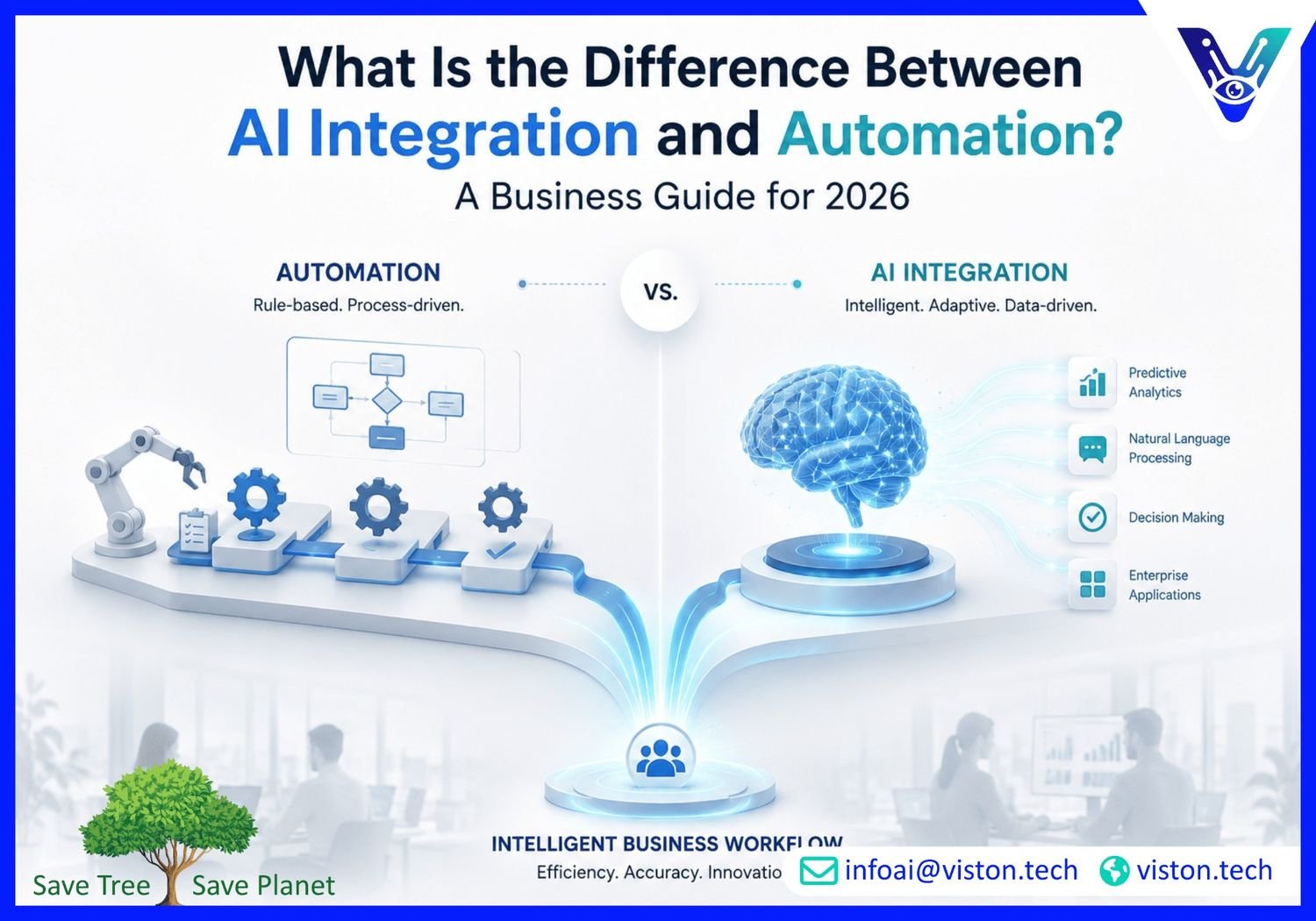
As businesses continue investing in digital transformation, terms like AI integration and automation are often used interchangeably. However, they solve different business challenges and deliver different outcomes. Understanding the difference is essential for organizations looking to improve efficiency, reduce operational costs, and create more intelligent business processes in 2026.
Although both technologies aim to improve productivity, they operate in fundamentally different ways.
Automation refers to the use of technology to perform predefined tasks without human intervention. Automated systems follow fixed rules, workflows, and instructions to execute repetitive processes consistently.
Examples of automation include:
Automation works best when processes are predictable, structured, and governed by clear business rules.
AI integration involves embedding artificial intelligence capabilities into existing business systems, applications, platforms, or workflows. Rather than simply following predefined rules, AI-enabled systems can analyze data, recognize patterns, learn from information, and support decision-making.
Examples of AI integration include:
AI integration enables systems to adapt and respond dynamically based on data and context.
Traditional automation follows predefined instructions. If conditions change beyond the programmed rules, the workflow may fail or require manual intervention.
AI-integrated systems can evaluate information, identify patterns, and make recommendations or decisions based on learned behavior.
For example, an automated support ticket routing system may assign tickets based on predefined categories. An AI-powered system can understand ticket content, customer sentiment, urgency, and historical resolution patterns before assigning it to the most appropriate team.
Automation is static and rule-based. Changes typically require workflow redesign or reconfiguration.
AI integration introduces adaptability. Machine learning models can continuously improve as more data becomes available, allowing systems to become smarter over time.
Automation performs best with structured data and predictable inputs.
AI systems can process:
This capability allows organizations to automate complex tasks that were previously dependent on human judgment.
Automation primarily focuses on efficiency, consistency, and reducing manual effort.
AI integration focuses on intelligence, insights, prediction, personalization, and decision support alongside operational efficiency.
Business leaders increasingly recognize that automation alone is no longer sufficient for competitive advantage. Modern organizations generate vast amounts of data, and extracting value from that data requires intelligent systems.
In 2026, organizations are using AI integration to:
Automation remains essential, but AI extends capabilities beyond task execution into business intelligence and strategic optimization.
Examples include payroll processing, appointment scheduling, invoice approvals, and data transfers between systems.
Examples include customer support assistants, sales forecasting, predictive maintenance, fraud detection, and intelligent search systems.
Rather than viewing AI integration and automation as competing technologies, organizations should consider them complementary.
A modern business workflow often combines both capabilities.
For example:
This combination creates intelligent automation, where AI provides insight and decision support while automation handles execution.
As organizations adopt AI-driven transformation initiatives, successful implementation requires more than simply deploying new technology. Businesses need scalable integration strategies that align with existing systems, workflows, security requirements, and operational goals.
Viston AI specializes in AI integration solutions that help organizations connect artificial intelligence capabilities with business applications, enterprise platforms, customer-facing systems, and operational workflows. By integrating technologies such as machine learning, natural language processing, predictive analytics, intelligent automation, and AI assistants, businesses can move beyond basic process automation and unlock more intelligent decision-making.
A practical AI integration approach focuses on measurable business outcomes, including improved efficiency, enhanced customer experiences, better data utilization, and stronger operational visibility. Whether organizations are exploring AI-powered customer support, intelligent document processing, workflow optimization, or predictive analytics, effective integration ensures that AI capabilities work seamlessly within existing business environments.
As AI adoption accelerates in 2026, organizations increasingly seek partners that understand both the technical and operational aspects of implementation. A structured integration strategy helps reduce risk, improve scalability, and maximize long-term business value.
No. Automation follows predefined rules to complete tasks, while AI integration enables systems to analyze information, learn from data, and support intelligent decision-making.
Yes. Many modern organizations combine AI and automation to create intelligent workflows that improve efficiency while enhancing decision quality.
AI integration often requires greater investment due to data requirements, model development, integration complexity, and ongoing optimization. However, costs vary based on project scope and business objectives.
Industries such as healthcare, finance, manufacturing, retail, logistics, customer service, and technology are increasingly using AI integration to improve operations and customer experiences.
AI can analyze customer interactions, understand intent, personalize responses, automate support processes, and provide agents with actionable recommendations in real time.
Organizations seeking AI integration support often look for expertise in connecting AI capabilities with existing systems, workflows, and business objectives while ensuring scalability, security, and long-term operational value.
The difference between AI integration and automation comes down to intelligence versus execution. Automation focuses on performing predefined tasks efficiently, while AI integration enables systems to analyze information, learn from data, and support smarter business decisions. In 2026, organizations that combine both approaches are often better positioned to improve productivity, enhance customer experiences, and create scalable digital operations. For businesses exploring advanced AI integration strategies, working with experienced specialists can help ensure successful implementation and long-term value creation.
