
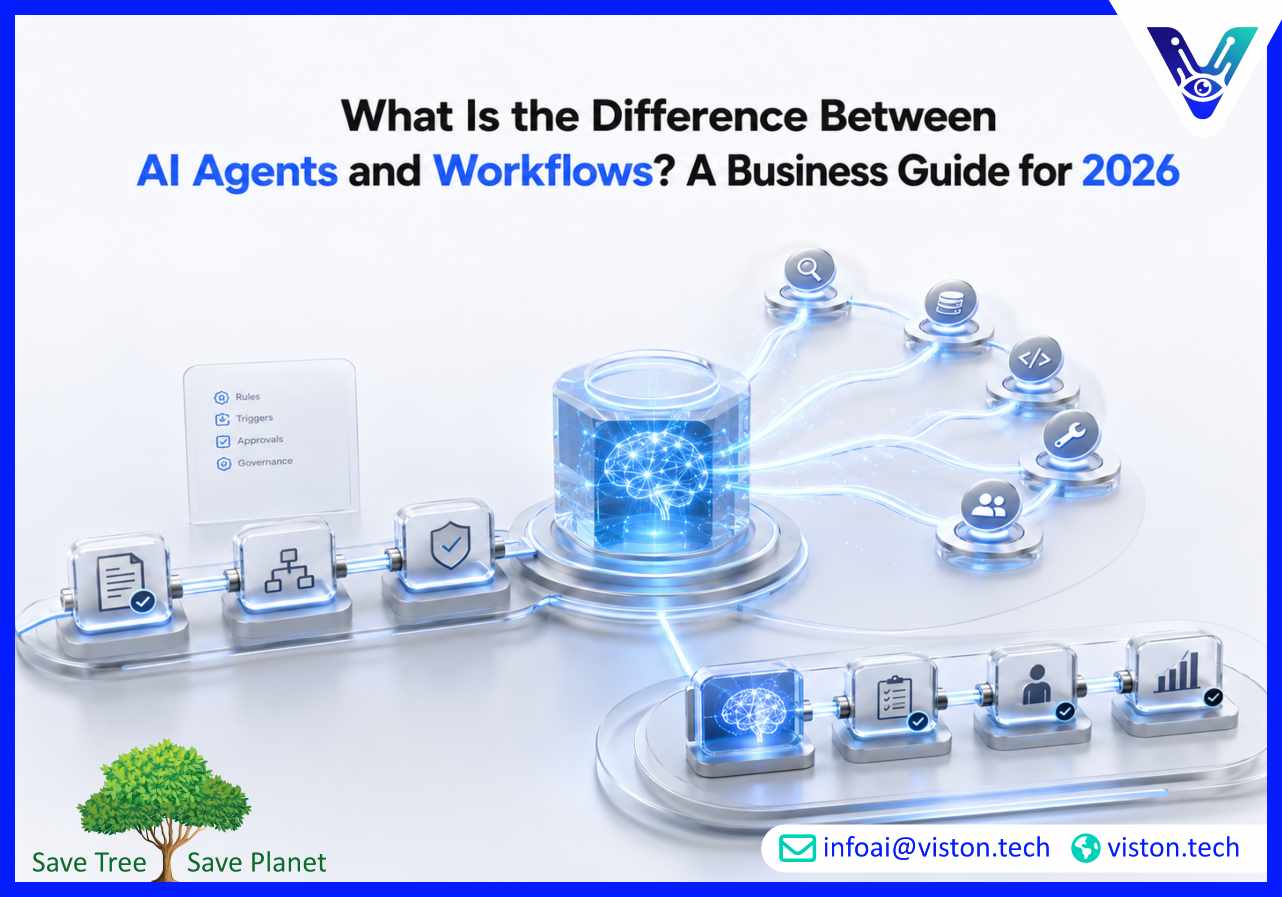
As artificial intelligence adoption accelerates across industries, organizations are increasingly exploring ways to automate processes, improve operational efficiency, and enhance decision-making. Two concepts frequently discussed in modern automation strategies are AI agents and workflows. Although these terms are often used together, they represent fundamentally different approaches to business automation. Understanding the difference between AI agents and workflows is essential for organizations evaluating Agentic AI Workflows and planning their automation roadmap in 2026
Before comparing them, it is important to understand what each concept means within a business and technology context.
AI agents are intelligent software systems designed to perceive information, reason about tasks, make decisions, and take actions to achieve specific goals. Unlike traditional software, AI agents can adapt to changing situations, analyze multiple inputs, and determine the best course of action without requiring explicit instructions for every scenario.
An AI agent typically combines:
For example, a customer service AI agent may analyze a customer’s issue, retrieve account information, determine the best response, and initiate actions across multiple systems without human intervention.
Workflows are structured sequences of tasks designed to achieve a predefined business outcome. Traditional workflows follow established rules, conditions, and process steps that guide how tasks move from one stage to another.
Workflow automation focuses on:
For example, an employee onboarding workflow may automatically create accounts, send documentation, assign training modules, and notify managers based on predefined triggers.
While workflows execute predefined processes, AI agents can dynamically determine how to achieve objectives.
The primary distinction lies in autonomy, adaptability, and decision-making capabilities.
Traditional workflows operate according to predefined instructions. Every step, condition, and action is typically mapped in advance.
AI agents, however, can evaluate situations and determine actions dynamically based on context.
Workflow Example:
AI Agent Example:
The workflow follows rules. The agent makes decisions.
Workflows perform best when processes are predictable and repeatable.
AI agents excel when situations are variable, complex, or require contextual understanding.
For example, a workflow may process invoices according to fixed rules. An AI agent may analyze unusual invoices, detect anomalies, request clarification, and adjust recommendations based on historical patterns.
Workflows solve predefined business processes.
AI agents solve business objectives.
This distinction is significant because workflows focus on execution while agents focus on outcomes.
An AI agent may explore multiple approaches to achieve a goal, whereas a workflow executes a predetermined path.
Traditional workflows do not learn from experience.
AI agents can improve through:
This makes AI agents particularly valuable in environments where conditions frequently change.
Choosing the right approach depends on the complexity of the business process.
Workflows are ideal when:
Examples include:
In these scenarios, workflow automation provides reliability and efficiency without requiring advanced reasoning capabilities.
AI agents are most valuable when:
Examples include:
In these situations, static workflows may struggle to handle exceptions, while AI agents can adapt to changing circumstances.
The most advanced automation strategies in 2026 do not treat AI agents and workflows as competing technologies. Instead, they combine them within agentic AI workflows.
An agentic workflow integrates structured workflow automation with autonomous AI decision-making.
This hybrid approach allows organizations to maintain governance while benefiting from intelligent automation.
In an agentic workflow:
This structure provides both flexibility and accountability.
A traditional workflow might:
An agentic workflow can:
The workflow manages the process, while the AI agent enhances decision quality.
Organizations that understand when to use workflows, AI agents, or both can achieve better automation outcomes.
Businesses avoid overengineering simple processes while applying advanced intelligence where it delivers the most value.
Not every task requires autonomous AI capabilities. Identifying the right use cases improves return on investment and reduces implementation complexity.
Combining workflows with AI agents enables organizations to maintain oversight, approvals, auditability, and compliance requirements.
Agentic workflows can manage increasing process complexity without requiring extensive manual intervention.
Organizations that deploy intelligent automation strategically can improve customer experiences, accelerate operations, and make faster business decisions.
As organizations move beyond basic automation, many are discovering that successful transformation requires a combination of structured workflows and intelligent AI agents. The challenge is not simply adopting AI but designing systems that align with business objectives, governance requirements, operational processes, and scalability goals.
Viston AI specializes in Agentic AI Workflows that combine workflow orchestration with intelligent AI-driven decision-making. By integrating AI agents into business processes, organizations can automate complex tasks while maintaining visibility, control, and accountability.
Businesses exploring agentic workflows often need support with workflow architecture, AI agent integration, system connectivity, automation strategy, governance frameworks, monitoring, and optimization. Effective implementations require balancing autonomy with business oversight to ensure operational reliability and measurable outcomes.
Whether organizations are modernizing customer service operations, streamlining internal processes, enhancing data workflows, or building multi-agent automation environments, a structured implementation approach is critical. The objective is not to replace workflows with AI agents but to combine both technologies in a way that improves efficiency, adaptability, and business performance.
By leveraging specialized expertise in Agentic AI Workflows, organizations can build automation systems that are practical, scalable, and aligned with long-term business goals.
The main difference is that workflows follow predefined rules and process steps, while AI agents can analyze situations, make decisions, and adapt their actions based on context and objectives.
Not entirely. Workflows remain valuable for structured, repeatable processes. AI agents are most effective when combined with workflows to enhance decision-making and handle complex scenarios.
For many complex business processes, agentic AI workflows offer greater flexibility, adaptability, and intelligence than traditional rule-based automation. However, simple workflows may still be the most efficient solution for predictable tasks.
Businesses should consider AI agents when processes involve complex decision-making, unstructured data, dynamic conditions, or tasks that require contextual understanding.
Industries including healthcare, finance, manufacturing, retail, logistics, technology, and professional services can benefit from combining AI agents with workflow automation.
Viston AI helps businesses design, integrate, manage, and optimize Agentic AI Workflows that combine structured automation with intelligent AI capabilities to improve efficiency and business outcomes.
Understanding the difference between AI agents and workflows is essential for organizations building modern automation strategies in 2026. Workflows provide structure, consistency, and governance, while AI agents bring intelligence, adaptability, and autonomous decision-making. Rather than choosing one over the other, many businesses are achieving the best results through Agentic AI Workflows that combine both approaches. By aligning automation technologies with specific business objectives, organizations can improve operational efficiency, enhance decision quality, and create scalable systems capable of supporting future growth. For businesses exploring advanced automation, Viston AI offers specialized expertise in designing and implementing practical Agentic AI Workflow solutions.
