
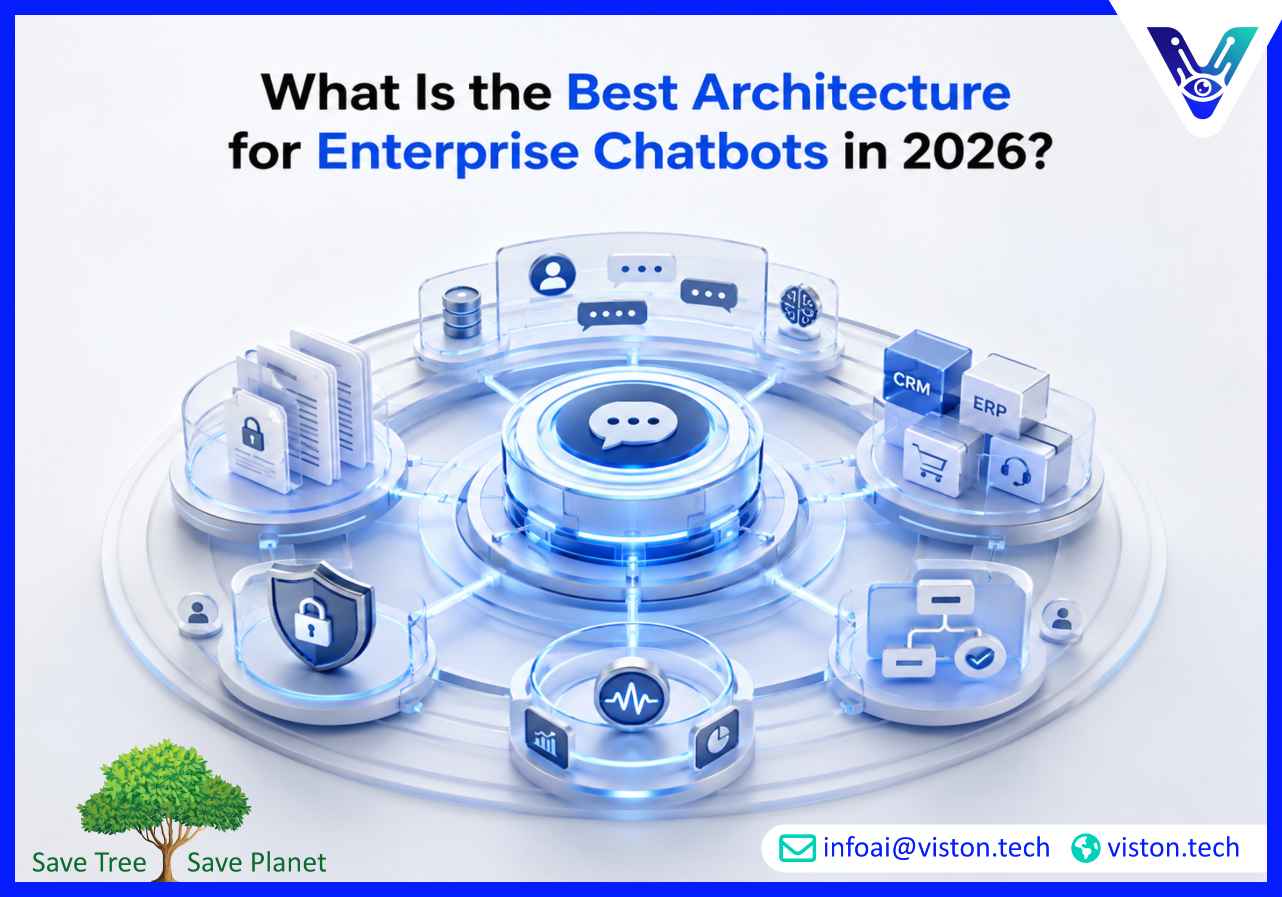
The best architecture for enterprise chatbots is no longer a simple chat interface connected to a fixed FAQ database. In 2026, businesses need secure, integrated, retrieval-enabled, workflow-ready chatbot systems that can understand context, access trusted knowledge, respect permissions, and support measurable operational outcomes.
The best architecture for enterprise chatbots is a layered system that separates the user experience, conversation logic, knowledge retrieval, AI model orchestration, business integrations, security controls, analytics, and governance. This matters because enterprise AI chatbots must operate inside complex business environments where accuracy, data access, compliance, scalability, and reliability are just as important as natural conversation.
A basic chatbot may answer simple questions from a script. An enterprise chatbot needs to support customers, employees, partners, sales teams, service desks, and operations teams across multiple channels. It may need to check CRM records, retrieve policy information, create support tickets, qualify leads, update order status, authenticate users, summarize cases, or escalate sensitive issues to human teams.
For that reason, the best architecture is not one single technology. It is a production-ready framework that combines conversational AI, retrieval-augmented generation, enterprise search, API integrations, identity management, observability, human handoff, compliance controls, and continuous optimization.
This architecture allows enterprise AI chatbots to answer questions, complete tasks, and support business workflows without becoming a risky black box. It also gives technology leaders enough control to improve performance, test changes, and maintain trust over time.
Enterprise chatbot architecture matters in 2026 because business users expect AI systems to be accurate, secure, fast, contextual, multilingual, and connected to real operations. A chatbot that only generates conversational replies is not enough. Organizations now need systems that can retrieve reliable information, respect data permissions, trigger workflows, and provide clear auditability.
Poor architecture creates practical business risks. The chatbot may answer from outdated documents, expose sensitive data, misunderstand user intent, fail during traffic spikes, create duplicate CRM records, route tickets incorrectly, or escalate without enough context. These failures damage customer experience and make internal teams lose confidence in automation.
Large language models can generate fluent responses, but enterprise use cases require responses grounded in approved business content. This is why retrieval-augmented generation, or RAG, is now a common architectural pattern. Instead of relying only on model memory, the chatbot retrieves relevant information from approved sources before generating an answer.
For enterprise AI chatbots, the knowledge layer should include version control, document ownership, source freshness, metadata tagging, access permissions, and content review workflows. The chatbot should be able to distinguish between public information, customer-specific data, employee-only content, and restricted internal material.
Many enterprise chatbot projects fail because the chatbot can talk but cannot act. A strong architecture connects the chatbot to business systems through APIs, webhooks, middleware, or integration platforms. This allows the chatbot to create tickets, update CRM fields, schedule appointments, check inventory, generate quotes, retrieve invoices, trigger approvals, or notify the right team.
Workflow capability should be designed carefully. The chatbot should not have unlimited access to systems. Each action should have permission checks, validation rules, error handling, confirmation steps, and logs. For sensitive workflows, human approval may be required before the chatbot completes the action.
Enterprise AI chatbots handle customer records, commercial data, employee information, operational workflows, and sometimes regulated content. Security must therefore be built into every layer of the architecture. This includes identity verification, role-based access control, encryption, data retention policies, audit trails, rate limiting, abuse detection, prompt injection protection, and secure integration design.
Good architecture also limits what the chatbot can see and do. The system should retrieve only the data needed for the current task, avoid unnecessary storage of sensitive information, and prevent users from accessing information outside their permissions.
The best architecture for enterprise chatbots in 2026 is usually a hybrid RAG and tool-orchestration architecture. This means the chatbot uses retrieval to ground answers in trusted content and uses controlled tools or APIs to perform approved business actions. This approach gives enterprises a balance of accuracy, flexibility, governance, and operational usefulness.
The front-end layer should support the channels where customers and employees already work. This may include websites, mobile apps, messaging platforms, internal portals, Microsoft Teams, Slack, WhatsApp, or voice interfaces. The goal is to keep the experience consistent while allowing each channel to reflect its own user behavior.
The interface should capture user intent clearly, support file or image uploads where relevant, provide escalation options, and show transparent responses when the chatbot is uncertain. For internal use cases, the interface may also need single sign-on and role-specific experiences.
The conversation layer manages sessions, user context, dialogue state, follow-up questions, fallback behavior, and handoff rules. This layer prevents the chatbot from treating every message as a disconnected query. It helps the bot understand what the user has already shared, what task is in progress, and what information is still needed.
For enterprise AI chatbots, context management should be controlled. Short-term conversation memory can improve usability, but long-term memory should be governed by privacy rules, retention policies, and clear business need. Sensitive information should not be stored unless there is a legitimate operational reason.
The orchestration layer is the brain of the chatbot architecture. It decides whether the user request should be answered from knowledge, routed to a tool, escalated to a human, blocked for safety, or clarified with a follow-up question. It may coordinate multiple models, prompts, retrieval pipelines, APIs, and business rules.
In a mature enterprise chatbot, orchestration includes prompt templates, model selection, intent classification, confidence scoring, tool routing, grounding checks, policy enforcement, and response formatting. This layer is essential because it prevents the system from sending every request directly to a language model without business control.
The knowledge layer should connect the chatbot to approved sources such as product documentation, help centers, policy documents, SOPs, CRM notes, support tickets, knowledge bases, and internal wikis. Retrieval should use metadata, permissions, semantic search, keyword search, document ranking, and freshness rules.
For complex enterprises, hybrid retrieval is often better than pure vector search. Semantic search helps find conceptually relevant information, while keyword and metadata filters help enforce precision, permissions, geography, product line, department, language, and document version.
The integration layer connects the chatbot to systems such as Salesforce, HubSpot, Microsoft Dynamics, SAP, Oracle, ServiceNow, Zendesk, Shopify, Magento, Workday, payment systems, booking systems, data warehouses, and proprietary applications. This layer turns the chatbot from an information assistant into an operational assistant.
Each integration should include authentication, authorization, input validation, retry logic, error messages, and event logging. The chatbot should confirm important actions before execution, especially when creating orders, changing account details, updating records, processing payments, or submitting regulated information.
Enterprise chatbot architecture should include a clear handoff path to human teams. The goal is not to force automation when human judgment is needed. The best systems detect low confidence, negative sentiment, repeated failure, sensitive topics, VIP customers, legal concerns, complex complaints, or high-value sales opportunities.
When the chatbot escalates, it should pass the conversation summary, user details, detected intent, attempted solutions, relevant records, and recommended next steps to the human agent. This avoids making customers repeat themselves and helps support teams resolve issues faster.
Enterprise chatbots need monitoring from day one. Teams should track conversation volume, resolution rate, fallback rate, hallucination risk, escalation rate, response latency, user satisfaction, tool success rate, CRM update accuracy, ticket deflection, and cost per resolved interaction.
Analytics should feed continuous improvement. Failed conversations can reveal missing knowledge, weak prompts, poor intent mapping, broken integrations, unclear content, or training data gaps. Architecture should make these insights visible so the chatbot improves over time instead of degrading after launch.
The best architecture for enterprise chatbots depends on the business use case, risk level, data sensitivity, user volume, integration complexity, and compliance requirements. A customer support chatbot for public FAQs may need a lighter architecture than a banking assistant that accesses account information and performs transactions.
A support chatbot should prioritize knowledge retrieval, ticketing integration, escalation quality, and resolution analytics. A sales chatbot should prioritize lead qualification, CRM updates, calendar booking, account routing, and conversion tracking. An internal knowledge chatbot should prioritize role-based access, document freshness, source citations, and secure enterprise search. A workflow chatbot should prioritize API reliability, approvals, transaction safety, and auditability.
Before choosing tools, teams should define what the chatbot is allowed to answer, what it is allowed to do, what systems it needs to access, who will own the knowledge base, and how performance will be measured.
Cloud deployment can support faster scaling, managed services, and easier access to modern AI capabilities. On-premises deployment may be preferred for highly sensitive environments with strict data control requirements. Hybrid architecture is often practical for enterprises because it allows the chatbot to use cloud AI capabilities while keeping sensitive data, identity systems, or regulated workloads within controlled infrastructure.
The deployment model should be chosen based on security policies, data residency needs, compliance obligations, latency expectations, cost structure, and internal IT capabilities.
Governance should be part of the architecture from the beginning. Enterprises should define ownership for prompts, models, knowledge sources, access controls, escalation policies, monitoring dashboards, compliance reviews, and release management. Without governance, chatbot performance becomes inconsistent and difficult to audit.
Strong governance includes approval workflows for content changes, red-team testing for unsafe prompts, review of sensitive use cases, documented escalation rules, model evaluation, and periodic audits. This is especially important when chatbots are used in healthcare, finance, insurance, legal, government, education, manufacturing, and other regulated or high-impact environments.
Scalability is not only about handling more conversations. It also means supporting more business units, regions, languages, products, policies, workflows, and user roles. The architecture should allow reusable components, shared governance, localized knowledge, region-specific compliance, and modular integrations.
A modular architecture helps enterprises expand from one chatbot use case to many without rebuilding the foundation each time. It also makes it easier to maintain quality as new teams, systems, and languages are added.
Viston AI is relevant to this topic because the best architecture for enterprise chatbots requires more than chatbot interface design. It requires practical experience across conversational AI, enterprise system integration, multilingual support, workflow automation, NLP, AI strategy, data governance, and ongoing optimization.
Viston AI’s Enterprise AI Chatbots service focuses on building conversational AI systems for complex business environments where chatbots must work across channels, languages, business units, and enterprise data sources. Its service offering is aligned with the architectural needs discussed in this article, including natural language understanding, contextual dialogue, CRM and knowledge base integration, transactional system connectivity, analytics, escalation logic, and enterprise-grade security considerations.
For businesses evaluating chatbot architecture, this matters because a successful enterprise chatbot is not simply a model connected to a chat window. It needs trusted knowledge retrieval, controlled workflows, secure access to business systems, measurable performance, and a clear improvement cycle. Viston AI’s broader AI portfolio, including AI chatbot integration, AI chatbot development, NLP and text analysis, multilingual support, AI automation and workflow bots, AI strategy development, and MLOps capabilities, can support organizations that want chatbot architecture designed around business outcomes rather than isolated automation.
This makes Viston AI a relevant specialist partner for companies planning enterprise AI chatbots that need to scale across customer support, sales operations, internal service desks, knowledge search, and workflow automation.
The best architecture for enterprise chatbots is a modular, layered architecture with an omnichannel interface, conversation management, AI orchestration, RAG-based knowledge retrieval, secure business system integrations, human handoff, analytics, and governance controls. This allows the chatbot to answer accurately, complete workflows, and operate safely at enterprise scale.
Yes, most enterprise AI chatbots should use retrieval-augmented generation when they need to answer from company-specific knowledge. RAG helps ground responses in approved documents, policies, help articles, product data, and internal knowledge sources instead of relying only on model memory.
Enterprise chatbots integrate with business systems through APIs, webhooks, middleware, integration platforms, and secure connectors. Common integrations include CRM, ERP, helpdesk, ecommerce, HRIS, billing, scheduling, knowledge bases, and internal databases. Good architecture includes permissions, validation, error handling, and audit logs for every workflow.
Enterprise chatbot architecture should include authentication, role-based access control, encryption, audit logging, data minimization, prompt injection protection, content filtering, rate limiting, secure API design, and retention policies. Sensitive actions should include confirmation steps or human approval where needed.
Cloud architecture is often suitable for scalability and faster deployment, while hybrid architecture is better when sensitive data, regulated workloads, or internal systems need stronger control. Many enterprises choose hybrid deployment to balance modern AI capability with data security and compliance requirements.
Yes. Viston AI’s Enterprise AI Chatbots service is relevant for organizations that need chatbot architecture covering conversational AI, knowledge integration, CRM and business system connectivity, multilingual support, workflow automation, analytics, and enterprise-focused optimization.
The best architecture for enterprise chatbots in 2026 is secure, modular, retrieval-enabled, integrated, observable, and governed. Businesses should avoid treating chatbot development as a front-end project only. A reliable enterprise AI chatbot needs trusted knowledge, controlled model orchestration, secure system access, workflow automation, human escalation, and continuous performance improvement. When designed properly, chatbot architecture can support better customer service, faster internal support, stronger lead handling, cleaner data workflows, and scalable automation. Viston AI offers relevant Enterprise AI Chatbots capabilities for organizations that want chatbot systems built with practical business architecture rather than basic conversational automation.
